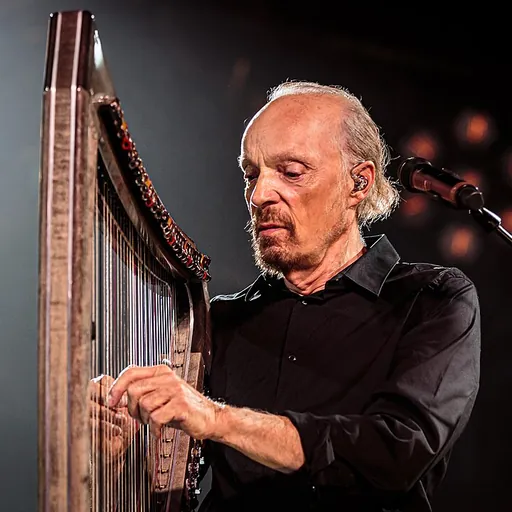
About Alan Stivell
Born 1944. Alan Stivell is a French singer-songwriter, conductor, harpist, singer, activist and musician.
Alan Stivell (; born Alan Cochevelou on 6 January 1944) is a French Celtic musician and singer, songwriter, recording artist, and master of the Celtic harp from Brittany.
From the early 1970s, he revived global interest in the Celtic (specifically Breton) harp and Celtic music as part of world music. As a bagpiper and bombard player, he modernized traditional Breton music and singing in the Breton language. A precursor of Celtic rock, he is inspired by the union of the Celtic cultures and is a keeper of the Breton culture.
Musical career Early life and career beginnings
Alan Stivell was born in Riom on 6 January 1944.
His father, Georges Cochevelou, was a civil servant in the French Ministry of Finance who achieved his dream of recreating a Celtic or Breton harp in the small town of Gourin, Brittany and his mother Fanny-Julienne Dobroushkess was of Lithuanian-Jewish descent. In 1953, Alan began playing the instrument at the age of nine under the tutelage of his father and Denise Megevand, a concert harpist. Alan also learned Celtic mythology, art, and history, as well as the Breton language, traditional Breton dance, and the Scottish bagpipe and the bombarde, a traditional Breton instrument, from the oboe family. Alan began playing concerts at the age of eleven and studied traditional Breton, English, Irish, Scottish, and Welsh folk music, also learning the drum, Irish flute, and tin whistle. Alan spent his childhood in Paris, with its cosmopolitan influences. But he fell in love with Breton music and Celtic culture, in general, and often went back in his teens to Brittany.
In 1970, Stivell released his first hits, the single "Broceliande" and the album Reflets, both on the Philips record label. He became closely associated with the burgeoning Breton roots revival, especially after the release of the purely instrumental 1971 album Renaissance of the Celtic Harp, which won one of the most famous awards in France, the prize of the Académie Charles Cros.
On 28 February 1972, Stivell performed a concert in the Olympia theater, a famous music hall in Paris, where Alan and his band played music combining traditional Celtic music with modern sounds (electric guitar, drums, etc.). This concert made Stivell and his music well known throughout France. Stivell's records in the late 1990s contained more pronounced rock elements, and he performed at a rock festival called Transmusicales in Rennes. He continued working with a variety of musicians, inviting Paddy Moloney (of The Chieftains), Jim Kerr (of Simple Minds), Khaled and Youssou N'Dour to be in his very international 1 Douar / 1 Earth album. The same year, the DVD Parcours was published by Fox-Pathé.
In 2006, a new CD album called Explore came out in France and other countries, distributed through Harmonia Mundi. The album explored fusions of Celtic music with electro-rock, raga and hip-hop with a unique and personal vocal style and an original mix of lyrics in Breton, English and French.
In 2009, the title of his album Emerald celebrated his emerald anniversary with his fans (i.e. forty years together) and paid homage to the sea and the Celtic lands (color blue-green, Glaz in Breton language). In 2013, a new CD album and DVD called Olympia 40th Anniversary came out in France (Universal) as a result of the concert performed at the Olympia mythical music hall on 16 February 2012.
On 2 October 2015, Stivell released a new CD album called AMzer: Seasons through WorldVillage in France (and other countries), his first one of the 2010s, coinciding with his career's 50th anniversary. The album is also available as a "Leclerc limited edition" including 3 bonus tracks (2 alternative mixes and a brand new instrumental) and a 60-page booklet.
Critical acclaim Music critic Bruce Eder has written: "[Stivell's] harp recordings, with their enveloping lyricism and tightly interwoven patterns of variations, can appeal to more serious listeners of new age music. Stivell's main audience, however, lies with fans of Celtic music and culture, and English folk music. Embracing ancient and modern elements, but (apart from his folk-rock work) making no compromises to modern melodic sensibilities, his music captures the mystery and strangeness of Breton, Irish, Welsh, and Scottish landscapes that are both ageless and timeless. It is haunting, mysterious, and beautiful, with no equivalent in modern popular music and few peers in the realm of commercial folk music."
In the 1978 book Racines interdites ("Forbidden Roots"), a series of interviews with Stivell covers questions about the Breton language, history and geography, as well as his utopian vision of a world living in meditative harmony with nature. Lyrics for 17 of Stivell's songs are reprinted at the back of the book.
Legacy
Alan Stivell has influenced multiple contemporary artists, most notably folk metal band Eluveitie. Their biggest hit 'Inis Mona' shares a melody with the traditional Tri Martolod. Where it is played on bagpipes, tin whistle and hurdy-gurdy with the addition of harsh vocals, electric guitar, bass guitar and drums.
Instruments
Discography
Original (studio and live) albums Telenn Geltiek / Harpe celtique (1964) (studio #01 / instrumental #01) Reflets / Reflections (1970) (studio #02) Renaissance of the Celtic Harp (1971) (studio #03 / instrumental #02) À l'Olympia / Olympia Concert (1972) (live #01) Chemins de Terre / From Celtic Roots / Celtic Rock (1973) (studio #04) E Langonned (1974) (studio #05) E Dulenn / À Dublin / Live in Dublin (1975) (live #02) Trema'n inis: Vers l'Île (1976) (studio #06) Raok Dilestra: Avant d'accoster / Before Landing (1977) (studio #07) Un dewezh 'barzh 'gêr: Journée à la maison / A Homecoming (1978) (studio #08) International Tour: Tro ar Bed (1979) (live #03) Symphonie Celtique: Tir Na N-Og / Celtic Symphony (1979) (studio #09) Terre des vivants: Bed an dud vew (1981) (studio #10) Legend / Légende / Mojenn (1983) (studio #11) Harps of the New Age / Harpes du Nouvel Âge / Telenn a' Skuilh-dour (1985) (studio #12 / instrumental #03) The Mist of Avalon (1991) (studio #13) Again (1993) (studio re-recordings with other artists in duet) Brian Boru (1995) (studio #15) 1 Douar / 1 Earth (1998) (studio #16) ("Eunn Douar" in Breton) Back to Breizh (1999) (studio #17) Au-delà des mots / En tu-hont d'ar c'homzoù / Beyond Words (2002) (studio #18 / instrumental #04) Explore (2006) (studio #19) Emerald (2009) (studio #20) AMzer: Seasons (2015) (studio #21) Human~Kelt (2018) (studio #22)
A l'Olympia and In Dublin were recorded live, but featured only new, previously unreleased tracks.
Compilations Attention! Alan Stivell! (1973) Grand Succès d'Alan Stivell (1975) 70/95 Zoom (1997) – Disques Dreyfus (2-CD compilation 1970~1995, 35 tracks) Routes (1997) – Disques Dreyfus (4-CD boxset / 73 tracks / 32-pages booklet) Vers l'île (1999) – Universal Music Group (3CD "Long Box" / 30 titres / booklet) Ar Pep Gwellañ (Le best of) (2012) – Universal Music Group (CD best-of including a bonus CD of the remastered recording of the 1972 "Olympia" concert) 40th Anniversary Olympia 2012 (2013) – Universal Mercury (CD/DVD Live about the new concert in Paris)
Family tree
Don’t just read it —
keep it.
Full-length biographies made to live with: read them, listen on the way to work, watch them tonight.
- E-book
- Audio
- Video
Instant download · yours to keep · every purchase keeps this site free
Important facts
People in Alan Stivell's life
Named in this biography and alive at the same time





Related people
Same field, nearest in time




Contemporaries
People whose lives overlapped Alan Stivell's



Frequently asked questions
Who is Alan Stivell?
Breton musician
When was Alan Stivell born?
Alan Stivell was born on 6 January 1944 in Riom.
What is Alan Stivell's occupation?
Alan Stivell is a singer-songwriter, conductor, harpist, singer, activist and musician.
What nationality is Alan Stivell?
Alan Stivell is French.
Sources & further reading
Cite this page
APA: Biography.guide. (2026). Alan Stivell. https://biography.guide/alan-stivell/
MLA: "Alan Stivell." Biography.guide, https://biography.guide/alan-stivell/.
Chicago: "Alan Stivell." Biography.guide. https://biography.guide/alan-stivell/.
Data last updated: 2026-09-22 · Spot an error? Report a correction.
Portrait: Wikimedia Commons · author & licence
Page generated 2026-09-27 05:01 UTC