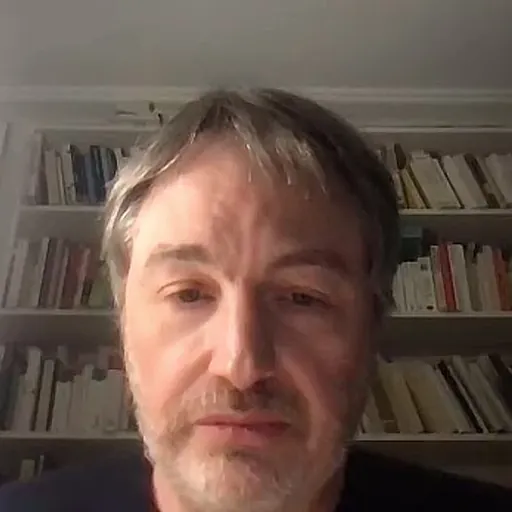
About Quentin Meillassoux
Born 1967. Quentin Meillassoux is a French philosopher.
Quentin Meillassoux (; ; born 26 October 1967) is a French philosopher. He teaches at the Université Paris 1 Panthéon-Sorbonne.
Biography Quentin Meillassoux is the son of the anthropologist Claude Meillassoux. He is a former student of the philosophers Bernard Bourgeois and Alain Badiou. He is married to the novelist and philosopher Gwenaëlle Aubry.
Philosophical work Meillassoux's first book is After Finitude (Après la finitude, 2006). Alain Badiou, Meillassoux's former teacher, wrote the foreword. Badiou describes the work as introducing a new possibility for philosophy which is different from Immanuel Kant's three alternatives of criticism, skepticism, and dogmatism. The book was translated into English by Ray Brassier. Meillassoux is associated with the speculative realism movement.
In this book, Meillassoux argues that post-Kantian philosophy is dominated by what he calls "correlationism", the theory that humans cannot exist without the world nor the world without humans. In Meillassoux's view, this theory allows philosophy to avoid the problem of how to describe the world as it really is independent of human knowledge. He terms this reality independent of human knowledge as the "ancestral" realm. Following the commitment to mathematics of his mentor Alain Badiou, Meillassoux claims that mathematics describes the primary qualities of things as opposed to their secondary qualities shown by perception.
Meillassoux argues that in place of the agnostic scepticism about the reality of cause and effect, there should be a radical certainty that there is no causality at all. Following the rejection of causality, Meillassoux says that it is absolutely necessary that the laws of nature be contingent. The world is a kind of hyper-chaos in which the principle of sufficient reason is not necessary although Meillassoux says that the principle of non-contradiction is necessary.
For these reasons, Meillassoux rejects Kant's Copernican Revolution in philosophy. Since Kant makes the world dependent on the conditions by which humans observe it, Meillassoux accuses Kant of a "Ptolemaic Counter-Revolution." Meillassoux clarified and revised some of the views published in After Finitude during his lectures at the Free University of Berlin in 2012.
Several of Meillassoux's articles have appeared in English via the British philosophical journal Collapse, helping to spark interest in his work in the Anglophone world.
His unpublished dissertation L'inexistence divine (1997) is noted in After Finitude to be "forthcoming" in book form; as of 2021, it had not yet been published. In Parrhesia, in 2016, an excerpt from Meillassoux's dissertation was translated by Nathan Brown, who noted in his introduction that "what is striking about the document... is the marked difference of its rhetorical strategies, its order of reasons, and its philosophical style" from After Finitude, counter to the general view that the latter merely constituted "a partial précis" of L'inexistence divine; he notes further that the dissertation presents a "very different articulation of the Principle of Factiality" from that in After Finitude. While Nathan Brown's translation uses the French text of the 1997 dissertation, in 2011 Graham Harman used a 2003 revision to offer a partial translation of Meillassoux's ongoing work of expanding the dissertation into a book.
In September 2011, Meillassoux's book on Stéphane Mallarmé was published in France under the title Le nombre et la sirène. Un déchiffrage du coup de dés de Mallarmé. In this second book, he offers a detailed reading of Mallarmé's famous poem "Un coup de dés jamais n'abolira le hasard" ("A Throw of the Dice Will Never Abolish Chance"), in which he finds a numerical code at work in the text.
Don’t just read it —
keep it.
Full-length biographies made to live with: read them, listen on the way to work, watch them tonight.
- E-book
- Audio
- Video
Instant download · yours to keep · every purchase keeps this site free
Important facts
People in Quentin Meillassoux's life
Named in this biography and alive at the same time





Related people
Same field, nearest in time

Contemporaries
People whose lives overlapped Quentin Meillassoux's



Frequently asked questions
Who is Quentin Meillassoux?
French philosopher
When was Quentin Meillassoux born?
Quentin Meillassoux was born on 26 October 1967 in Paris.
What is Quentin Meillassoux's occupation?
Quentin Meillassoux is a philosopher.
What nationality is Quentin Meillassoux?
Quentin Meillassoux is French.
Sources & further reading
· Wikipedia: Quentin Meillassoux
· DBpedia: Quentin Meillassoux
Cite this page
APA: Biography.guide. (2026). Quentin Meillassoux. https://biography.guide/quentin-meillassoux/
MLA: "Quentin Meillassoux." Biography.guide, https://biography.guide/quentin-meillassoux/.
Chicago: "Quentin Meillassoux." Biography.guide. https://biography.guide/quentin-meillassoux/.
Data last updated: 2026-09-21 · Spot an error? Report a correction.
Portrait: Wikimedia Commons · author & licence
Page generated 2026-09-27 05:00 UTC