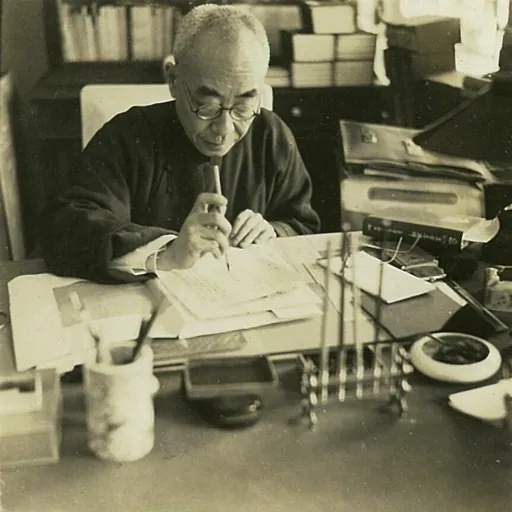
About Qian Daosun
Lived 1887 – 1966 (aged 78–79). Qian Daosun was a Chinese translator, literary critic and poet.
Qian Daosun (1887–1966) was a Chinese writer and translator. His renowned translations include the Inferno part of the Divine Comedy, Man'yōshū and The Tale of Genji. Qian was born in a family of officials and scholars. Since 1927, Qian taught Japanese in the Tsinghua University, where he obtained the professor's title in 1931, while also being the head of the university library.
Family members Mother: Shan Shili (1856–1943), courtesy name Shouzi, was born in Xiaoshan, Zhejiang. Shan Shili accompanied her husband on several missions since 1899 to countries such as Japan, Russia, the Netherlands, and Italy. And wrote the first Chinese female account of women's experience travelling abroad, Gui Mao Lv Xing Ji (癸卯旅行记 1903). Shan also compiled Gui Qian Ji (归潜记 1910) and The First Edition of the Continuation of the Beautiful Lady's Beginning (清闺秀正始再续集初编 1944). alt=錢恂.png
Father: Qian Xun (1854–1927), famous diplomat in the late Qing dynasty. Between 1899 and 1908, Qian Xun was appointed to go to Japan (1899), Russia (1903), the Netherlands (1907), and Italy (1908). In 1912, Qian became the first director of Zhejiang Provincial Library. In 1914, he served as a member of the Senate of the Republic of China and participated in politics. In 1917, Qian Xun worked as the editor at the National History Compilation Office of Peking University.
Career life: Ministry of Education Qian Daosun worked at the Ministry of Education of the Beiyang government between 1912 and 1927. Together with Lu Xun and Xu Shoushang, he designed the Twelve Symbols national emblem during his first year in office. In March 1913, the Commission on the Unification of Pronunciation organized by the Ministry of Education passed the proposal, which Qian participated in the drafting, to adopt Jiuwen (later renamed to ‘Zhuyin’) as the system of phonetic symbols to standardize the pronunciation of Mandarin Chinese characters.
Qian Daosun was a colleague and a close friend of Lu Xun between 1912 and 1915. According to Lu Xun's Diary, they also helped prepare the 1914 National Children's Art Exhibition. While Qian was visiting Tokyo in 1916, the correspondence between him and Lu Xun continued via letters and postcards. In August 1917, Qian was appointed to work in the Department of College Education to tackle the difficulties associated with the admission criteria. Qian became an appointed member of the National Anthem Research Committee in December 1919, and the Beiyang government ordered a change of the national anthem to the Song to the Auspicious Cloud in 1921.
Career life: Librarian After leaving the Ministry of Education in 1927, Qian Daosun took on different positions at higher education institutions in Beijing, one of which was the lecturer of Japanese language at the National Tsinghua University Library. Between 1913 and 1944, however, Qian also worked at different libraries in Beijing, such as the Capital Library (nowadays the National Library of China) between 1913 and 1914, the National Beijing College of Fine Arts in 1925, and the National Peking University Library in 1931.
In 1936, after completing the handover procedures with Zhu Ziqing, Qian Daosun officially served as the director of the National Tsinghua University Library and facilitated a considerable growth in the number of library collections before the outbreak of the Marco Polo Bridge Incident of the Japanese invasion in July 1937. Between 1940 and 1945, Qian endured the Wang Jingwei Regime and worked as the Secretary to the pseudo-Peking University. During his speech, Qian advised the students to be responsible not only for their studies but also for their own health: "I had to carry my own clothes and go to the post alone,” Qian later told his colleague at the People's Literature Publishing House, “but it was much better than living in jail." After his retirement in 1956, he worked as a guest interpreter for People's Literature Publishing House.
Poems written in Jail (1946) In 1946, after the KMT-ruled Nationalist government took control, Qian Daosun was charged with “conspiracy with enemy countries and plotting against one's own country,” sentenced to ten years in prison, and deprived of his civil rights for six years. While Qian was in prison, he sent to his friend the classical-style verses he composed while he was in prison, and three of those poems were published in the newspaper Qiao sheng bao in November.
Translation Divine Comedy (神曲一臠 1921)
Qian translated the opening part of Dante's Divine Comedy in the form of Chu Ci and published it in Fiction Monthly.
The Tale of Genji (源氏物語 1957)
He began translating slowly and carefully to interpret The Tale of Genji in 1933. In 1957, Kiritsubo (桐壺), translated by Qian, was published in the magazine Yi Wen (譯文). Qian translated the first five chapters, but all but Kiritsubo were lost during the Cultural Revolution. In order to reproduce the atmosphere and stylistic characteristics of the original text, Qian used Written vernacular Chinese.
Man'yōshū (漢譯萬葉集選 1959)
Han yi wan ye ji xuan (漢譯萬葉集選, 1959) is the first Chinese-translated collection of Man'yōshū, edited and translated by Sasaki Nobutsuna and Qian Daosun and proofread by Ichimura Sanjiro, Suzuki Torao, Maekawa Saburo, and others. However, the connection was resumed in 1955, and thanks to Kojiro Yoshikawa of Kyoto University, the book was finally published in 1959, with funding from the Japan Society for the Promotion of Science (日本学術振興会). Sasaki and Qian likely met at the first Greater East Asia Literary Conference (第一回大東亜文学者大会) in 1942.
A collection book of Ihara Saikaku's The Eternal Storehouse of Japan (日本永代蔵, Nippon Eitaigura, 1688) and Reckonings that Carry Men Through the World or This Scheming World (世間胸算用, Seken Munesan'yō, 1692) and Chikamatsu Monzaimon's The Love Suicides at Sonezaki (曾根崎心中, Sonezaki shinjū, 1703), The Love Suicides at Amijima (心中天網島, Shinjū Ten no Amijima, 1721), Kagekiyo Victorious (出世景清, Shusse kagekiyo, 1685) and Shunkan. It was published as part of Nihon bungaku sousho (日本文学叢書).
Other translations Jintai kaibougaku vol. 1 (人体解剖学 第一巻 1916) Jintai kaibougaku vol. 2 (人体解剖学 第二巻 1916) Zoukei bijutsu (造形美術 1924) You kao gu xue kan dao de zhong ri wen hua di jiao she (由考古学上看到的中日文化底交涉 1930) Ri ben jing shen yu jin dai ke xue (日本精神与近代科学 1937) Nihon shika sen (日本詩歌選 1941) Bonjuki : youkyoku (盆樹記 : 謡曲 1942) Ying hua guo ge hua (樱花国歌话 1943) Handcart Songs (荷車の歌 1961) Tōa gakkikō (東亜楽器考 1962) Screenplay of Rashomon (1979)
Don’t just read it —
keep it.
Full-length biographies made to live with: read them, listen on the way to work, watch them tonight.
- E-book
- Audio
- Video
Instant download · yours to keep · every purchase keeps this site free
Important facts
People in Qian Daosun's life
Named in this biography and alive at the same time




Related people
Same field, nearest in time



Contemporaries
People whose lives overlapped Qian Daosun's



Frequently asked questions
Who was Qian Daosun?
Chinese translator and educator
When was Qian Daosun born?
Qian Daosun was born in 1887.
When did Qian Daosun die?
Qian Daosun died in 1966.
What was Qian Daosun's occupation?
Qian Daosun was a translator, literary critic and poet.
What nationality was Qian Daosun?
Qian Daosun was Chinese.
Sources & further reading
Cite this page
APA: Biography.guide. (2026). Qian Daosun. https://biography.guide/qian-daosun/
MLA: "Qian Daosun." Biography.guide, https://biography.guide/qian-daosun/.
Chicago: "Qian Daosun." Biography.guide. https://biography.guide/qian-daosun/.
Data last updated: 2026-09-22 · Spot an error? Report a correction.
Portrait: Wikimedia Commons · author & licence
Page generated 2026-09-27 05:03 UTC