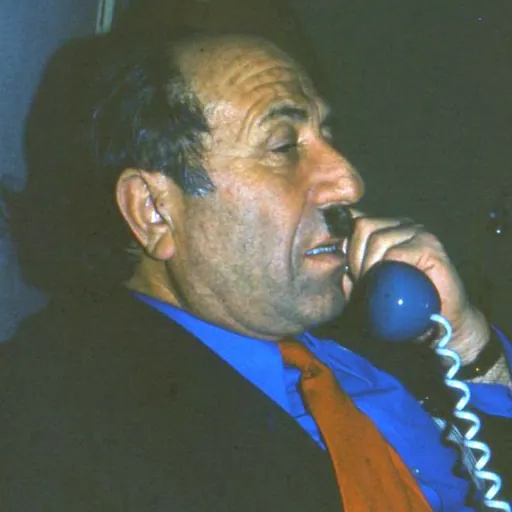
About Qaysin Quli
Lived 1917 – 1985 (aged 67). Qaysin Quli was a Russian poet, prose writer, politician, war correspondent, journalist and writer.
Kaisyn Shuvayevich Kuliev or Qaysin Quli (; ; 1 November 1917 – 4 June 1985) was a Balkar poet. He wrote in the Karachay-Balkar language. His poems are widely translated to most languages in the former Soviet Union, including Russian, Ossetian, Lithuanian, Belarusian, Armenian. Kuliev's books have been published in 140 languages in Europe, Asia, and America.
Early life Kaisyn Kuliev (Quli) was born on November 1, 1917, in a Balkar aul Upper Chegem to a family of stock-breeders and hunters. He spent his childhood in the mountains. He was orphaned at an early age and started to work. In 1926 a school was established in his aul, and he started to read and study Russian. By age ten, he had written his first poems. After graduation from school, he entered a technical college in Nalchik and first published at age 17.
In 1935 Kuliev arrived in Moscow and entered the Russian Institute of Theatre Arts (GITIS). He attended lectures at the Maxim Gorky Literature Institute and continued to write.
Career In 1939 he returned to Nalchik, where he taught literature at the local teachers' training college. In 1940, he published his first book of poetry, Hello, Morning!.
In 1940 Kuliev was drafted into the Red Army, where he served in the paratrooper brigade. In the summer of 1941, his brigade was transferred to Latvian SSR. He was wounded in a battle near Oryol. While in the hospital Kaisyn Kuliev wrote many poems that were published in Pravda, and Krasnaya Zvezda. He participated in the Battle of Stalingrad as a military correspondent for the Syny Otechestva newspaper. In the operation to liberate southern cities, Kuliev was wounded again.
During the period between 1942 and 1944, he wrote In an hour of Trouble, About Someone Who Didn't Return, and Perekop. In 1944, Joseph Stalin ordered deportation of the Balkar ethnic group to Kyrgyzstan and Kazakhstan. Although Boris Pasternak managed to secure a permit for Kuliev to stay in Moscow, in 1945, Kuliev chose to live in Kyrgyzstan, where he worked in the local Union of Writers. In Frunze, he married an Ingush girl, Maka. The Ingush ethnic group was also deported by Stalin to Central Asia. Since Kaisyn Kuliev's poetry could not be published, because he belonged to a deported people, he translated others' poetry. Pasternak, in his letters, encouraged the younger poet to have faith in a better future.
In May 1956, Kuliev went to Moscow, and in 1957 he published Mountains and The Bread and the Rose (1957) with the help of Russian poet Nikolai Tikhonov. In 1956, Balkars were allowed to return to their native places and Kuliev returned to Nalchik where he published his collections The Wounded Stone (1964), The Book of the Land (1972), The Evening (1974), The Evening Light (1979), A Beauty of the Earth (1980), and others. Kuliev's poetry was recognized by Soviet officials when Stalin's era ended, and he was posthumously honored with State Prizes of the Soviet Republics (1966), USSR State Prize (1974) and also Lenin Prize but only in 1990. His Russian translators included Naum Grebnev, Bella Akhmadulina, Nahum Korzhavin and Oleg Chukhontsev.
Kaisyn Kuliev died in 1985 and was buried in the garden of his house. The Kaisyn Kuliev Memorial Museum now operates at that location. One of the major streets of Nalchik, the capital of Kabardino-Balkaria, was named after the poet. Balkar Theater of Drama in Nalchik was named for him. His poetry presents "lessons of courage, nobleness and honour".
Don’t just read it —
keep it.
Full-length biographies made to live with: read them, listen on the way to work, watch them tonight.
- E-book
- Audio
- Video
Instant download · yours to keep · every purchase keeps this site free
Important facts
Family & relationships
People in Qaysin Quli's life
Named in this biography and alive at the same time




Related people
Same field, nearest in time


Contemporaries
People whose lives overlapped Qaysin Quli's

Frequently asked questions
Who was Qaysin Quli?
Balkar Soviet writer (1917–1985)
When was Qaysin Quli born?
Qaysin Quli was born on 19 October 1917 in Verkhne-Chegemskoye rural community.
When did Qaysin Quli die?
Qaysin Quli died on 4 June 1985 in Chegem.
What was Qaysin Quli's occupation?
Qaysin Quli was a poet, prose writer, politician, war correspondent, journalist and writer.
What nationality was Qaysin Quli?
Qaysin Quli was Russian.
Sources & further reading
Cite this page
APA: Biography.guide. (2026). Qaysin Quli. https://biography.guide/qaysin-quli/
MLA: "Qaysin Quli." Biography.guide, https://biography.guide/qaysin-quli/.
Chicago: "Qaysin Quli." Biography.guide. https://biography.guide/qaysin-quli/.
Data last updated: 2026-09-21 · Spot an error? Report a correction.
Portrait: Wikimedia Commons · author & licence
Page generated 2026-09-27 04:59 UTC