
Pyotr Rumyantsev
Field Marshal of Russia
About Pyotr Rumyantsev
Lived 1725 – 1796 (aged 71). Pyotr Rumyantsev was a Russian general field marshal.
Count Pyotr Alexandrovich Rumyantsev-Zadunaisky (; – ) was one of the foremost Russian military commanders of the 18th century, widely considered to be one of Russia's greatest military leaders and is referred to as one of the greatest commanders in military history. As a commander, he is placed on par with Alexander Suvorov, to whom he was a mentor. Rumyantsev used mobile divisional squares for the first time in history as opposed to linear battle orders and initiated the formation of light (jaeger) battalions in the Russian Army, which operated in a scattered order.
He governed Little Russia in the name of Empress Catherine the Great from the abolition of the Cossack Hetmanate in 1764 until Catherine's death 32 years later. Monuments to his victories include the Kagul Obelisk in Tsarskoye Selo (1772), the Rumyantsev Obelisk on Vasilievsky Island (1798–1801), and a galaxy of Derzhavin's odes.
Early life
Pyotr came from the Russian noble Rumyantsev family. He was the only son of Count Alexander Rumyantsev, and was born in the village of Stroiești (modern Moldova/Transnistria), which had twice been unsuccessfully beleaguered by other Russia's commanders; thus clearing for Russian armies the path to Berlin. The siege of Kolberg of 1761 was an important milestone in the development of Russian military art. Here Rumyantsev pioneered a new tactic – the action of troops in battalion (regimental) columns, combined with a scattered formation of jaegers.
First Russo-Turkish War The Rumyantsev Obelisk (1799–1801) was moved from the Field of Mars to St. Andrew's Cathedral by Carlo Rossi in 1818.
Throughout the reign of Catherine the Great, Rumyantsev served as supreme governor of Little Russia. In this post, which his father had held with so much honesty, Rumyantsev made it his priority to eliminate any autonomy of the hetmans and to fully incorporate the newly conquered territories into the Russian Empire. Some accuse him of having promoted serfdom in New Russia, but the choice of such a policy remained out of his control.
With the outbreak of the Russo-Turkish war in 1768, Rumyantsev took command of the army sent to capture Azov. He thoroughly defeated the Turks in the battles of Ryabaya Mogila, Larga, and Kagul, crossed the Danube and advanced to Romania. For these dazzling victories he became Field-Marshal and gained the victory title Zadunaisky (meaning "Trans-Danubian"). When his forces approached Shumla in 1774, the new Sultan Abdul Hamid I started to panic and sued for peace, which Rumyanstev signed upon a military tambourine at the village of Küçük Kaynarca.
Second Russo-Turkish War
By that point, Rumyantsev had undoubtedly become the most famous Russian commander. Other Catharinian generals, notably Potemkin, allegedly regarded his fame with such jealousy that they wouldn't permit him to take the command again. In times of peace, Rumyantsev expressed his innovative views on the martial art in the Instructions (1761), Customs of Military Service (1770), and the Thoughts (1777). These works provided a theoretical base for the re-organisation of the Russian army undertaken by Potemkin.
During the Second Russo-Turkish War, Rumyantsev suspected Potemkin of deliberately curtailing supplies of his army and presently resigned his command. In the Polish campaign of 1794 he once again won appointment as commander-in-chief, but his rival Suvorov actually led the armies into battle. On this occasion Rumyantsev didn't bother even to leave his Ukrainian manor at Tashan which he had rebuilt into a fortress. He died there on 19 December 1796, just over a month after Catherine's death, and was interred in the Kiev Pechersk Lavra.
As the story goes, old Rumyantsev-Zadunaisky grew enormously fat and avaricious, so that he pretended not to recognize his own sons when they came from the capital to ask for money. Under his son Sergey's administration, Tashan fell into ruins, although he erected a mausoleum near Balashikha for his father's reburial (which never took place). Neither Sergey nor his brother Nikolay Petrovich Rumyantsev married, and the comital branch of the Rumyantsev family became extinct upon their death.
Honours Blessed is he who, striving for gloryPreserved the common goodHe was merciful in bloody warAnd spared even the lives of enemies;Blessed among the later agesMay this man be a friend of humanity. Gavrila Derzhavin, "Waterfall" Rumyantsev was presented with the following awards:
Don’t just read it —
keep it.
Full-length biographies made to live with: read them, listen on the way to work, watch them tonight.
- E-book
- Audio
- Video
Instant download · yours to keep · every purchase keeps this site free
Important facts
People in Pyotr Rumyantsev's life
Named in this biography and alive at the same time
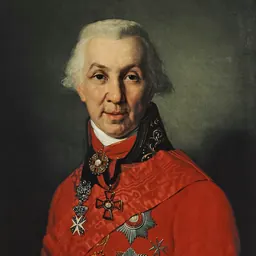
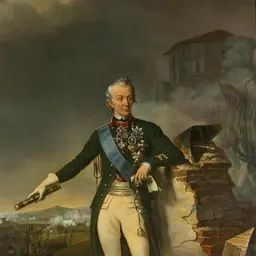
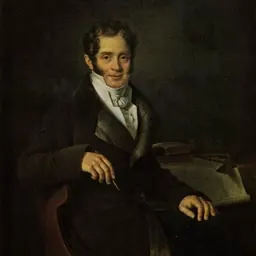
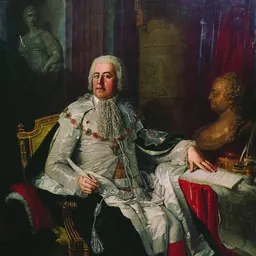
Related people
Same field, nearest in time


Contemporaries
People whose lives overlapped Pyotr Rumyantsev's





Frequently asked questions
Who was Pyotr Rumyantsev?
Field Marshal of Russia (1725-1796)
When was Pyotr Rumyantsev born?
Pyotr Rumyantsev was born on 4 January 1725 in Stroiești (Transnistria).
When did Pyotr Rumyantsev die?
Pyotr Rumyantsev died on 8 December 1796 in Tashan.
What was Pyotr Rumyantsev's occupation?
Pyotr Rumyantsev was a general field marshal.
What nationality was Pyotr Rumyantsev?
Pyotr Rumyantsev was Russian.
Sources & further reading
Cite this page
APA: Biography.guide. (2026). Pyotr Rumyantsev. https://biography.guide/pyotr-rumyantsev/
MLA: "Pyotr Rumyantsev." Biography.guide, https://biography.guide/pyotr-rumyantsev/.
Chicago: "Pyotr Rumyantsev." Biography.guide. https://biography.guide/pyotr-rumyantsev/.
Data last updated: 2026-09-20 · Spot an error? Report a correction.
Page generated 2026-09-27 05:19 UTC