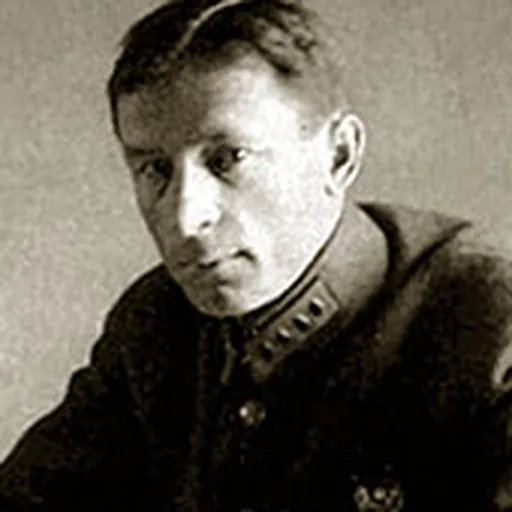
Pyotr Baranov
Soviet military leader and statesman
About Pyotr Baranov
Lived 1892 – 1933 (aged 40). Pyotr Baranov was a Russian statesperson, military officer and politician.
Biography Baranov was born in to a poor working-class family and himself became a worker from a young age. In 1912 he became a member of the Bolshevik faction of the Russian Social Democratic Labour. He was arrested in 1913 and was deported from Saint Petersburg for his revolutionary activities and was not allowed to live in large cities.
In 1915 Baranov was mobilized in the Imperial Russian Army. He deserted and conducted illegal revolutionary activities in Kharkiv. In 1916 he was once again arrested for revolutionary agitation and sentenced by a court-martial to eight years of hard labor, but was released after the February Revolution.
In September 1917, Baranov was the chairman of the front-line department of the Soviet of Soldiers' Deputies of the Romanian Front, and from October of the same year he was a member of the Revolutionary Committee and the RSDLP (b) committee of the 8th Army. In 1918 he joined the ranks of the Red Army. From April 7 to April 20, he commanded the Donetsk army of the Donetsk–Krivoy Rog Soviet Republic, which repulsed the offensive of the Austro-German troops in the Donbass. From 1919 to 1920 he was successively commissar of the headquarters of the 4th Army, a member of the Revolutionary Military Council of the 8th Army, the Southern Group of the Eastern Front, the Turkestan Front and 1st and 14th armies. In 1921, Baranov worked as the head of the political department of the troops of Ukraine and Crimea.
Baranov was a delegate of the 10th Congress of the RCP (b) and participated in the suppression of the Kronstadt uprising for which he was awarded the Order of the Red Banner.
From 1921 to 1922 he was a member of the Revolutionary Military Council of the Turkestan Front and the Central Asian Bureau of the Central Committee of the RCP (b). He led the units of the Red Army in military operations against the Basmachi and was awarded the military order of the Khorezm Soviet Republic.
In 1923, Baranov was appointed chief and commissar of the armored forces of the Red Army. In August of the same year, he was appointed deputy chief, and from December 10, 1924, he was acting chief of the Red Army Air Force. On March 2, 1925, he was appointed Commander-in-Chief. He headed the Air Force until June 1931. On April 15, 1925, in Moscow, Baranov signed a document establishing the Lipetsk German aviation school. At the same time, from 1925 to 1931, he was a member of the Revolutionary Military Council of the USSR.
Don’t just read it —
keep it.
Full-length biographies made to live with: read them, listen on the way to work, watch them tonight.
- E-book
- Audio
- Video
Instant download · yours to keep · every purchase keeps this site free
Important facts
Related people
Same field, nearest in time




Contemporaries
People whose lives overlapped Pyotr Baranov's

Frequently asked questions
Who was Pyotr Baranov?
Soviet military leader and statesman (1892-1933)
When was Pyotr Baranov born?
Pyotr Baranov was born on 22 September 1892 in Saint Petersburg.
When did Pyotr Baranov die?
Pyotr Baranov died on 5 September 1933 in Moscow Oblast.
What was Pyotr Baranov's occupation?
Pyotr Baranov was a statesperson, military officer and politician.
What nationality was Pyotr Baranov?
Pyotr Baranov was Russian.
Sources & further reading
Cite this page
APA: Biography.guide. (2026). Pyotr Baranov. https://biography.guide/pyotr-baranov/
MLA: "Pyotr Baranov." Biography.guide, https://biography.guide/pyotr-baranov/.
Chicago: "Pyotr Baranov." Biography.guide. https://biography.guide/pyotr-baranov/.
Data last updated: 2026-09-20 · Spot an error? Report a correction.
Page generated 2026-09-27 05:09 UTC