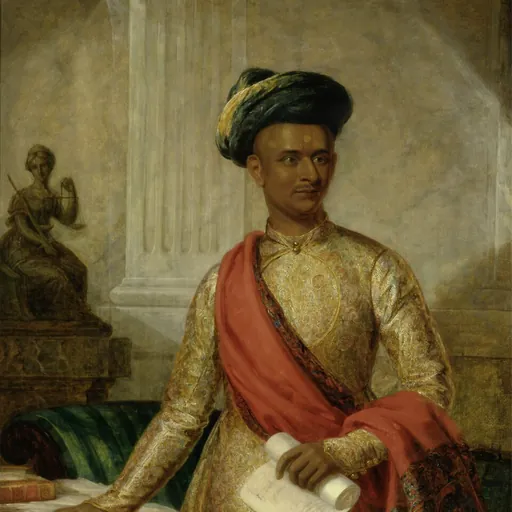
Purnaiah
Diwan of Mysore
About Purnaiah
Lived 1746 – 1812 (aged 65–66).
Krishnacharya Purnaiah (1746 – 27 March 1812), popularly known as Dewan Purnaiah, was an Indian administrator, statesman, and military strategist who served as the first dewan of Mysore from 1782 to 1811. He was instrumental in the restoration of the rule of the Kingdom of Mysore to the Wadiyar dynasty. After the death of Tipu, he continued to advice Lakshmi Devi, the queen regent to the newly installed monarch Krishnaraja Wodeyar III.
Purnaiah was known for his accounting skills, prodigious memory, and proficiency in several languages. He was also a wartime military commander while serving under Tipu. After Tipu's defeat, he served as the dewan to Krishnaraja Wodeyar III. Wodeyar was educated and mentored by Purnaiah in the latter's early years .
Early life Krishnacharya Purniah was born in 1746. He was fluent in Kannada, Marathi, Sanskrit, and Persian. He understood English but could not read or write the language.
At the age of eleven, Purnaiah lost his father and had to seek employment to support his family. He started writing accounts at a trader's shop. This grocer had close contact with a rich merchant, Annadana Shetty, who supplied large quantities of groceries to Hyder Ali's palace and army.
Dewan of Mysore Purniah earned the confidence of Hyder Ali thanks to his aptitude in accounting and excellent handwriting. Endowed with prodigious memory, proficiency in multiple languages, and sheer hard work, Purniah became the head of the accounting department, and minister, and a confidant and close advisor of the ruler. Hyder Ali also granted Purnaiah a jagir in Maralahalli, Mysore. From then on, many of the ruler’s decisions, including political matters, were shaped by Purnaiah’s counsel. During the Battle of Seringapatam, Tipu had entrusted his eldest son and heir-apparent to Purniah's care. In the Fourth Anglo-Mysore War, Purniah commanded the forces of Mysore against East India Company in a few battles including the Battle of Sultanpet Tope.
After Tipu's defeat at the hands of Arthur Wellesley, Purniah and Wellesley became closely associated when the latter was stationed in Mysore. Robert Frykenberg suggests that Wellesley learned how to maximise the utility of cavalry from Purniah.
Administration After Tipu's death in 1799, he suppressed the revolting local chieftains who had become despots.
Under Maharaja Krishnaraja Wodeyar III, Purnaiah started releasing cash allowances to mathas, temples, and dargahs, which had stopped under the Company rule after Tippu's death. He opened a judicial department to hear peoples' grievances. His public works have left a great legacy. About a nine-mile canal and several tanks were dug to supply drinking water to the city of Mysore. In honour of Richard Wellesley, the Governor-General of Bengal, a stone bridge was constructed across the river Kaveri connecting Srirangapattana with Kirangur. His work to improve agriculture was also acknowledged.
A large number of public shelters open to locals and travellers were erected in the name of Krishnaraja Wodeyar III, which were known as "Dewan Purniah".
Revenue administration was streamlined: the kingdom had a volatile border with incessant skirmishes, a legacy of the previous regime. Methodical land surveys were conducted; borders were notified; and the posts of shekdars, amaldars, and tehsildars (tax officers) were created, positions that are still in force throughout modern South Asia.
Family The obverse depicts "Sardula," a mythological tiger, facing right with its right paw and tail raised, accompanied by Kannada inscriptions at the top. Purnaiah's family were devout followers of the Uttaradi Matha and the Dvaita philosophy of Madhvacharya. Religion and spirituality were very important to Purnaiah. He was a contemporary and disciple of Satyadharma Tirtha of the Uttaradi Matha.
Purnaiah's great-great grandson was Sir P. N. Krishnamurti, a lawyer and the 16th dewan of Mysore.
Death After his retirement in 1811, Purnaiah settled at his residence (formerly known as Lord Harris's House and the Doctor's Bungalow, located near Scott’s Bungalow and Garrison Cemetery) in Srirangapatna. A tablet on the wall of this house records the connection of Harris and Puraniah to this house. A year later, he died in the residence on 27 March 1812.
Legacy The reverse is notable for featuring inscriptions in both Kannada and Persian, as well as the coin's denomination in English using Roman numerals (XV Cash). In 2013, a museum to map Purnaiah's achievements was opened at his former residence in Yelandur by the Department of Archaeology, Museums and Heritage.
In popular culture Films and television
In 1988, Vijay Kashyap portrayed Purnaiah in the television serial Bharat Ek Khoj In 1990, Anant Mahadevan portrayed Purnaiah in the television series The Sword of Tipu Sultan
Don’t just read it —
keep it.
Full-length biographies made to live with: read them, listen on the way to work, watch them tonight.
- E-book
- Audio
- Video
Instant download · yours to keep · every purchase keeps this site free
Important facts
People in Purnaiah's life
Named in this biography and alive at the same time
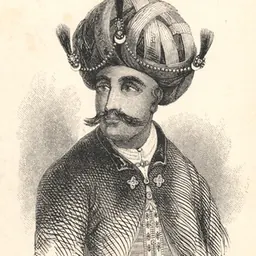



Contemporaries
People whose lives overlapped Purnaiah's






Frequently asked questions
Who was Purnaiah?
diwan of Mysore
When was Purnaiah born?
Purnaiah was born in 1746 in Coimbatore.
When did Purnaiah die?
Purnaiah died on 27 March 1812 in Srirangapatna.
Sources & further reading
Cite this page
APA: Biography.guide. (2026). Purnaiah. https://biography.guide/purnaiah/
MLA: "Purnaiah." Biography.guide, https://biography.guide/purnaiah/.
Chicago: "Purnaiah." Biography.guide. https://biography.guide/purnaiah/.
Data last updated: 2026-09-20 · Spot an error? Report a correction.
Portrait: Wikimedia Commons · author & licence
Page generated 2026-09-27 04:58 UTC