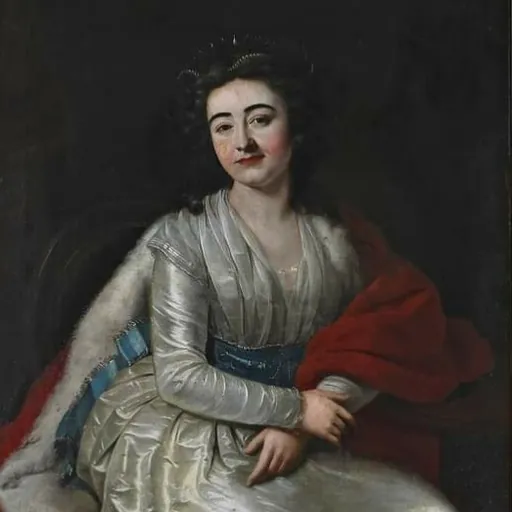
About Princess Pauline of Anhalt-Bernburg
Lived 1769 – 1820 (aged 51). Princess Pauline of Anhalt-Bernburg was a politician.
Pauline Christine Wilhelmine of Anhalt-Bernburg (also: Princess Pauline of Lippe; 23 February 1769 – 29 December 1820) was a princess consort of Lippe, married in 1796 to Leopold I, Prince of Lippe. She served as the regent of Lippe during the minority of her son from 1802 to 1820. She is regarded as one of the most important rulers of Lippe. On 1 January 1809, she abolished serfdom by princely decree. She managed to keep the principality independent during the Napoleonic Wars. She wrote a constitution, in which the power of the estates was reduced. In the collective historical consciousness of the Lippe population, however, she is best remembered for her social goals. Influenced by French reformist writings, she founded the first day care center in Germany, a labor school for neglected children, a voluntary work camp for adult charity recipients and a health care institution with first aid center.
Life
Pauline was born in Ballenstedt, the daughter of Prince Frederick Albert, Prince of Anhalt-Bernburg and his wife Louise Albertine of Schleswig-Holstein-Sonderburg-Plön. A few days after her birth, her mother died of the measles. She had an elder brother, Alexius Frederick Christian (1767–1834), who was Duke of Anhalt-Bernburg from 1807. It was noticed at an early age that Pauline had an alert mind. Her father, Prince Frederick Albert personally took over the upbringing of his daughter Pauline and his son and heir Alexei. She was a good student and learned French in addition to Latin, history and political sciences. Already at 13 years of age, she assisted her father in the business of government. First she took over the French correspondence, and later the entire correspondence between the residence in Ballenstedt Castle and the government offices in Bernburg. Her education was strongly influenced by Christian ethics and the ideas of the Enlightenment. Later Pauline continued to practice what she had learned in her youth, such as the teachings of Johann Heinrich Pestalozzi and Jean-Jacques Rousseau. husband. She confessed in a letter to her trusted cousin Frederick Christian of Schleswig-Holstein-Sonderburg-Augustenburg:
The Prince and the state government had to agree with the Estates, the nobility as landowners and representatives of the cities, on important political issues. Before Pauline's rule, the sovereign, the government and the Estates had usually been able to work out a compromise, despite their often conflicting interests. Pauline, however, was accustomed to the absolute monarchy as practiced in Anhalt-Bernburg, where the Prince ultimately takes the decision. She did not want to allow the Estates to talk her out of realizing her well-intentioned social plans. She felt that she knew what was best for the country and its inhabitants. In 1805, the Estates rejected her plan to introduce a tax on liquor to finance a hospital for the insane. After that, she rarely summoned the Estates and mostly ruled by decree.
The government of Lippe had been presided over by a chancellor or prime minister since the 18th century. Their weight grew over time. They rarely came into conflict with Princess Pauline, since their reform ideas of both sides were largely compatible with hers. Pauline regularly participated in meetings of the cabinet or the parliament and made her decisions there. Such sessions were often dominated by her impatience and her desire to lead. Her main focus was on foreign policy, however, because she spoke and wrote better French than any of her officials. She broke through the male monopoly, which in those days was only possible due to her Princely rank. No other females were active in the Lippe government, until some female councillors were elected after 1945.
That Lippe came out of the political disaster of 1813 intact, was due to the tendency of the rulers in Austria and Russia to restore the . The South German members of the Confederation had been accepted as allies and it was felt that Lippe could not be treated differently.
In the preamble to the decree, the Princess Regent, explained her humanistic and, above all, economic motives. Her words were read from the pulpits and published through posters and printed in the :
quote|text=Convinced that serfdom, even if it is as moderate as it has been so far in this country, will always have a negative influence on the morality and the diligence and solvency of the peasants, we find ourselves, as mother of the nation, and in the interest of the wealth of this class of faithful subjects, moved to follow the example of other member states of the Confederation and give up such a relationship, [...]|author=Pauline|sign= (quoted in Bender: Fürstliche Großtat? Die Aufhebung der Leibeigenschaft in Lippe vor 200 Jahren) rule stipulated that when a serf sold his (his right to use a certain parcel of land), a transfer fee had to be paid to the landlord. Under the Sterbfall rule, when a serf died, his heirs had to deliver his best set of clothes or his or the most valuable piece of cattle (the so-called to the landlord. The Estates protested against the restriction of their traditional rights and asked the Emperor to counter the Princess's subversive and the democratic spirit of the times. At the instigation of Metternich, the so-called Carlsbad Decrees were taken against democratic agitation. These coincided with the bitter confrontation about the Constitution in Lippe. The Federal Assembly of the German Confederation asked Pauline to immediately repeal the Constitution. Historical research in the second half of the 20th century began to question the uncritical historical view of Pauline. Elizabeth Stolle asked in her contribution to Lippischen Mitteilungen aus Geschichte und Landeskunde, 1969 questions about the Pauline's religious stance, in order to obtain a better understanding of her diaconal interests. The foundation runs a number of day care centers and strives to help people in need in the spirit of the Princess.
Issue Leopold II, Prince of Lippe (6 November 1796 – 1 January 1851) Prince Frederick (8 December 1797 – 20 October 1854) Princess Louise (17 July 1800 – 18 July 1800)
Ancestry
Footnotes
References and Sources
, also available via Google
Don’t just read it —
keep it.
Full-length biographies made to live with: read them, listen on the way to work, watch them tonight.
- E-book
- Audio
- Video
Instant download · yours to keep · every purchase keeps this site free
Important facts
Family & relationships
People in Princess Pauline of Anhalt-Bernburg's life
Named in this biography and alive at the same time

Related people
Same field, nearest in time



Contemporaries
People whose lives overlapped Princess Pauline of Anhalt-Bernburg's





Frequently asked questions
Who was Princess Pauline of Anhalt-Bernburg?
Regent of Lippe (1769-1820)
When was Princess Pauline of Anhalt-Bernburg born?
Princess Pauline of Anhalt-Bernburg was born on 23 February 1769 in Ballenstedt.
When did Princess Pauline of Anhalt-Bernburg die?
Princess Pauline of Anhalt-Bernburg died on 29 December 1820 in Detmold.
What was Princess Pauline of Anhalt-Bernburg's occupation?
Princess Pauline of Anhalt-Bernburg was a politician.
Sources & further reading
· Wikipedia: Princess Pauline of Anhalt-Bernburg
· DBpedia: Princess Pauline of Anhalt-Bernburg
Cite this page
APA: Biography.guide. (2026). Princess Pauline of Anhalt-Bernburg. https://biography.guide/princess-pauline-of-anhalt-bernburg/
MLA: "Princess Pauline of Anhalt-Bernburg." Biography.guide, https://biography.guide/princess-pauline-of-anhalt-bernburg/.
Chicago: "Princess Pauline of Anhalt-Bernburg." Biography.guide. https://biography.guide/princess-pauline-of-anhalt-bernburg/.
Data last updated: 2026-09-21 · Spot an error? Report a correction.
Portrait: Wikimedia Commons · author & licence
Page generated 2026-09-27 04:58 UTC