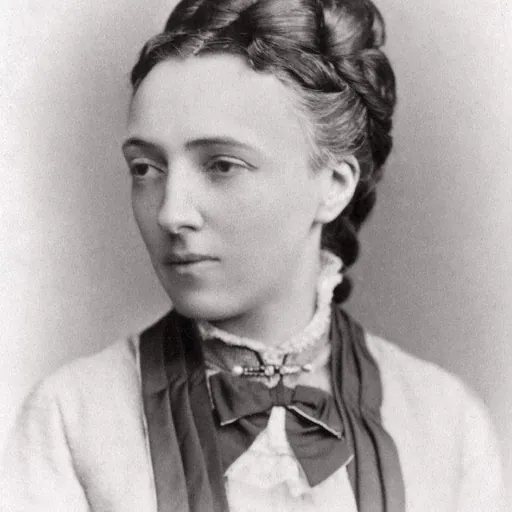
Princess Cecilie of Baden
Russian grand duchess (1839-1891); youngest daughter of Leopold, Grand Duke of Baden, and Princess Sophie of Sweden
About Princess Cecilie of Baden
Lived 1839 – 1891 (aged 51). Princess Cecilie of Baden was a Russian aristocrat.
Grand Duchess Olga Feodorovna of Russia (; 20 September 1839 – 12 April 1891), born Princess Cäcilie of Baden, was the youngest daughter of Grand Duke Leopold of Baden and Sophie Wilhelmine of Sweden.
She received a strict education at the court of Baden in Karlsruhe, becoming a cultured woman. On 28 August 1857, she married Grand Duke Mikhail Nikolaevich of Russia, the youngest son of Tsar Nicholas I of Russia. Upon her marriage, she converted to the Russian Orthodox faith and took the name Olga Feodorovna with the title of Grand Duchess of Russia. Unusually among the Romanovs of her generation, her marriage was a long and happy union. The couple remained devoted to each other. She raised their seven children with an iron hand.
Between 1862 and 1882, she lived with her husband and their children in the Caucasus in a palace in Tiflis. She was a strong supporter of her husband's governmental activities as a viceroy of the region and she took an interest in charities, particularly in the field of female education. In 1882, the family moved back to the Imperial court in St Petersburg to a large palace on the bank of the Neva river. With a strong personality and a sharp tongue, Grand Duchess Olga Feodorovna was not a popular member of the Romanov family. She spent the last years of her life traveling frequently, trying to find relief for her failing health. She died of a heart attack while traveling by train to Crimea.
Early life
Grand Duchess Olga Feodorovna was born on 20 September 1839, in Karlsruhe as Cäcilie Auguste, Princess and Margravine of Baden. She was the youngest daughter among the seven children of Grand Duke Leopold of Baden and Princess Sophie Wilhelmine of Sweden.
Cäcilie's father, Grand Duke Leopold, descended from a morganatic branch of the Baden family (his mother was Luise Geyer von Geyersberg, a noblewoman) and thus did not have rights to a princely status or the sovereign rights of the House of Zähringen of Baden. However, in 1830 he ascended to the throne of the Grand Duchy of Baden after the main male line of his family died out. Leopold was considered the first German ruler who held in his country's liberal reforms. In 1856, her brother, Frederick I, Grand Duke of Baden, married Princess Louise of Prussia, a daughter of the reigning Crown Prince Wilhelm I of Prussia and therefore a first cousin of Grand Duke Michael.
When Olga came to Russia as Cäcilie, her husband did not like her birth name and chose for her the name Olga Feodorovna, which she took upon her conversion to the Orthodox faith. The marriage took place on 28 August 1857 at the Chapel of the Winter Palace in Saint Petersburg. Grand Duke Michael loved his wife deeply all his life and was under her strong influence; they were like polar opposites and this only seemed to cement their alliance. Michael Nikolaevich was a kind, calm, rather dull man who would have been completely happy to devote himself only to the artillery and his family, and he did not shine with exceptional intellect. On the other hand, Olga Feodorovna was lively, sharp-tongued, witty society-lady, very fond of malicious tales and gossips – according to some of her contemporaries, gossip was her main raison d'être, or purpose for existing.
The couple remained close and theirs was a happy marriage. They lived in their own large residence in Saint Petersburg, the New Mikhailovsky Palace, which was built for them in 1861. The couple had seven children. Grand Duchess Olga, with a stronger personality than her husband, was the dominating force in the family. She raised her seven children with an iron hand.
Issue
Grand Duchess
In the fall of 1860 Olga and her husband visited England. Queen Victoria described their meeting in a letter to her daughter Victoria, Crown Princess of Prussia Windsor, 24 October 1860:
In 1862 Grand Duke Michael Nikolayevich's brother, Emperor Alexander II of Russia, appointed him as governor of the Empire in the Caucasus, and Olga moved with her husband to Tiflis. The couple had already three children, four more were born there. For almost 20 years the family lived in the Caucasus. In addition to official duties as wife of the imperial governor, Olga provided support to her husband Grand Duke Michael Nikolayevich, who supervised the implementation of the liberal reforms of Alexander II in the region.
Grand Duchess Olga took part in ceremonies as the viceroy's wife and in supporting many charities, especially in the field of female education. Using in large part personal funds, in 1864, the grand duchess organized a women's school in Tiflis, later renamed Grand Duchess Olga Feodorovna women's gymnasium. She also founded the first Ossetian school for girls, which was named Ossetian Olginsky. She also became the patroness of a hospital in Pyatigorsk which was named Saint Olga. In 1884, in St. Petersburg, Olga became the patroness of the new Alexander's men's Hospital (now the City Psychiatric Hospital No. 7). One of the streets of Tiflis - Olginskaya was named in her honor. The village of Olginskaya (now the Right Bank district of North Ossetia) was also named after her.
Final years
With the assassination of Tsar Alexander II in 1881, the governorship ended in the Caucasus. During the reign of the new Tsar Alexander III of Russia, Grand Duke Michael Nikolayevich served as chairman of the Imperial Council and the family moved back permanently to Saint Petersburg. Alexander III, who did not like Olga, sometimes referred to her behind her back as "Auntie Haber", hinting at her alleged Jewish heritage and illegitimacy. Such rumors of Jewish paternity followed Olga through her life. Her husband was protective of her. The Romanovs were anti-Semitic and Olga, who was not a popular member of the family, was mocked as "Frau Haber." She demanded complete obedience from her children. She was particularly close to her eldest son Grand Duke Nicholas Mikhailovich of Russia, whose intellectual interests were like hers, but she remained aloof and cold towards the others. Her second son, Grand Duke Michael Mikhailovich, who was not intellectually gifted (she called him a fool), was a constant source of disappointment for her. In 1879, Olga with Grand Duchess Maria Pavlovna arranged the marriage between her only daughter, Grand Duchess Anastasia Mikhailovna of Russia, with Frederick Francis III, Grand Duke of Mecklenburg-Schwerin, Maria Pavlovna's brother. Anastasia carried some bitterness about her upbringing and relationship with her mother - her daughter Cäcilie recounts that at a party to celebrate her engagement, when she committed some infraction she was sent to bed by Olga like a naughty child.
Around noon on 9 April 1891, the express train in which Olga was riding passed through Kharkov. During the afternoon the Grand Duchess suffered a heart attack. As Kharkov was the largest nearby city, the train returned there at about 7 pm. Several doctors in Kharkov were invited into her train compartment and they diagnosed her ailments as an inflammation of the lungs. She was taken into the tsar's waiting room in the station. She was surrounded by her attendants and doctors, but neither her husband nor any of her children were with her as she was traveling alone. A priest was called and she died there at the train station three days later on 12 April 1891 at the age of 51.
Ancestry
Don’t just read it —
keep it.
Full-length biographies made to live with: read them, listen on the way to work, watch them tonight.
- E-book
- Audio
- Video
Instant download · yours to keep · every purchase keeps this site free
Important facts
Family & relationships
People in Princess Cecilie of Baden's life
Named in this biography and alive at the same time

Related people
Same field, nearest in time


Contemporaries
People whose lives overlapped Princess Cecilie of Baden's


Frequently asked questions
Who was Princess Cecilie of Baden?
Russian grand duchess (1839-1891); youngest daughter of Leopold, Grand Duke of Baden, and Princess Sophie of Sweden
When was Princess Cecilie of Baden born?
Princess Cecilie of Baden was born on 20 September 1839 in Karlsruhe.
When did Princess Cecilie of Baden die?
Princess Cecilie of Baden died on 12 April 1891 in Kharkiv.
What was Princess Cecilie of Baden's occupation?
Princess Cecilie of Baden was an aristocrat.
What nationality was Princess Cecilie of Baden?
Princess Cecilie of Baden was Russian.
Sources & further reading
· Wikipedia: Princess Cecilie of Baden
· DBpedia: Princess Cecilie of Baden
Cite this page
APA: Biography.guide. (2026). Princess Cecilie of Baden. https://biography.guide/princess-cecilie-of-baden/
MLA: "Princess Cecilie of Baden." Biography.guide, https://biography.guide/princess-cecilie-of-baden/.
Chicago: "Princess Cecilie of Baden." Biography.guide. https://biography.guide/princess-cecilie-of-baden/.
Data last updated: 2026-09-21 · Spot an error? Report a correction.
Portrait: Wikimedia Commons · author & licence
Page generated 2026-09-27 04:59 UTC