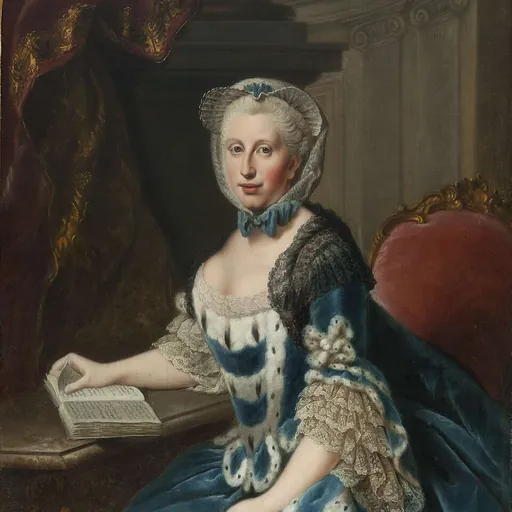
About Princess Augusta of Great Britain
Lived 1737 – 1813 (aged 75). Princess Augusta of Great Britain was a British aristocrat.
Augusta of Great Britain (Augusta Frederica; 31 July 1737 – 23 March 1813) was a British princess, granddaughter of George II and the only elder sibling of George III. She was Duchess of Brunswick-Lüneburg and Princess of Brunswick-Wolfenbüttel by marriage to Charles William Ferdinand, Duke of Brunswick. Her daughter Caroline was the wife of George IV.
Early life Princess Augusta was born at St. James's Palace on 31 July 1737.
As she was the first born child of Frederick, Prince of Wales and the first born grandchild of George II of Great Britain and Caroline of Ansbach, Augusta was second in line for the throne of Great Britain, which changed a year later in 1738, when her brother Prince George (later George III of Great Britain) was born. Her mother was the Princess Augusta of Saxe-Gotha.
In the months before her birth, her father did not have a good relationship with his parents. In June 1737, Frederick announced to his parents that his wife would give birth in October. In reality, the birth was due earlier, and when Augusta went into labour, Frederick smuggled her out of Hampton Court Palace in the middle of the night, to prevent his parents from witnessing the birth. George and Caroline were horrified. Traditionally, royal births were witnessed by members of the family and senior courtiers to guard against supposititious children, and Augusta had been forced by her husband to ride in a rattling carriage for an hour and a half while heavily pregnant and in pain. With a party including her daughters Amelia and Caroline and Lord Hervey, Queen Caroline raced over to St James's Palace, where Frederick had taken Augusta. The delivery was traumatic: St James's was not ready to receive them, no bed was prepared, no sheets could be found, and Augusta was forced to give birth on a tablecloth. Caroline was relieved to discover that Augusta had given birth to a "poor, ugly little she-mouse", rather than a "large, fat, healthy boy" as the pitiful nature of the baby made a supposititious child unlikely.
Fifty days later, she was christened at St. James's Palace by the Archbishop of Canterbury. Her godparents were her paternal grandfather, the King (represented by his Lord Chamberlain, the Duke of Grafton), and her grandmothers, Queen Caroline and the Dowager Duchess of Saxe-Gotha (both represented by proxies).
Her third birthday was celebrated by the first public performance of the masque Alfred (1740) by Thomas Arne, performed at her father's residence at Cliveden. In its original form, Alfred contained only eight vocal sections and the overture, including the famous patriotic song "Rule, Britannia!".
Augusta was given a careful education. She was not described as a rare beauty, having a loose mouth and long face.
In 1761–63, a marriage was discussed between Augusta and her second cousin, Charles William Ferdinand, Duke of Brunswick-Wolfenbüttel. The negotiations were delayed because her mother disliked the House of Brunswick. This obstacle was overcome by a reason described by Horace Walpole: "Lady Augusta was lively, and much inclined to meddle in the private politics of the Court. As none of her [The [Dowager] Princess [of Wales]'s] children but the King, had, or had reason to have, much affection for their mother, she justly apprehended Lady Augusta instilling their disgust on to the Queen. She could not forbid her daughter's frequent visits at Buckingham House, but to prevent ill consequence of them, she often accompanied her thither. This, however, was an attendance and a constraint the Princess of Wales could not support. Her exceeding indolence, her more excessive love of privacy, and the subjection of being frequently with the Queen, whose higher rank was a never ceasing mortification, all concurred to make her resolve, at any rate, to deliver herself of her daughter. To obtain this end, the profusion of favours to the hated House of Brunswick was not though too much. The Hereditary Prince was prevailed to accept Lady Augusta's hand, with four-score thousand pounds, an annuity of £5,000 a year on Ireland, and three thousand a year on Hanover."
The marriage agreement was announced to the House of Lords on 1 December 1763. On 16 January 1764, Augusta married Charles William Ferdinand at the Chapel Royal of St James's Palace. The wedding was followed by a state dinner at Leicester House, congratulations from the Houses of Parliament, a ball given by the Queen, and an opera performance at Covent Garden. The couple departed from Harwich on the 26th.
Life in Brunswick The Duchess never fully adapted to life in Brunswick. She always viewed Great Britain in very high regard all her life and disregarded anything "east of the Rhine". Whilst in England, it was noted that the couple were cheered on by crowds every time they showed themselves in public. This reportedly exposed them to suspicion at court. During their visit, her sister-in-law Queen Charlotte apparently refused them some honours at court, such as military salutes. This attracted negative publicity toward the hosting royal couple. During the negotiations thirty years later for the marriage of her daughter to the Prince of Wales, Augusta commented to the British negotiator, Lord Malmesbury, that Queen Charlotte disliked both her and her mother because of jealousy dating from the visit of 1764.
Augusta saw the court of her mother-in-law as boring and dull, especially during the summer months when her husband was absent at camp. According to Mr. Walpole, the reason was jealousy on the part of the queen.
Later life
In 1806, when Prussia declared war on France, her husband, the Prince of Brunswick-Wolfenbuttel, 71 at the time, was appointed commander-in-chief of the Prussian army. On 14 October of that year, at the Battle of Jena, Napoleon defeated the Prussian army; and on the same day, at the Battle of Auerstadt, the Prince was seriously wounded, dying a few days later. Augusta, with the Hereditary Prince and Hereditary Princess, fled to Altona, where they were present at her dying spouse's side. Because of the advancing French army, they were advised by the British ambassador to flee, and they left shortly before the death of the Prince. They were invited to Sweden by the Hereditary Princess's brother-in-law King Gustav IV Adolf of Sweden. Through her great-granddaughter Princess Pauline of Württemberg, she is an ancestress of the present Belgian, Danish, Dutch, Luxembourgish, Norwegian, and Swedish royal families.
Arms Augusta was granted use of the arms of the kingdom, differenced by a label argent of five points, the centre bearing a cross gules, the other points each bearing a rose gules.
Ancestors
Issue Together the couple had 7 children:
Don’t just read it —
keep it.
Full-length biographies made to live with: read them, listen on the way to work, watch them tonight.
- E-book
- Audio
- Video
Instant download · yours to keep · every purchase keeps this site free
Important facts
Family & relationships
People in Princess Augusta of Great Britain's life
Named in this biography and alive at the same time

Related people
Same field, nearest in time



Contemporaries
People whose lives overlapped Princess Augusta of Great Britain's





Frequently asked questions
Who was Princess Augusta of Great Britain?
British princess (1737-1813)
When was Princess Augusta of Great Britain born?
Princess Augusta of Great Britain was born on 31 July 1737 in London.
When did Princess Augusta of Great Britain die?
Princess Augusta of Great Britain died on 23 March 1813 in London.
What was Princess Augusta of Great Britain's occupation?
Princess Augusta of Great Britain was an aristocrat.
What nationality was Princess Augusta of Great Britain?
Princess Augusta of Great Britain was British.
Sources & further reading
· Wikipedia: Princess Augusta of Great Britain
· DBpedia: Princess Augusta of Great Britain
Cite this page
APA: Biography.guide. (2026). Princess Augusta of Great Britain. https://biography.guide/princess-augusta-of-great-britain/
MLA: "Princess Augusta of Great Britain." Biography.guide, https://biography.guide/princess-augusta-of-great-britain/.
Chicago: "Princess Augusta of Great Britain." Biography.guide. https://biography.guide/princess-augusta-of-great-britain/.
Data last updated: 2026-09-21 · Spot an error? Report a correction.
Portrait: Wikimedia Commons · author & licence
Page generated 2026-09-27 05:00 UTC