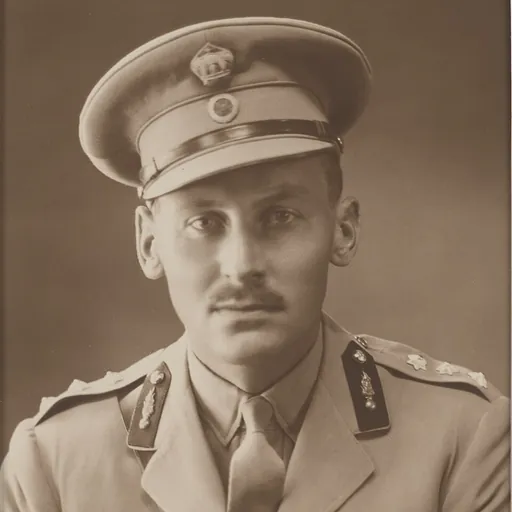
Prince Peter of Greece and Denmark
Anthropologist, specialising in Tibetan beliefs and customs
About Prince Peter of Greece and Denmark
Lived 1908 – 1980 (aged 72). Prince Peter of Greece and Denmark was a Greek anthropologist, military personnel, military officer and ethnologist.
Prince Peter of Greece and Denmark (; 3 December 1908 – 15 October 1980) was a Greek prince, soldier and anthropologist specialising in Tibetan culture and polyandry. Born in Paris and high in the line of succession to the Greek throne, Prince Peter was deemed to have forfeited his succession rights by marrying a twice-divorced Russian commoner, Irina Aleksandrovna Ovtchinnikova. Following his first scientific voyage to Asia, Peter served as an officer of the Greek army during the Second World War. The Prince returned to Asia several more times for his research of Tibetan culture. He strongly protested against the royal family's treatment of his wife. After King Paul's death, he declared himself heir presumptive to the Greek throne, on the pretext that female dynasts had been unlawfully granted succession rights in 1952. Peter eventually separated from his wife and died childless in London.
Early life
A member of the House of Schleswig-Holstein-Sonderburg-Glücksburg, Prince Peter was the elder child and only son of Prince George of Greece and Denmark and the wealthy author and psychoanalyst Princess Marie Bonaparte. His father was the second son of King George I of Greece and his mother the only daughter of the French botanist Prince Roland Bonaparte and Marie-Félix Blanc. In the 1930s, a possible marriage between Prince Peter and Princess Frederica of Hanover may have been discussed, but she eventually married Prince Paul. Peter joined the 3/40 Evzone Regiment in 1936, becoming an officer. He proceeded to travel through Greece with his parents and visited Crete in April 1937.
While in Madras, Peter decided to officialise his relationship with Ovtchinnikova. The pair were married in a Danish consulate in September 1939. Aware of his family's disapproval of the relationship, but also possibly wishing to take advantage of the turmoil created by the recently declared Second World War, the Prince did not bother to inform either the Greek royal court or his parents about the marriage. The royal family learned of the mesalliance through the press a few weeks later. Prince George, affronted by his son's decision not to ask him or the King for permission to marry, disowned Peter and henceforward refused contact with him. Despite her own disappointment, however, Princess George remained in touch with her son and continued to regularly send him money. Peter was the only one to remain in Cairo, having been named "Representative of the King of the Hellenes in the Middle East".
Tibetan studies
First sojourn
Prince Peter and Ovtchinnikova left the United States in January 1949, travelling from California to Colombo, the capital of Ceylon. They arrived on the island on 16 February and crossed over to India, once again meeting with the Toda people. Peter was dismayed to find out that the people lived in poor sanitary conditions and that their culture was on the verge of disappearance. He then demanded that the Indian government intervene, and a hospital was built in the Nilgiris District.
Second sojourn The expedition ended in 1952, and the pair went to Copenhagen, where Peter presented his findings. The committee wanted him to return and continue his research, which he did within a few weeks. He and his wife were again prohibited from entering Tibet, but this time they also faced the hostility of the Indian government. West Bengal authorities refused to allow him to collect more anthropometric data.
Final decades
Upon their return to Europe, Prince Peter and Ovtchinnikova settled in the United Kingdom, where the Prince resumed his studies at the London School of Economics. He prepared a thesis on polyandry under the mentorship of the ethnologist Sir Raymond Firth, Malinowski's successor, and received a doctorate of philosophy in 1959.
Shortly after the King's marriage to their cousin, Princess Anne-Marie of Denmark, the uninvited Prince Peter called a press conference in Athens and openly questioned the legality of the constitutional amendment. Above all, he attacked his cousin Paul's widow, the tremendously unpopular Queen Frederika, and accused her of having a bad influence on her son. In 1967 he, "...was instrumental in procuring vocational training for young Tibetans in Denmark."
Death and burial He was surprised by an offer from the Chinese government to visit the Tibet Autonomous Region in the late 1970s. He accepted, but did not advise the Dalai-Lama to return, as the Chinese seemed to ask. Within a few months, he was planning another visit to the Himalayas, to film the areas he had visited in his youth. He died of intracranial haemorrhage before he could do so, at the National Hospital for Neurology and Neurosurgery in London on 15 October 1980.
A memorial mass for Prince Peter was held at St Sophia's Cathedral, London, on 22 October. It was attended by his widow and the Greek royal family, including Queen Frederika, who once again ostracised Ovtchinnikova. His body remained unburied for 340 days. In his testament, he requested that he be buried among the members of his family at Tatoi Palace, but only if his widow would be buried there as well. He compromised by agreeing that the tomb inscription would describe her as "Irina, spouse of Prince Peter, née Alexandrovna Ovtchinnikova" rather than as a Greek princess. The Greek government, however, refused to allow his burial in Greece. The royal family was relieved that Ovtchinnikova would not be buried among the royals, but was left with the question of where he should be buried. Finally, he was buried in the grounds of his Danish palace, Lille Bernstorff, on 25 September 1981. Ten years later, Ovtchinnikova was buried next to him.
Ancestry
Don’t just read it —
keep it.
Full-length biographies made to live with: read them, listen on the way to work, watch them tonight.
- E-book
- Audio
- Video
Instant download · yours to keep · every purchase keeps this site free
Important facts
Family & relationships
People in Prince Peter of Greece and Denmark's life
Named in this biography and alive at the same time



Related people
Same field, nearest in time

Contemporaries
People whose lives overlapped Prince Peter of Greece and Denmark's

Frequently asked questions
Who was Prince Peter of Greece and Denmark?
anthropologist, specialising in Tibetan beliefs and customs
When was Prince Peter of Greece and Denmark born?
Prince Peter of Greece and Denmark was born on 2 July 1908 in 16th arrondissement of Paris.
When did Prince Peter of Greece and Denmark die?
Prince Peter of Greece and Denmark died on 15 October 1980 in London.
What was Prince Peter of Greece and Denmark's occupation?
Prince Peter of Greece and Denmark was an anthropologist, military personnel, military officer and ethnologist.
What nationality was Prince Peter of Greece and Denmark?
Prince Peter of Greece and Denmark was Greek.
Sources & further reading
· Wikipedia: Prince Peter of Greece and Denmark
· DBpedia: Prince Peter of Greece and Denmark
Cite this page
APA: Biography.guide. (2026). Prince Peter of Greece and Denmark. https://biography.guide/prince-peter-of-greece-and-denmark/
MLA: "Prince Peter of Greece and Denmark." Biography.guide, https://biography.guide/prince-peter-of-greece-and-denmark/.
Chicago: "Prince Peter of Greece and Denmark." Biography.guide. https://biography.guide/prince-peter-of-greece-and-denmark/.
Data last updated: 2026-09-20 · Spot an error? Report a correction.
Page generated 2026-09-27 05:10 UTC