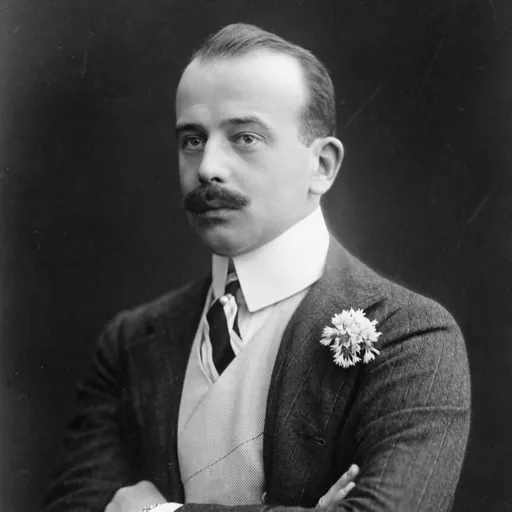
About Prince Maximilian of Baden
Lived 1867 – 1929 (aged 62). Prince Maximilian of Baden was a German politician.
Maximilian, Margrave of Baden (Maximilian Alexander Friedrich Wilhelm; 10 July 1867 – 6 November 1929), also known as Max von Baden, was a German aristocrat, general and politician. A member of the House of Baden, in October and November 1918 he briefly served as the last chancellor of the German Empire and minister-president of Prussia.
The son of Prince Wilhelm of Baden and Maria Maximilianovna of Leuchtenberg, Max studied law at the Leipzig University before joining the Prussian Army. He became heir presumptive to the throne of the Grand Duchy of Baden in 1907 upon the death of his uncle, Grand Duke Frederick I. He served as a general staff officer at the XIV Corps upon the outbreak of World War I. In 1914, he became honorary president of the Baden section of the German Red Cross, where he worked for the welfare of prisoners of war using his international connections.
Emperor Wilhelm II appointed Max chancellor in October 1918, replacing Georg von Hertling, and he was immediately tasked to approach the Allies and secure an armistice. Despite his own reservations, he began peace negotiations based on U.S. President Woodrow Wilson's Fourteen Points and took steps towards transforming the government into a parliamentary system. He forced Erich Ludendorff's resignation from the Supreme Army Command when the latter threatened to derail the negotiations. As revolution in Germany rapidly spread in November 1918, Max unilaterally proclaimed the abdication of Wilhelm and handed over the chancellorship to SPD Chairman Friedrich Ebert, marking the end of the German Empire and the beginning of the Weimar Republic.
After the revolution, Max returned to Baden and spent the rest of his life in retirement. He wrote a number of books and established the private boarding school Schule Schloss Salem with the help of Kurt Hahn. He died in 1929, a year after becoming the head of the House of Baden.
Early life
Born in Baden-Baden on 10 July 1867, Maximilian was a member of the House of Baden, the son of Prince Wilhelm Max (1829–1897), third son of Grand Duke Leopold (1790–1852) and Princess Maria Maximilianovna of Leuchtenberg (1841–1914), a granddaughter of Eugène de Beauharnais. He was named after his maternal grandfather, Maximilian de Beauharnais, and bore a resemblance to his cousin, Emperor Napoleon III.
Max received a humanistic education at a Gymnasium secondary school and studied law and cameralism at the Leipzig University. Upon the order of Queen Victoria, Prince Max was brought to Darmstadt in the Grand Duchy of Hesse and by Rhine as a suitor for Victoria's granddaughter, Alix of Hesse-Darmstadt. Alix was the daughter of Victoria's late daughter, Princess Alice, and Louis IV, Grand Duke of Hesse. Alix quickly rejected Prince Max, as she was in love with Nicholas II, the future Tsar of Russia. Max von Baden was homosexual and even listed on an according list of the Berlin criminal police as a young officer, however in 1900 he decided for dynastic reasons to marry Princess Marie Louise of Hanover and Cumberland. So did the future King Gustaf V of Sweden who married Max's cousin Victoria of Baden.
Early military and political career After finishing his studies, he trained as an officer of the Prussian Army. Following the death of his uncle Grand Duke Frederick I of Baden in 1907, he became heir to the grand-ducal throne of his cousin Frederick II, whose marriage remained childless. In 1911, Max applied for a military discharge with the rank of a Generalmajor (Major general).
In October 1914, he became honorary president of the Baden section of the German Red Cross, thus beginning his work for prisoners-of-war inside and outside Germany in which he made use of his family connections to the Russian and Swedish courts as well as his connections to Switzerland. Since he was almost unknown to the public, it was mainly due to Kurt Hahn, who served from spring 1917 in the military office of the Foreign Ministry, that he was later considered for the position of chancellor. Hahn maintained close links with Secretary of State Wilhelm Solf and several Reichstag deputies like Eduard David (SPD) and Conrad Haußmann (FVP). David pushed for Max to be appointed Chancellor in July 1917, after the fall of Chancellor Bethmann Hollweg. Max then put himself forward for the position in early September 1918, pointing out his links to the social democrats, but Emperor Wilhelm II turned him down.
In office Although Max had serious reservations about the conditions under which the OHL was willing to conduct negotiations and tried to interpret Wilson's Fourteen Points in a way most favourable to the German position, This was not possible under the imperial constitution as it stood. Article 11 defined the empire as a confederation of states under the permanent presidency of the king of Prussia. While Wilhelm believed he ruled the empire in personal union with Prussia, in truth the imperial crown was tied to the Prussian crown. Under the constitution, Wilhelm could not renounce one crown without renouncing the other.
Foreign Grand Cordon of the Order of Leopold (military), 2 October 1906 Grand Cross of St. Alexander Knight of the Elephant, 10 July 1900 Grand Cross of the Order of Prince Danilo I Knight of St. Andrew Sweden–Norway: Grand Cross of St. Olav, 30 August 1887 Knight of the Seraphim, 24 April 1902
Works Memoirs, 2 vols. (1928)
Ancestry
Don’t just read it —
keep it.
Full-length biographies made to live with: read them, listen on the way to work, watch them tonight.
- E-book
- Audio
- Video
Instant download · yours to keep · every purchase keeps this site free
Important facts
Family & relationships
People in Prince Maximilian of Baden's life
Named in this biography and alive at the same time

Related people
Same field, nearest in time


Contemporaries
People whose lives overlapped Prince Maximilian of Baden's

Frequently asked questions
Who was Prince Maximilian of Baden?
German chancellor (1867-1929)
When was Prince Maximilian of Baden born?
Prince Maximilian of Baden was born on 10 July 1867 in Baden-Baden.
When did Prince Maximilian of Baden die?
Prince Maximilian of Baden died on 6 November 1929 in Salem.
What was Prince Maximilian of Baden's occupation?
Prince Maximilian of Baden was a politician.
What nationality was Prince Maximilian of Baden?
Prince Maximilian of Baden was German.
Sources & further reading
· Wikipedia: Prince Maximilian of Baden
· DBpedia: Prince Maximilian of Baden
Cite this page
APA: Biography.guide. (2026). Prince Maximilian of Baden. https://biography.guide/prince-maximilian-of-baden/
MLA: "Prince Maximilian of Baden." Biography.guide, https://biography.guide/prince-maximilian-of-baden/.
Chicago: "Prince Maximilian of Baden." Biography.guide. https://biography.guide/prince-maximilian-of-baden/.
Data last updated: 2026-09-30 · Spot an error? Report a correction.
Portrait: Wikimedia Commons · author & licence
Page generated 2026-10-04 14:27 UTC