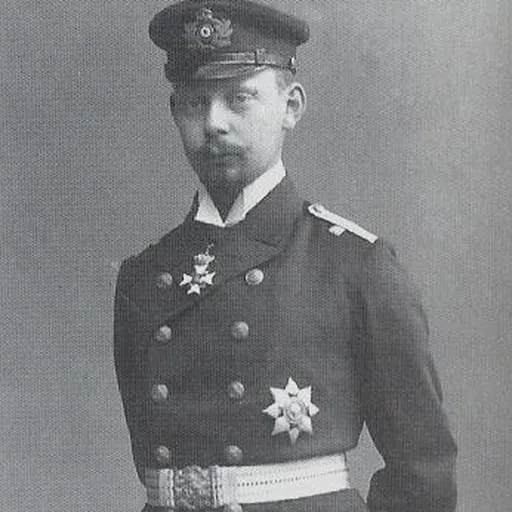
About Prince Heinrich XXXII Reuss of Köstritz
Lived 1878 – 1935 (aged 57). Prince Heinrich XXXII Reuss of Köstritz was a German military personnel.
Prince Heinrich XXXII Reuss of Köstritz (4 March 1878 – 6 May 1935) was the eldest surviving son of Prince Heinrich VII Reuss of Köstritz and his wife, Princess Marie Alexandrine of Saxe-Weimar-Eisenach.
As Wilhelmina of the Netherlands was childless for the first eight years of her marriage, Heinrich XXXII was third-in-line to the Dutch throne, after the claims of his cousin William Ernest, Grand Duke of Saxe-Weimar-Eisenach and Princess Marie Alexandrine, who was Wilhelmina's cousin, William Ernest's aunt and Heinrich's mother. William Ernest had made it clear however that he would not give up his title of Grand Duke of Saxe-Weimar-Eisenach if that was a requirement for becoming king of the Netherlands. Furthermore, Marie Alexandrine was elderly and prone to sickness. Thus it was assumed that she would give up her claim in favor of her eldest son, Heinrich XXXII. Consequently, Heinrich was for all intents and purposes the heir presumptive to the Dutch throne until the birth of the future Queen Juliana in 1909.
Family and early life Prince Heinrich XXXII Reuss of Köstritz was born on 4 March 1878 in Istanbul, where his father, who had previously been ambassador to Vienna, was German ambassador. The House of Reuss practises an unusual system of naming and numbering the male members of the family, every one of which for centuries has borne the name "Heinrich". While most royal and noble houses give numbers only to the reigning head of the house, and that in the order of his reign, the Reuss Younger Line used a numbering sequence for all male family members which began and ended roughly as centuries began and ended. In consequence of this naming system, certain heads of the Reuss Younger Line have had the highest numbers attached to their name of any European nobility.
Dutch succession Queen Wilhelmina in 1898, whom it was popularly assumed Heinrich XXXII would succeed. The 1909 birth of her daughter Princess Juliana would assure the succession, and keep the Dutch throne in her family.
Background Through his maternal grandmother Princess Sophie of the Netherlands, Heinrich XXXII could claim descent from William II of the Netherlands. As such, he was a second cousin of Queen Wilhelmina of the Netherlands, whose childless marriage was increasingly causing speculation about the succession to the Dutch throne.
Heinrich's cousin William Ernest, Grand Duke of Saxe-Weimar-Eisenach was for much of this period heir presumptive to the Dutch throne. However, the Dutch constitution explicitly prohibited their sovereign from a foreign house from holding another title. The Grand Duke had made it known on more than one occasion his preference for his own duchy versus inheriting the Netherlands crown, as the latter would have required a great deal more work and time. As such, he traveled in 1905 to Japan and China, as well to other countries across the world to fulfill his naval duties. He was described as a very "democratic young nobleman", and was a guest of honor with the German ambassador Speck von Sternburg at the embassy in Washington. No room reservation had been made for him when he arrived at a hotel in Washington, and the desk clerk not recognizing him, asked Heinrich to sign his name in the guest book; this he did, signing "Prince Henry of Reuss, Belair, Md". After returning from abroad, Heinrich decided to further develop his interest in business, industry, and commerce. He soon quit the imperial navy. As a result of his education and character, Heinrich was reported in the foreign press to be well-known and well regarded in the Netherlands, and was supposed to have left a favorable impression when he stayed there.
A commentator of the Bataviaasch Nieuwsblad wrote: "[...]His careless, dour appearance could be a mask, behind which an ardent love for the Dutch nation is hiding - but I bet my little finger that the entire nation would rather see someone else than him taking the place of the Queen.".
Citing a report by the Berliner Tagesblatt, the Peel- en Kempenbode wrote in 1908: "We never heard anything about [...] the favourable impression young Reuss is supposed to have made over here and in the Indies."
The Dutch people were still fervently hoping for the birth of an heir to Queen Wilhelmina, as evident in newspapers during that time.
Constitutional issues and the birth of an heir
A government bill was presented to the Dutch States-General in 1905 for a revision of the constitution. Its purpose was to revise the laws of succession, and allow the governing body the right to select their own ruler in the event of Queen Wilhelmina dying childless. Such fears were misplaced however, as Wilhelmina later elaborated that she had no wish of abdicating, and that the legislation was directed at the widowed and childless Grand Duke of Saxe-Weimar-Eisenach, who, though well known to be considering giving up his claim to the throne, was considering marrying again; there would have been considerable confusion as a result were he to give up the succession claim in favor of his aunt Marie, only to later pass his claim onto any children he might have. Two months later on 12 April 1921 at Bremen, Marie Adelheid subsequently remarried to Heinrich's youngest brother Prince Heinrich XXXV Reuss of Köstritz (1887-1936), producing one son before their divorce in 1923 (Heinrich XXXV had to divorce his wife of ten years Princess Marie of Saxe-Altenburg (1888-1947) for his marriage to Marie Adelheid to occur). Marie Adelheid would become a prominent Nazi socialite in later years, serving as an aide to Richard Walther Darré. Her choice of third husband, commoner Friedrich Kurt Hanno Konopath (1882-1962), was in reaction to her first two unhappy marriages, and would reflect her changing views of a new nobility dictated not only by blood, but also support of certain ideals.
Prince Heinrich XXXII never remarried, and died childless on 6 May 1935, aged 57, at Bad Tölz, Germany.
Don’t just read it —
keep it.
Full-length biographies made to live with: read them, listen on the way to work, watch them tonight.
- E-book
- Audio
- Video
Instant download · yours to keep · every purchase keeps this site free
Important facts
People in Prince Heinrich XXXII Reuss of Köstritz's life
Named in this biography and alive at the same time
Related people
Same field, nearest in time

Contemporaries
People whose lives overlapped Prince Heinrich XXXII Reuss of Köstritz's



Frequently asked questions
Who was Prince Heinrich XXXII Reuss of Köstritz?
Member of the House of Reuss (1878-1935)
When was Prince Heinrich XXXII Reuss of Köstritz born?
Prince Heinrich XXXII Reuss of Köstritz was born on 4 March 1878 in Istanbul.
When did Prince Heinrich XXXII Reuss of Köstritz die?
Prince Heinrich XXXII Reuss of Köstritz died on 6 May 1935 in Bad Tölz.
What was Prince Heinrich XXXII Reuss of Köstritz's occupation?
Prince Heinrich XXXII Reuss of Köstritz was a military personnel.
What nationality was Prince Heinrich XXXII Reuss of Köstritz?
Prince Heinrich XXXII Reuss of Köstritz was German.
Sources & further reading
· Wikipedia: Prince Heinrich XXXII Reuss of Köstritz
· DBpedia: Heinrich XXXII, Prince Reuss of Köstritz
Cite this page
APA: Biography.guide. (2026). Prince Heinrich XXXII Reuss of Köstritz. https://biography.guide/prince-heinrich-xxxii-reuss-of-kostritz/
MLA: "Prince Heinrich XXXII Reuss of Köstritz." Biography.guide, https://biography.guide/prince-heinrich-xxxii-reuss-of-kostritz/.
Chicago: "Prince Heinrich XXXII Reuss of Köstritz." Biography.guide. https://biography.guide/prince-heinrich-xxxii-reuss-of-kostritz/.
Data last updated: 2026-10-02 · Spot an error? Report a correction.
Portrait: Wikimedia Commons · author & licence
Page generated 2026-10-04 10:50 UTC