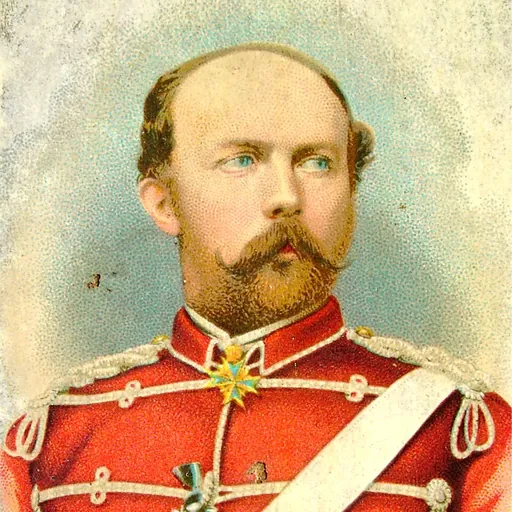
Prince Friedrich Karl of Prussia
German general
About Prince Friedrich Karl of Prussia
Lived 1828 – 1885 (aged 57). Prince Friedrich Karl of Prussia was a German military officer, career soldier and military leader.
Prince Friedrich Karl Nikolaus of Prussia (20 March 1828 – 15 June 1885) was the son of Prince Charles of Prussia and Princess Marie of Saxe-Weimar-Eisenach. He was the grandson of King Frederick William III of Prussia and nephew of Frederick William IV and William I. Friedrich Karl is highly regarded as a military commander.
As a military commander, the Prince had a major influence on the Royal Prussian Army's advances in training and tactics in the 1850s and 1860s. He commanded one of the armies which defeated the Austrian army at the Battle of Königgrätz in 1866 and the French Army of the Rhine at the Battle of Mars-la-Tour, overseeing the defeat of the Army of the Rhine at the Siege of Metz in 1870.
Biography Friedrich Karl was born at the Royal Palace in Berlin on 20 March 1828, as the only son of Prince Charles of Prussia, the brother of future German emperor William I. From 1842 to 1846, Frederick Charles was under the military tutelage of then Major Albrecht von Roon. In 1845, the Prince joined the army and was sent to an infantry company. Roon accompanied the Prince to the University of Bonn in 1846. He was the first Hohenzollern prince to study in a university. He became a member of the Corps Borussia Bonn in 1847 and was awarded Prussia's Lifesaving Medal for rescuing a child from the Rhine the same year. After his studies, the Prince went back to his regiment in 1848, where he was promoted to captain. His company was issued the breech-loading Dreyse needle gun and the Prince produced an article on its probable future impact, writing that the troops could be prevented from firing off all their ammunition through good training and discipline. He served on Friedrich Graf von Wrangel's staff during the First Schleswig War of 1848. During the war Friedrich Karl received the Pour le Mérite.
He served with distinction in the Austro-Prussian War where he commanded the First Army, consisting of the II, III, IV, and Cavalry corps. At the start of the war the prince's army marched to the East. This caused a gap between the First Army and the Second Army, however enabled it to link up with the Army of the Elbe. On June 28, the Prince and Karl Eberhard Herwarth von Bittenfeld attacked the Austrian Army at Munchengratz. They gained a victory in that battle and caused the Austrians to retreat to Jičín. On 29 June 1866, the prince ordered August von Werder, commanding the 3rd Division, to fight against the Austrians at Jičín. The 3rd Division was victorious in the resulting Battle of Gitschin but the campaign was ill regarded by the headquarters as it was outside of the strategic plans of King William of Prussia. Friedrich Karl was disappointed by the German General Staff in return. Meanwhile the combined operation of the two armies strained the supply lines and both Armies were starving. Chief of Staff Helmuth von Moltke inferred that the operational aim of Friedrich Karl was not to unite with the Second Army at Jičín but to capture Prague on his own. Before the Battle of Königgrätz, the troops of the prince were at Kamenitz. By his command the First Army was the first to arrive at Königgrätz. Along with the Army of the Elbe, the First Army held the numerically superior Austrians at bay for seven hours from 08:00 to 15:00, inflicting such massive casualties on the Austrians that it took the arrival of just one division from the Second Army, the latter commanded by his cousin the Crown Prince Frederick William, to complete the victory and cause the Austrians to order a general withdrawal at 15:00. The First Army then marched on Vienna. After the war, he was awarded the Grand Cross of the Pour le Mérite.
He was elected to the North German Reichstag in the February 1867 North German federal election, representing the East Prussian constituency of Labiau-Wehlau.
At the outbreak of the Franco-Prussian War, the Prince was given command of the Second Army, and defeated the French Army of the Rhine at the Battle of Mars-la-Tour on 16 August 1870, cutting off its escape route to the west. The battle was followed by another victory at Gravelotte-St.Privat on 18 August and the encirclement and annihilation of the Army of the Rhine at the Siege of Metz. After the fall of Metz on 27 October, his army was sent to the Loire to clear the area around Orléans, where French armies, first under Aurelle de Paladines, then under Chanzy, were trying to march north to relieve Paris. He won battles at Orléans on 2 December and Le Mans from 10–12 January 1871. For his services he was promoted to the rank of Generalfeldmarschall. After the war, the Prince was made Inspector-General and was given the rank of Field Marshal of Russia by his cousin Alexander II of Russia.
He died of a heart attack at Jagdschloss Glienicke on 15 June 1885. He became the namesake of the armored cruiser .
Family On 29 November 1854 at Dessau he married Princess Maria Anna of Anhalt-Dessau, daughter of Leopold IV, Duke of Anhalt. He had met her at a hunt. They had five children:
Honours He received the following decorations and awards: German honours
Foreign honours
Ancestry
Don’t just read it —
keep it.
Full-length biographies made to live with: read them, listen on the way to work, watch them tonight.
- E-book
- Audio
- Video
Instant download · yours to keep · every purchase keeps this site free
Important facts
Family & relationships
People in Prince Friedrich Karl of Prussia's life
Named in this biography and alive at the same time

Related people
Same field, nearest in time
Contemporaries
People whose lives overlapped Prince Friedrich Karl of Prussia's


Frequently asked questions
Who was Prince Friedrich Karl of Prussia?
German general (1828–1885)
When was Prince Friedrich Karl of Prussia born?
Prince Friedrich Karl of Prussia was born on 20 March 1828 in Berlin.
When did Prince Friedrich Karl of Prussia die?
Prince Friedrich Karl of Prussia died on 15 June 1885 in Jagdschloss Glienicke.
What was Prince Friedrich Karl of Prussia's occupation?
Prince Friedrich Karl of Prussia was a military officer, career soldier and military leader.
What nationality was Prince Friedrich Karl of Prussia?
Prince Friedrich Karl of Prussia was German.
Sources & further reading
· Wikipedia: Prince Friedrich Karl of Prussia
· DBpedia: Prince Friedrich Karl of Prussia (1828–1885)
Cite this page
APA: Biography.guide. (2026). Prince Friedrich Karl of Prussia. https://biography.guide/prince-friedrich-karl-of-prussia-military-officer/
MLA: "Prince Friedrich Karl of Prussia." Biography.guide, https://biography.guide/prince-friedrich-karl-of-prussia-military-officer/.
Chicago: "Prince Friedrich Karl of Prussia." Biography.guide. https://biography.guide/prince-friedrich-karl-of-prussia-military-officer/.
Data last updated: 2026-09-27 · Spot an error? Report a correction.
Portrait: Wikimedia Commons · author & licence
Page generated 2026-10-04 12:03 UTC