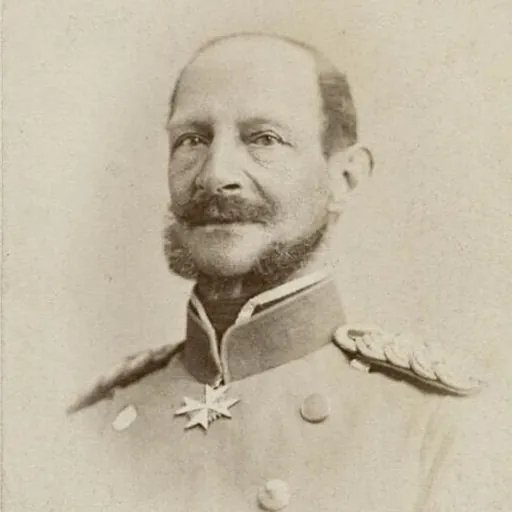
About Prince Albert of Prussia
Lived 1809 – 1872 (aged 63). Prince Albert of Prussia was a German military officer and politician.
Prince Frederick Henry Albert of Prussia (; 4 October 1809 – 14 October 1872) was the fifth son and youngest child of King Frederick William III of Prussia and Louise of Mecklenburg-Strelitz. His parents had fled to East Prussia after the occupation of Berlin by Napoleon, and Albert was born in Königsberg. Two of Albert's elder brothers were Frederick William IV, King of Prussia from 1840 till 1861, and William I, King of Prussia from 1861 to 1888 and German Emperor from 1871 until 1888.
Career
In 1819 he joined the Prussian Army as a lieutenant and held the rank of a general of cavalry in 1852. He took part in the 1866 Austro-Prussian War as a cavalry corps commander at the battles of Gitschin and Königgrätz. In the Franco-Prussian War of 1870/71 he led a cavalry division at the battles of Wissembourg, Wörth and Sedan. He later joined the forces of his nephews Prince Frederick Charles of Prussia and Frederick Francis II, Grand Duke of Mecklenburg-Schwerin in the campaign against the Armée de la Loire.
After the war Albert was awarded the title of a Generaloberst. He died in Berlin, where he is buried at the Charlottenburg Palace Park Mausoleum.
He was the 74th Grand Cross of the Order of the Tower and Sword.
Family In The Hague, on 14 September 1830 Albert married his first cousin Princess Marianne, daughter of King William I of the Netherlands. The marriage was dissolved on 28 March 1849. They had five children:
Charlotte (b. Schloss Schönhausen, near Berlin, 21 June 1831 - d. Meiningen, 30 March 1855), married on 18 May 1850 to the future Georg II, Duke of Saxe-Meiningen. A son (Prinz-Albrecht-Palais, Wilhelmstraße, near Berlin, 4 December 1832). He was either stillborn or lived only a few hours. Albert (b. Berlin, 8 May 1837 - d. Kamenz, 13 September 1906), married Princess Marie of Saxe-Altenburg, had 3 sons. Elisabeth (b. Kamenz, 27 August 1840 - d. Kamenz, 9 October 1840) died in infancy. Alexandrine (b. Berlin, 1 February 1842 - d. Schloss Marley, near Potsdam, 26 March 1906), married on 9 December 1865 to Duke William of Mecklenburg-Schwerin.
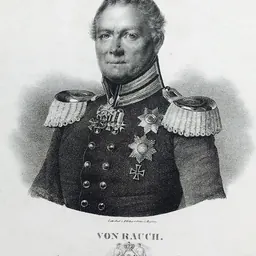
In Berlin on 13 June 1853, Albert married secondly Rosalie Wilhelmine Johanna von Rauch, daughter of Gustav von Rauch, chief of the Prussian General Staff 1812-1813 and Prussian Minister of War 1837–1841. She was created Countess of Hohenau on 28 May 1853. They had two sons:
Georg Albrecht Wilhelm, Count of Hohenau (b. Albrechtsberg Castle, 25 April 1854 - d. Bad Flinsburg, 28 October 1930). He married Princess Margarethe of Hohenlohe-Öhringen (1865-1940), daughter of Hugo zu Hohenlohe-Öhringen. Bernhard Wilhelm Albrecht Frederick, Count of Hohenau (b. Albrechtsberg Castle, 21 May 1857 - d. Ochelhermsdorf, 15 April 1914).
As this second union was considered a morganatic marriage, the couple temporarily had to avoid the Prussian court. Albert acquired a vineyard in Loschwitz near Dresden, Saxony, where he had a residence, Albrechtsberg Castle, erected in 1854.
Aftermath In 1830 Albert had acquired a city palace in Berlin on Wilhelmstraße, then called Prinz-Albrecht-Palais. An adjacent street off Wilhelmstraße laid out in 1891 was named Prinz-Albrecht-Straße. After the Nazi Machtergreifung it became notorious as the seat of the Gestapo and the Reichsführer-SS. The Prinz-Albrecht-Palais itself from 1934 served as the headquarters of the SS Sicherheitsdienst under Reinhard Heydrich, from 1939 the Reichssicherheitshauptamt. In 1944 the building was heavily damaged by air raids and finally razed to the ground in 1955, leaving the foundations and cellars exposed to the open air. They remain so today, and are used as part of the Topography of Terror project.
Honours German orders and decorations
Foreign orders and decorations Military Merit Cross, with War Decoration Grand Cordon of the Order of Leopold (military), 25 April 1867 French Empire: Grand Cross of the Legion of Honour, 1858 Kingdom of Greece: Grand Cross of the Redeemer Grand Cross of the Netherlands Lion Sword of Honour Grand Cross of the Tower and Sword Grand Cross of St. Ferdinand and Merit Knight of St. Andrew, 1826 Knight of St. Alexander Nevsky Knight of the White Eagle Knight of St. Anna, 1st Class Knight of St. Stanislaus, 1st Class Knight of St. George, 3rd Class, October 1870
Ancestry
Don’t just read it —
keep it.
Full-length biographies made to live with: read them, listen on the way to work, watch them tonight.
- E-book
- Audio
- Video
Instant download · yours to keep · every purchase keeps this site free
Important facts
more
Friedrich Heinrich Albrecht of Prussia, Prince Albrecht of Prussia, Albrecht of PrussiaFamily & relationships
People in Prince Albert of Prussia's life
Named in this biography and alive at the same time



Related people
Same field, nearest in time
Contemporaries
People whose lives overlapped Prince Albert of Prussia's





Frequently asked questions
Who was Prince Albert of Prussia?
Prussian colonel-general (1809-1872)
When was Prince Albert of Prussia born?
Prince Albert of Prussia was born on 4 October 1809 in Königsberg.
When did Prince Albert of Prussia die?
Prince Albert of Prussia died on 14 October 1872 in Berlin.
What was Prince Albert of Prussia's occupation?
Prince Albert of Prussia was a military officer and politician.
What nationality was Prince Albert of Prussia?
Prince Albert of Prussia was German.
Sources & further reading
· Wikipedia: Prince Albert of Prussia
· DBpedia: Prince Albert of Prussia (1809–1872)
Cite this page
APA: Biography.guide. (2026). Prince Albert of Prussia. https://biography.guide/prince-albert-of-prussia-military-officer/
MLA: "Prince Albert of Prussia." Biography.guide, https://biography.guide/prince-albert-of-prussia-military-officer/.
Chicago: "Prince Albert of Prussia." Biography.guide. https://biography.guide/prince-albert-of-prussia-military-officer/.
Data last updated: 2026-09-22 · Spot an error? Report a correction.
Portrait: Wikimedia Commons · author & licence
Page generated 2026-09-27 05:03 UTC