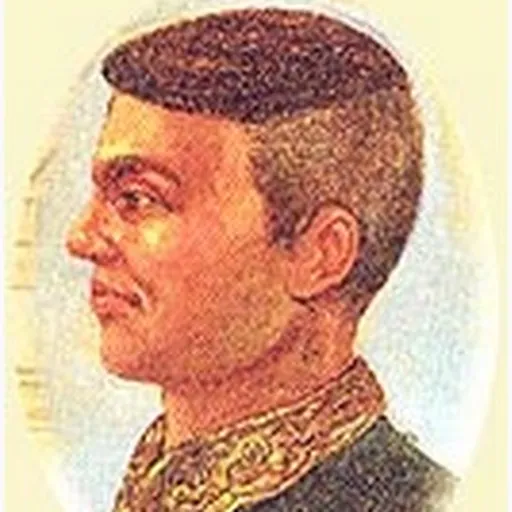
About Prasat Thong
Lived 1600 – 1655. Prasat Thong was a Thai sovereign, politician and military officer.
Prasat Thong (, ; c. 1599–1655; reigned 1629–1655) was the founder and first monarch of the Prasat Thong dynasty, the fourth ruling house of the Ayutthaya Kingdom. Formerly a high-ranking official known as Okya Kalahom , he rose to prominence during the reign of King Songtham by assisting in the suppression of a rebellion led by the king's son, Phra Sisin, in collaboration with the Japanese mercenary leader Yamada Nagamasa. Following a series of succession crises after Songtham's death, he seized power in 1629, briefly installing the infant Athittayawong as a puppet king before executing him and ascending the throne himself. His reign was marked by the reassertion of Siamese authority over Cambodia, though it also saw a weakening of Ayutthaya's control over its northern principalities.
Rise to power The rise of Prasat Thong to power was documented in van Vliet's The Historical Account of the war of Succession following the death of King Pra Interajatsia (1650). As the king's maternal cousin, he held great influence. It is said that he was an ambitious prince and wanted to become a king. King Songtham had had his brother Phra Phanpi Sisin or Phra Sisin (Siamese chronicles states that Phra Sisin was one of the King Songtham's three sons ) as the Front Palace, technically his successor, but a palace faction including Prasat Thong persuaded the king to give the throne instead to his son Prince Chetthathirat. Upon the death of King Songtham in 1628, Chetthathirat ascended the throne, followed by a major purge of court officials who had supported the rival claimant Phra Sisin. Among those executed was the incumbent Samuha Kalahom (Minister of Military Affairs). Prasat Thong was subsequently appointed to the vacancy, receiving the title of Okya Kalahom .
The king maker
During the reign of King Chetthathirat, Okya Kalahom Suriyawong maintained a strategic alliance with Yamada Nagamasa or Okya Senaphimuk, the influential leader of the Japanese mercenaries. Following Chetthathirat's ascension, the King's brother, Phra Sisin, sought refuge in the monkhood. According to the Royal Chronicles, he was later lured back to the palace, stripped of his monastic robes, and arrested. He was exiled to Phetchaburi to be executed by starvation in a deep well. However, he was reportedly saved by local monks who substituted a corpse in his place, allowing Phra Sisin to organize a short-lived rebellion. Okya Kalahom dispatched Yamada Nagamasa to suppress the uprising; Phra Sisin was eventually captured and executed in Ayutthaya. Rebellion of Okya Kalahom in 1629, painting made by an unknown Thai artist according to the royal decree of King Chulalongkorn in 1897. With his primary rival eliminated, Okya Kalahom's influence grew unchecked. In 1629, the death of his father became a pivotal political turning point. He organized a grand funeral with ceremonies and cremations normally reserved for royalty, a move seen by many as a direct challenge to the throne. When King Chetthathirat discovered that the majority of his nobles had attended the funeral instead of his royal audience, he was reportedly incensed and threatened punishment.
Guided by his ally, the Okya Phraklang (Minister of Trade), Okya Kalahom launched a preemptive strike, leading his private army into the palace. King Chetthathirat fled but was captured and subsequently executed. In his place, Okya Kalahom installed the King's seven-year-old (some sources say eleven) brother, Athittayawong, as a puppet ruler. Acting as regent, Okya Kalahom assumed near-absolute authority, effectively setting the stage for his own coronation shortly thereafter.
Coup and rebellion Prasat Thong strived to eliminate his allies-turned-rivals – the Okya Kamhaeng who contested for the throne and Yamada Nagamasa who objected to the takeover of the throne by Prasat Thong. He quickly condemned Okya Kamhaeng for treason and execution followed. And he sent Yamada Nagamasa to the south as the governor of Ligor, away from Ayutthaya. As soon as the Japanese mandarin left the city, only about a month after his ascension, the child-king was deposed and subsequently executed. Suriyawong or Okya Suriyawong crowned himself as the full-fledged King of Siam.
Prasat Thong had acted as "king-maker" before assuming the throne, by performing the double regicide of King Songtham's sons. Yamada, Okya Seniphimok, heard of the coup at Ayutthaya and rebelled. Prasat Thong had him poisoned and then expelled the remaining Japanese.
Reign and succession King Prasat Thong was a powerful and decisive leader who significantly centralized royal authority. He promulgated several important criminal and civil laws. According to the records of van Vliet, the King was known for his absolute and sometimes ruthless exercise of power, occasionally executing prisoners by himself to demonstrate his judicial supremacy.
Under his reign, Ayutthaya flourished as a major international trading center, attracting numerous European merchants, particularly from the Dutch East India Company (VOC). Prasat Thong sought to control the port towns in the southern peninsula to monopolize profits from overseas trade, leading to military expeditions against the Sultanate of Patani between 1632 and 1634. However, the kingdom saw a decline in its northern influence, losing control over principalities such as Chiang Mai to the Toungoo Dynasty of Burma. In 1630, he also suppressed the Japanese settlement in Ayutthaya and expelled Yamada Nagamasa.
Under Prasat Thong, Cambodia became subject to Siam again. He then built the capital city using Angkor Thom as a model and built "places of temporary rest on the way to the footprint of the Buddha."
Despite these social graces, van Vliet's records emphasize a legacy of betrayal and manipulation. Prasat Thong is described as deliberately orchestrating the rise and subsequent removal of King Songtham's two sons—King Chetthathirat and King Athittayawong—to legitimize his own ascension to the throne. Notably, van Vliet observed that Prasat Thong effectively used his eloquence to denounce King Chetthathirat's alleged cruelty and drunkenness before the council of nobles to win official and public sympathy. Furthermore, he employed elaborate ruses to eliminate his political rivals, such as falsely accusing Okya Kamhaeng of treason and deceiving the Japanese mercenary leader Yamada Nagamasa into leaving the capital for Nakhon Si Thammarat.
In modern Thai historiography, the political maneuvers of King Prasat Thong of Ayutthaya are often analyzed through a Machiavellian lens. His ascension and subsequent reign were characterized by the use of strategic deception, the consolidation of a new power base, and a pragmatic approach to governance centered primarily on the political survival of the sovereign.
Legacy
Prasat Thong built the monastery Chumphon Nikayaram where his mother resided and a rest palace, Bang Pa-In Royal Palace, at Bang Pa-In.
The Eulogy of King Prasat Thong is a remarkable, though lesser-known, example of the Thai tradition of royal panegyrics. Surviving only as a single samut thai (accordion book) fragment, the text records that the poem was originally composed during King Prasat Thong's reign by Phra Maharatchakhru Mahethon, a leading court Brahmin, with this surviving copy made later in 1737/8. Discovered and published for the first time in 1988, the poem offers a unique ideological perspective, stating that King Prasat Thong was a bodhisatta reincarnated from the Palelai elephant and destined to become the tenth future Buddha after Gautama—a claim completely absent from all other historical sources.
The text also chronicles the major milestones of his reign, including the construction and renaming of the Jakkawat Phaichaiyon audience hall, the changing of the calendar era at Chula Sakarat 1000, grand almsgivings, and military parades. Historians note that the poem's spiritual claims, alongside Prasat Thong's religious constructions, ritual practices, and the composition of the eulogy itself, served as crucial building blocks to legitimize a new form of royal absolutism.
Gallery
Don’t just read it —
keep it.
Full-length biographies made to live with: read them, listen on the way to work, watch them tonight.
- E-book
- Audio
- Video
Instant download · yours to keep · every purchase keeps this site free
Important facts
Family & relationships
People in Prasat Thong's life
Named in this biography and alive at the same time
Related people
Same field, nearest in time



Contemporaries
People whose lives overlapped Prasat Thong's




Frequently asked questions
Who was Prasat Thong?
King of Ayutthaya
When was Prasat Thong born?
Prasat Thong was born in 1600 in Phra Nakhon Si Ayutthaya.
When did Prasat Thong die?
Prasat Thong died on 8 August 1655 in Phra Ratchawang Boran.
What was Prasat Thong's occupation?
Prasat Thong was a sovereign, politician and military officer.
What nationality was Prasat Thong?
Prasat Thong was Thai.
Sources & further reading
Cite this page
APA: Biography.guide. (2026). Prasat Thong. https://biography.guide/prasat-thong/
MLA: "Prasat Thong." Biography.guide, https://biography.guide/prasat-thong/.
Chicago: "Prasat Thong." Biography.guide. https://biography.guide/prasat-thong/.
Data last updated: 2026-09-23 · Spot an error? Report a correction.
Portrait: Wikimedia Commons · author & licence
Page generated 2026-09-27 05:06 UTC