
About Polemon of Laodicea
Lived AD 90 – 144 (aged 53–54). Polemon of Laodicea was a philosopher, politician and sophist.
Marcus Antonius Polemon (; c. 90 – 144 AD) or Antonius Polemon, also known as Polemon of Smyrna or Polemon of Laodicea , was a sophist who lived in the 2nd century.
His son Attalus and great-grandson Hermocrates of Phocaea were also notable sophists.
Early life Polemon was Anatolian Greek from a family of Roman consular rank. He was the grandson of Polemon II of Pontus.
He was born in Laodicea on the Lycus in Phrygia (modern Turkey), however, he spent a great part of his life in Smyrna (modern İzmir, Turkey). From early manhood, he received civic honors from the citizens of Smyrna for his services to the city.
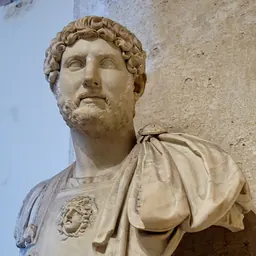
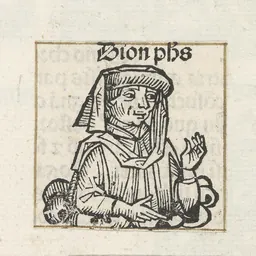
In Smyrna he was educated by Scopelianos of Klazomenai. He then attended the school of Timocrates of Heracleia for four years. After that he travelled to Bithynia to learn from the Sophist Dio Chrysostom. Hadrian not only admitted he ruled with Polemon's advice, but Polemon accompanied the emperor during his travels in Greece and Asia Minor. When his enemies accused Polemon of spending funds Hadrian had given him to benefit the city of Smyrna, the emperor defended the sophist with a letter declaring that Polemon had rendered Hadrian an account of the moneys entrusted to him. Polemon gave the dedicatory oration to Hadrian's Temple of Olympian Zeus in Athens, which G.W. Bowersock speculates was "an embarrassing repudiation of the obvious person for the occasion, Herodes Atticus.
Three times he headed a legation dispatched by Smyrna to the emperor. Under Hadrian he was made strategos, and subsequently appointed strategos for life. He was a priest of Dionysos and agonothetes of the athletic competitions that took place in Smyrna in honour of the emperor Hadrian. Owing to Polemon's rhetorical skills the emperor stopped favoring Ephesos and endowed Smyrna with 10 million drachmae, which financed the building of a new grain market, a gymnasium, and a temple.
Works Polemon's treatise on physiognomy is preserved in a 14th-century Arabic translation. The only fully surviving works of Polemon are his funeral orations for the Athenians generals Callimachus and Cynaegirus, who died at the Battle of Marathon in 490 BC. These orations are titled logoi epitaphioi (epitaphs). His rhetorical compositions were subjects that were taken from Athenian history.
Don’t just read it —
keep it.
Full-length biographies made to live with: read them, listen on the way to work, watch them tonight.
- E-book
- Audio
- Video
Instant download · yours to keep · every purchase keeps this site free
Important facts
People in Polemon of Laodicea's life
Named in this biography and alive at the same time

Related people
Same field, nearest in time



Contemporaries
People whose lives overlapped Polemon of Laodicea's

Frequently asked questions
Who was Polemon of Laodicea?
Greek sophist (c. 90 – 144)
When was Polemon of Laodicea born?
Polemon of Laodicea was born in AD 90 in Laodicea on the Lycus.
When did Polemon of Laodicea die?
Polemon of Laodicea died in 144 in Rome.
What was Polemon of Laodicea's occupation?
Polemon of Laodicea was a philosopher, politician and sophist.
Sources & further reading
· Wikipedia: Polemon of Laodicea
· DBpedia: Polemon of Laodicea
Cite this page
APA: Biography.guide. (2026). Polemon of Laodicea. https://biography.guide/polemon-of-laodicea/
MLA: "Polemon of Laodicea." Biography.guide, https://biography.guide/polemon-of-laodicea/.
Chicago: "Polemon of Laodicea." Biography.guide. https://biography.guide/polemon-of-laodicea/.
Data last updated: 2026-09-22 · Spot an error? Report a correction.
Page generated 2026-09-27 05:23 UTC