
About Pietro Nosadini
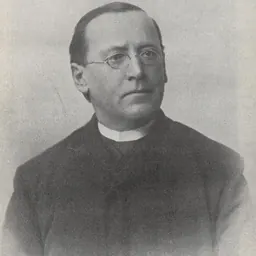
Lived 1862 – 1921 (aged 58). Pietro Nosadini was a catholic priest.
Pietro Antonio Maria Umberto Nosadini (Bassano del Grappa, August 15, 1862 – Padua, March 25, 1921) was an Italian Catholic priest and journalist.
He played a notable role in several parishes in Italy as a militant supporter of ultramontanism, founding many organizations. He spent a season in Brazil, in the early days of Italian immigration in Rio Grande do Sul, and is remembered for his short and tumultuous but remarkable period in Caxias do Sul, where he exercised a strong leadership in the Catholic community in one of the most troubled periods of the city's history, and for his pioneering work in the field of regional press. His role in the process of socio-political emancipation of the Italian settlers has also been noted, contributing, through the common bond of religion, to the union of dispersed and culturally conflicting groups, and to the creation of a collective identity where the settler was portrayed as a tireless, orderly, moral worker and promoter of progress and civilization.
Life
Early years
Pietro Nosadini came from an old family of Bassano del Grappa, which was added to the patriciate of Bassano in 1691 and to the patriciate of Venice in 1694. He was the first of the four children of Giuseppe Giovanni Battista Nosadini and Catterina Capellari and a devout Catholic even before his ordination. He became involved in the activities of the Italian Catholic Youth, and was secretary of the Circle of Bassano-Veneto in 1884. According to Costamilan, he was also secretary of his parish between 1884 and 1889, and "in spite of his young age, his gifts of unusual intelligence and his enterprising genius were evident, as is shown in the historical books that cover the evolution of Catholic action in Italy". His work was noted and cited several times by the Vicenza Olympic Academy, which led him to give a speech on the Peter's Pence during the Vicenza Regional Conclave on August 20, 1889.
Nosadini began his pastoral work by founding a series of committees in both urban and rural areas. These associations became known as Catholic Leagues and aimed to strengthen the influence of the Church in the region and to dissolve progressive currents, as well as to sustain the struggle for the return of the former Papal States to the Pope. According to Gustavo Valduga, Nosadini believed that all those who did not join the committees and refused them the sacraments were heretics, which led him to launch a campaign of civil disobedience against the determinations of the Public Power that went against the orthodox Catholic precepts. At the same time, he harshly criticized Campos' government and blamed Freemasonry for the state of tension and disorder that plagued the Italian colony, Indeed, in a context in which the immigrants came from different Italian regions, were heirs of old cultural, social and political rivalries, and even spoke dialects that were sometimes almost incomprehensible to each other, religion was a decisive factor in uniting everyone around common goals. In the words of Alves:Nosadini served as an intellectual of the rural type, identified by Gramsci as a member linked to the peasant and petty-bourgeois social mass of the cities, who puts the peasant mass in contact with the state or local administration, which gives him a great political and social function. [...] Father Nosadini played exactly the role attributed to the intellectual of the rural type, because the organization of the Italian settlers, in order to request the resolution of their problems, started from his action. [...] During his period in Caxias do Sul, the priest mobilized the settlers around the committees in such a way that, at the slightest sign of discontent, the Catholics promoted manifestations of displeasure, always criticizing the administration. The atmosphere quickly degenerated again into open conflict. The intendant gathered the main Catholic leaders and asked for their support for the definitive removal of the priest and to dissolve the Leagues as a measure of precaution, and on March 20 he telegraphed the State Government predicting tragedies:The Nosadini issue aggravates. Animosity rises. Insane work to calm down tempers. Sunday [13/03/1898] he preached truthfully, causing indignation. Last night [19/03/1898] he held a secret meeting at Sartori's house and declared he was waiting for the opportunity to depose me, because he thought it was dangerous for him to remain in the parish. Fanatical settlers advised by him are capable of trying. I will die defending the principle of authority.
Final years After being expelled from Caxias do Sul, Father Nosadini returned to Italy, being assigned to work in the Diocese of Concordia. There he met, in 1899, the Brazilian bishop Monsignor José de Camargo Barros, head of the Archdiocese of Curitiba, who was participating in the Latin American Council, to whom he asked for a parish in Paraná, obtaining his consent. On August 21, 1899, he was welcomed in Curitiba, being indicated to heal the souls of the colonies of Rondinha, Timbutuva, Rio Verde and Campina, in the region of Campo Largo, and Antônio Rebouças, with residence in Rondinha. However, at the end of 1900 he asked for a dispensation because of the small amount of work that was available there and the limited conditions that the small population had to maintain a priest. He left the colonies on March 16, 1901, and headed to Italy. and at the end of the year he was chaplain, making his mark by advocating the installation of an organ in the church. At the time it was reported about him:On that day [January 1, 1902] the chaplain Don Pietro Nosadini, a volcanic Basque priest recently returned from Brazil after an agitated experience, went up to the pulpit and gave a sermon that was to remain famous for years: 'Most beloved brothers! New year, new life! For us, new life means organization, because we have had enough of the old harmonium". The sermon aroused a sea of enthusiasm and an ocean of opposition: common sense people wanted the debts of the belfry to be paid first. But this was no argument, especially when we have Don Pietro, capable of setting up committees, launching appeals and gathering applause; common sense is not an argument, and in fact, after 18 months of struggles, projects and anxiety, the new organization is there, monumental and full of new debts. He then worked in various parishes in the Province of Vicenza, always founding new Catholic associations, and by the end of 1908 he was in Ceneda, where he became an oblate. He went on to serve the Diocese of Padua and once again made himself known for his tireless dedication, serving as secretary of the Fourth Group of the Catholic Movement, an association with outstanding activity in the region. and in the same year he organized the Youth Circle in the parish of Santa Maria Assunta in Saccolongo. The following year he is mentioned as the owner of an altar in the Church of the Most Holy Redeemer in Fellette and then appears as spiritual bursar of the parish in Selvazzano. He died on March 25, 1921, while working as a curate chaplain of the Minor Brothers of the Poor Old People in Padua, the day he celebrated the 25th anniversary of his priestly ordination.
Il Colono Italiano
The newspaper founded by the priest, Il Colono Italiano, Bollettino Cattolico Mensile, has been remembered by several historians for the role it played in the political and religious history of Caxias do Sul. Released on January 1, 1898, and printed in Porto Alegre, it featured his program in its first issue:Il Colono Italiano will be the friend, the counselor, the guide, the lawyer of the Italian Catholics immigrating to Caxias do Sul and the surrounding colonies. It will provide them with interesting news from dear and beautiful Italy. For this purpose it is pleased to announce that it has a distinguished correspondent in Rome and that it will find others in the main Italian cities. Il Colono Italiano will not be concerned with politics, since there is in the city O Caxiense - to which we send a fraternal greeting. Without being involved in politics, Il Colono Italiano will not cease to recommend to its readers obedience to the laws and to the authorities legitimately constituted. It will give an overview of the development of Catholic Societies, their festivals and actions, so that they may serve as an example of fervent encouragement to cowards and indifferent people. It will publish novels, stories and novels that are entertaining and honest. As Valduga stated, "the journal was born in the middle of regional disagreements and disputes, and no matter how much it wanted to distance itself from them, it was always involved in issues that concerned it". At the same time, the newspaper defended that work itself has edifying value, but the progress predicted for the colony could only occur under the guiding precepts of religion. It was evident that the newspaper's content, in that context, brought an explosive element. Due to the conflicts, it ceased circulation in August 1898. On Valduga's balance sheet,The first experience of the Catholic press in the colonial region had lasted only eight months and had succumbed to the political clashes between the clergy and the Freemasons. However, this newspaper had already given the basic guidelines on which the regional Catholic press was to be based, that is, the unconditional defense of the papacy, associating the immigrant identity with the figure of the orderly and hardworking Italian Catholic.
Don’t just read it —
keep it.
Full-length biographies made to live with: read them, listen on the way to work, watch them tonight.
- E-book
- Audio
- Video
Instant download · yours to keep · every purchase keeps this site free
Important facts
Related people
Same field, nearest in time

Contemporaries
People whose lives overlapped Pietro Nosadini's





Frequently asked questions
Who was Pietro Nosadini?
Italian Catholic priest and journalist
When was Pietro Nosadini born?
Pietro Nosadini was born on 15 August 1862 in Bassano del Grappa.
When did Pietro Nosadini die?
Pietro Nosadini died on 25 March 1921.
What was Pietro Nosadini's occupation?
Pietro Nosadini was a catholic priest.
Sources & further reading
Cite this page
APA: Biography.guide. (2026). Pietro Nosadini. https://biography.guide/pietro-nosadini/
MLA: "Pietro Nosadini." Biography.guide, https://biography.guide/pietro-nosadini/.
Chicago: "Pietro Nosadini." Biography.guide. https://biography.guide/pietro-nosadini/.
Data last updated: 2026-09-20 · Spot an error? Report a correction.
Page generated 2026-09-27 05:18 UTC