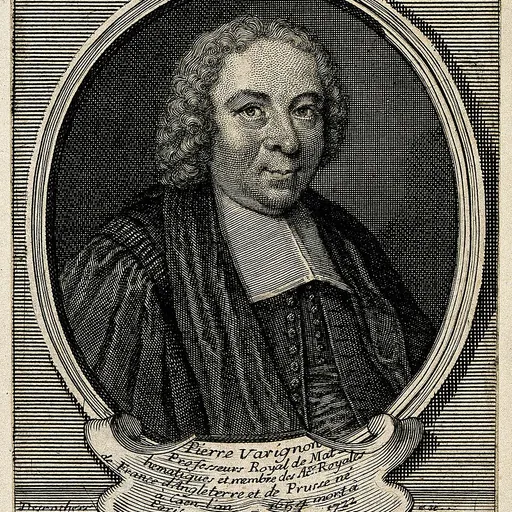
About Pierre Varignon
Lived 1654 – 1722 (aged 67–68). Pierre Varignon was a French mathematician, catholic priest, physicist, professor, scientist and university teacher, known for Convergent series, Infinitesimal calculus and Mechanical explanations of gravitation.
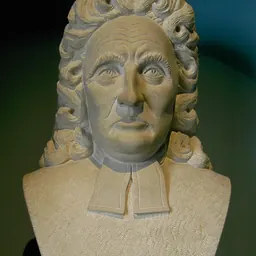
Pierre Varignon (; 1654 – 23 December 1722) was a French mathematician. He was educated at the Jesuit College and the University of Caen, where he received his M.A. in 1682. He took Holy Orders the following year.
Varignon gained his first exposure to mathematics by reading Euclid and then René Descartes' La Géométrie. He became professor of mathematics at the Collège Mazarin in Paris in 1688 and was elected to the Académie Royale des Sciences in the same year. In 1704, he held the departmental chair at Collège Mazarin and also became professor of mathematics at the Collège Royal. He was elected to the Berlin Academy in 1713 and to the Royal Society in 1718. Many of his works were published in Paris in 1725, three years after his death. His lectures at Mazarin were published in Elements de mathematique in 1731.
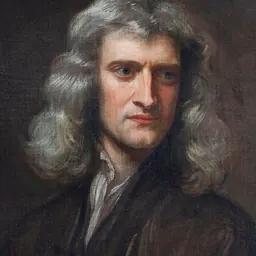
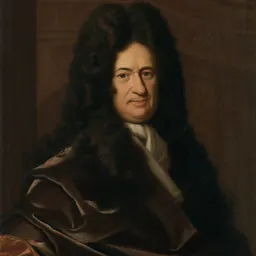
Varignon was a friend of Isaac Newton, Gottfried Wilhelm Leibniz, and the Bernoulli family. Varignon's principal contributions were to graphic statics and mechanics. Except for Guillaume de l'Hôpital, Varignon was the earliest and strongest French advocate of infinitesimal calculus, and exposed the errors in Michel Rolle's critique thereof. He recognized the importance of a test for the convergence of series, but analytical difficulties prevented his success. Nevertheless, he simplified the proofs of many propositions in mechanics, adapted Leibniz's calculus to the inertial mechanics of Newton's Principia, and treated mechanics in terms of the composition of forces in Projet d'une nouvelle mécanique in 1687. Among Varignon's other works was a 1699 publication concerning the application of differential calculus to fluid flow and to water clocks. In 1690, he created a mechanical explanation of gravitation. In 1702, he applied calculus to spring-driven clocks. In 1704, he invented the U-tube manometer, a device capable of measuring rarefaction in gases.
Works
Don’t just read it —
keep it.
Full-length biographies made to live with: read them, listen on the way to work, watch them tonight.
- E-book
- Audio
- Video
Instant download · yours to keep · every purchase keeps this site free
Important facts
more
Water clockPeople in Pierre Varignon's life
Named in this biography and alive at the same time
Related people
Same field, nearest in time

Contemporaries
People whose lives overlapped Pierre Varignon's





Frequently asked questions
Who was Pierre Varignon?
French mathematician
When was Pierre Varignon born?
Pierre Varignon was born in 1654 in Caen.
When did Pierre Varignon die?
Pierre Varignon died on 23 December 1722 in Paris.
What was Pierre Varignon's occupation?
Pierre Varignon was a mathematician, catholic priest, physicist, professor, scientist and university teacher.
What was Pierre Varignon known for?
Pierre Varignon was known for Convergent series, Infinitesimal calculus, Mechanical explanations of gravitation, Mechanics, Statics and Varignon's theorem.
What nationality was Pierre Varignon?
Pierre Varignon was French.
Sources & further reading
Cite this page
APA: Biography.guide. (2026). Pierre Varignon. https://biography.guide/pierre-varignon/
MLA: "Pierre Varignon." Biography.guide, https://biography.guide/pierre-varignon/.
Chicago: "Pierre Varignon." Biography.guide. https://biography.guide/pierre-varignon/.
Data last updated: 2026-09-20 · Spot an error? Report a correction.
Page generated 2026-09-27 05:10 UTC