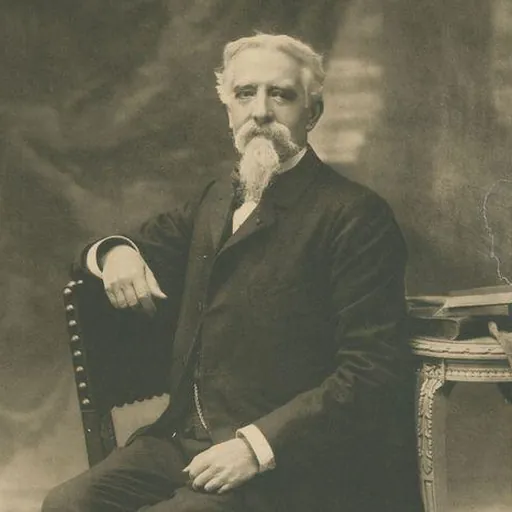
Philippe Édouard Léon Van Tieghem
French botanist and biologist
About Philippe Édouard Léon Van Tieghem
Lived 1839 – 1914 (aged 75). Philippe Édouard Léon Van Tieghem was a French botanist, physicist, university teacher and mycologist.
Philippe Édouard Léon Van Tieghem (; 19 April 1839 – 28 April 1914) was a French botanist born in Baillleul in the département of Nord. He was one of the best known French botanists of the latter nineteenth century.
Life Van Tieghem's father was a textile merchant who died of yellow fever in Martinique before he was born, and his mother shortly thereafter. One of five children, he obtained his baccalauréat in 1856, and continued his studies at the École Normale Supérieure, where after receiving agrégation, he worked in the laboratory of Louis Pasteur (1822–1895). Here he performed research involving the cultivation of mushrooms. He is credited with creation of the eponymous "Van Tieghem cell", a device mounted on a microscope slide that allows for observing the development of a fungus' mycelium.
In 1864 he earned his doctorate in physical sciences with a thesis titled Recherches sur la fermentation de l'urée et de l'acide hippurique, and two years later obtained a doctorate in natural history. From 1873 to 1886, he taught classes at the École centrale des arts et manufactures, and from 1878 to 1914, was a professor at the Muséum national d'histoire naturelle. Within this time period (1899–1914), he was also an instructor at the Institut agronomique in Paris. Van Tieghem became a member of the Société philomathique de Paris in 1871. In 1874 he translated the third edition of Julius von Sachs' Lehrbuch der Botanik textbook (1873) from German into French as Traité de botanique conforme à l'état présent de la science. Van Tieghem's own Traité de botanique appeared in 1884, in which he outlined his schema for taxonomic classification. He was the first, in 1876, to describe blastomycosis, a fungal infection that is also known as "Gilchrist disease", named after Thomas Casper Gilchrist (1862–1927), who published a treatise on the condition in 1896. He gained membership to the Académie des sciences, also in 1876. Van Tieghem wrote extensively on the mistletoe family of Loranthaceae, with much of his taxonomic work surviving to the present day. In 1890, botanist Pierre published Tieghemella a genus in the family Sapotaceae. Then in 1959, R.K.Benj. published a genus of fungi as Tieghemiomyces (in the family Dimargaritaceae).
In 1909 he was named a Commandeur of the Légion d'honneur in recognition of his contributions to botany.
Selected publications Recherches comparatives sur l'origine des membres endogènes dans les plantes vasculaires, 1889 - Comparative research on the origin of endogenous members of vascular plants. Eléments de botanique, 1886 2nd. ed. 1891, 2 vols., 3rd. ed. 1898, 4 vols. 5th ed. 1918 (Elements of botany) Traité de botanique 1884, 2nd ed. 1891 L'Oeuf des Plantes considéré comme base de leur Classification, 1901. Nouvelles observations sur les Ochnacées, 1903 - New observations on Ochnaceae. Sur les Luxembourgiacées, 1904 - On Luxemburgiaceae. Travaux divers: Pistil et fruit des Labiées, Boragacées et des familles voisines: Divers modes de Placentation: Anthères hétérogènes. : Une graminée à rhizome schizostélique: A propos de la Strasburgérie, 1907 - Diverse works, Pistil and fruit of Labiatae, Boraginaceae, etc.
System Van Tieghem's primary grouping was into embranchements (branches), followed by sous-embranchement (sub-branches), classes, orders, families, genera, species and varieties.
His four branches (1st edition) were, as follows, with the Phanerogames divided into two sub-branches. The angiosperms contain two classes, Monocotyledonés and Dicotyledonés; Thallophytes Muscinées (mosses) Cryptogames vasculaires Phanerogames Gymnospermes Angiospermes Monocotyledonés Dicotyledonés
He further divided the Monocotyledonés into four orders (ordres), based just on the presence or absence of a perianth and the position of the ovary, which in turn were divided into families (familles); Monocotyledonés, Corolle nulle ovaire supère: Graminidées Corolle sépaloïde ovaire supère: Joncinées Corolle pétaloïde ovaire supère: Liliinées Corolle pétaloïde ovaire infère: Iridinées
The Liliinées order contained five families; Alismacées Commelinacées Xyridacées Pontederiacées Liliacées
Don’t just read it —
keep it.
Full-length biographies made to live with: read them, listen on the way to work, watch them tonight.
- E-book
- Audio
- Video
Instant download · yours to keep · every purchase keeps this site free
Important facts
People in Philippe Édouard Léon Van Tieghem's life
Named in this biography and alive at the same time

Related people
Same field, nearest in time



Contemporaries
People whose lives overlapped Philippe Édouard Léon Van Tieghem's

Frequently asked questions
Who was Philippe Édouard Léon Van Tieghem?
French botanist and biologist (1839–1914)
When was Philippe Édouard Léon Van Tieghem born?
Philippe Édouard Léon Van Tieghem was born on 19 April 1839 in Bailleul.
When did Philippe Édouard Léon Van Tieghem die?
Philippe Édouard Léon Van Tieghem died on 28 April 1914 in Paris.
What was Philippe Édouard Léon Van Tieghem's occupation?
Philippe Édouard Léon Van Tieghem was a botanist, physicist, university teacher and mycologist.
What nationality was Philippe Édouard Léon Van Tieghem?
Philippe Édouard Léon Van Tieghem was French.
Sources & further reading
· Wikipedia: Philippe Édouard Léon Van Tieghem
· DBpedia: Philippe Édouard Léon Van Tieghem
Cite this page
APA: Biography.guide. (2026). Philippe Édouard Léon Van Tieghem. https://biography.guide/philippe-edouard-leon-van-tieghem/
MLA: "Philippe Édouard Léon Van Tieghem." Biography.guide, https://biography.guide/philippe-edouard-leon-van-tieghem/.
Chicago: "Philippe Édouard Léon Van Tieghem." Biography.guide. https://biography.guide/philippe-edouard-leon-van-tieghem/.
Data last updated: 2026-09-22 · Spot an error? Report a correction.
Portrait: Wikimedia Commons · author & licence
Page generated 2026-09-27 05:04 UTC