
About Philippe Berger
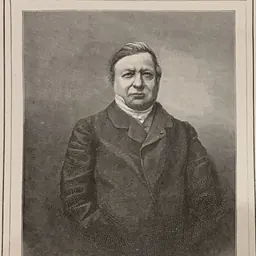
Lived 1846 – 1912 (aged 65). Philippe Berger was a French politician, professor, philologist, university teacher and theologian.
Philippe Berger, born on September 15, 1846, in Beaucourt (Haut-Rhin, currently in the Territoire de Belfort) and died on March 24, 1912, in Paris, was a French orientalist, professor and politician. He was a senator from 1904 to 1912.
Biography
Education Philippe Berger grew up in Paris, where he attended the Lycée Saint-Louis and the Lycée Louis-le-Grand. In 1867, he entered the Faculté de théologie protestante de Strasbourg, met Ernest Renan and began learning Hebrew.
Engaged in the health service of the Loire Army during the Franco-Prussian War of 1870, he was awarded the military medal for his conduct during the siege of Paris.
Academia In 1873, he supported a thesis of theology at the Faculty of Montauban, entitled Études des documents nouveaux fournis sur les Ophites par les «Philosophouména» (Studies of new documents provided on the Ophites by the "Philosophouména"), which caught Renan's attention. Thanks to him, he was appointed chief librarian of the Institut de France (1874). Becoming Renan's secretary, he worked with him on the publication of the Corpus inscriptionum semiticarum (in particular on articles dealing with Phoenicia) and was appointed professor of Hebrew at the Faculté de théologie protestante de Paris in 1877.
In 1892, Berger joined the Académie des inscriptions et belles-lettres in place of Ernest Renan. The following year, he succeeded his master at the Collège de France, where he held the chair of Hebrew until 1910.
Politics Philippe Berger entered politics in 1895, when he was elected general councillor of the canton of Giromagny (Territory of Belfort). Becoming President of the General Council, he won the by- Senate election of the Territory of Belfort in 1904, succeeding Frédéric Japy. He was re-elected without opposition in 1909.
In the Senate, Philippe Berger sat with the democratic left group and participated in several commissions. He died in office.
Family Coming from a family from Switzerland, settled in Montbéliard since 1660, he was the 3rd son of Eugène Berger, a Protestant pastor, and Louise Caroline Mathilde Pitois (sister of Éléonore, wife of Oscar Berger-Levrault). He had four brothers and a sister:
Samuel Berger (1843-1901), pastor Paul Berger (1845-1908), surgeon Théodore Berger (1848-1900), banker Élie Berger (1850-1925), archivist-paleographer Marie Berger (1858-1915), married to Edmond Berger-Levrault (son of Oscar Berger-Levrault)
Don’t just read it —
keep it.
Full-length biographies made to live with: read them, listen on the way to work, watch them tonight.
- E-book
- Audio
- Video
Instant download · yours to keep · every purchase keeps this site free
Important facts
People in Philippe Berger's life
Named in this biography and alive at the same time



Related people
Same field, nearest in time




Contemporaries
People whose lives overlapped Philippe Berger's



Frequently asked questions
Who was Philippe Berger?
French politician and professor (1846–1912)
When was Philippe Berger born?
Philippe Berger was born on 15 September 1846 in Beaucourt.
When did Philippe Berger die?
Philippe Berger died on 24 March 1912 in 5th arrondissement of Paris.
What was Philippe Berger's occupation?
Philippe Berger was a politician, professor, philologist, university teacher and theologian.
What nationality was Philippe Berger?
Philippe Berger was French.
Sources & further reading
Cite this page
APA: Biography.guide. (2026). Philippe Berger. https://biography.guide/philippe-berger/
MLA: "Philippe Berger." Biography.guide, https://biography.guide/philippe-berger/.
Chicago: "Philippe Berger." Biography.guide. https://biography.guide/philippe-berger/.
Data last updated: 2026-09-20 · Spot an error? Report a correction.
Page generated 2026-09-27 05:28 UTC