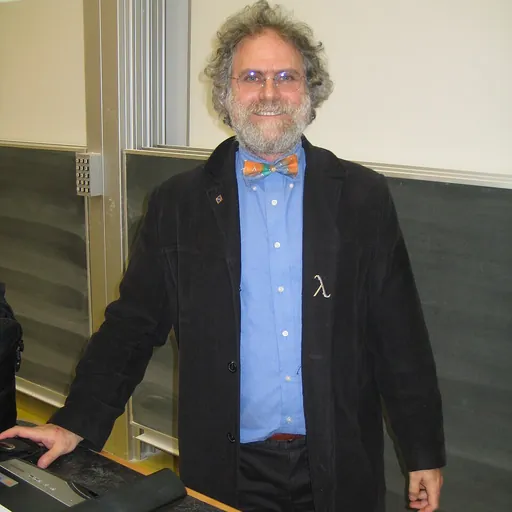
About Philip Wadler
Born 1956. Philip Wadler is a British and American computer scientist, engineer and university teacher.
Philip Lee Wadler (born April 8, 1956) is a UK-based American computer scientist known for his contributions to programming language design and type theory. He holds the position of Personal Chair of theoretical computer science at the Laboratory for Foundations of Computer Science at the School of Informatics, University of Edinburgh. He has contributed to the theory behind functional programming and the use of monads; and the designs of the purely functional language Haskell and the XQuery declarative query language. In 1984, he created the Orwell language. Wadler was involved in adding generic types to Java 5.0. He is also author of "Theorems for free!", a paper that gave rise to much research on functional language optimization (see also Parametricity).
Education Wadler received a Bachelor of Science degree in mathematics from Stanford University in 1977, and a Master of Science degree in computer science from Carnegie Mellon University in 1979. He completed his Doctor of Philosophy in computer science at Carnegie Mellon University in 1984. His thesis was entitled "Listlessness is better than laziness" and was supervised by Nico Habermann.
Research and career Wadler's research interests are in programming languages.
Wadler was a research fellow at the Programming Research Group (part of the Oxford University Computing Laboratory) and St Cross College, Oxford during 1983–87.
Wadler was editor of the Journal of Functional Programming from 1990 to 2004.
Since 2003, Wadler has been a professor of theoretical computer science at the Laboratory for Foundations of Computer Science at the University of Edinburgh and is the chair of theoretical computer science. In 2006, he was working on a new functional language for writing web applications, called Links. He has supervised many doctoral students to completion. He is also a member of the university's Blockchain Technology Laboratory. Wadler has a h-index of 72 with 26,864 citations at Google Scholar.
Since 2018 Wadler has also been a senior research fellow and area leader for programming languages at IOHK (now Input Output Global), the blockchain engineering company developing Cardano. He has contributed to work on Plutus, a Turing-complete smart contract language for Cardano written in Haskell; the UTXO ledger system, native tokens, and System F in Agda.
Awards and honours In 2003, Wadler was given the award for the most influential paper from ten years earlier by the Symposium on Principles of Programming Languages. The award cited "Imperative functional programming", a paper written jointly with Simon Peyton Jones in 1993. In 2005, he was elected Fellow of the Royal Society of Edinburgh (FRSE). In 2007, he was inducted as a fellow by the Association for Computing Machinery. He was elected Fellow of the Royal Society (FRS) in 2023.
Don’t just read it —
keep it.
Full-length biographies made to live with: read them, listen on the way to work, watch them tonight.
- E-book
- Audio
- Video
Instant download · yours to keep · every purchase keeps this site free
Important facts
People in Philip Wadler's life
Named in this biography and alive at the same time




Related people
Same field, nearest in time





Contemporaries
People whose lives overlapped Philip Wadler's


Frequently asked questions
Who is Philip Wadler?
American computer scientist
When was Philip Wadler born?
Philip Wadler was born on 8 April 1956 in United States.
What is Philip Wadler's occupation?
Philip Wadler is a computer scientist, engineer and university teacher.
What nationality is Philip Wadler?
Philip Wadler is British and American.
Sources & further reading
Cite this page
APA: Biography.guide. (2026). Philip Wadler. https://biography.guide/philip-wadler/
MLA: "Philip Wadler." Biography.guide, https://biography.guide/philip-wadler/.
Chicago: "Philip Wadler." Biography.guide. https://biography.guide/philip-wadler/.
Data last updated: 2026-09-23 · Spot an error? Report a correction.
Portrait: Wikimedia Commons · author & licence
Page generated 2026-09-27 05:07 UTC