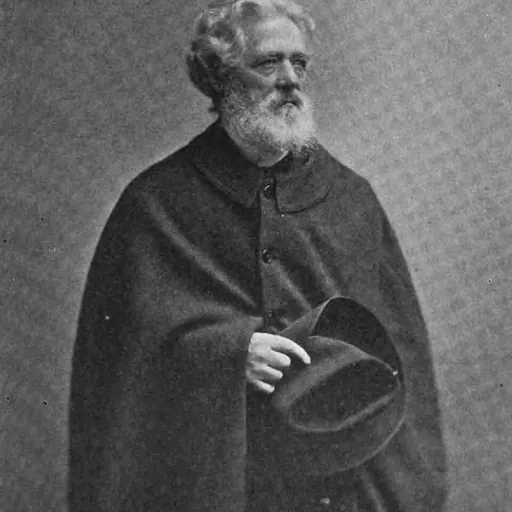
About Philip James Bailey
Lived 1816 – 1902 (aged 86). Philip James Bailey was a British poet, writer and barrister.
Philip James Bailey (22 April 1816 – 6 September 1902) was an English poet, best known as the author of Festus.
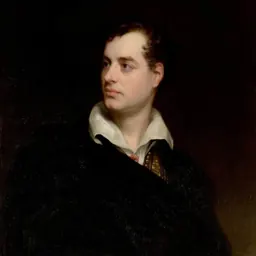
Life Bailey was born on 22 April 1816, in Nottingham, the only son of Thomas Bailey by his first wife, Mary Taylor. He was brought up on the poetry of Lord Byron. Educated in Nottingham, he was tutored in classics by Benjamin Carpenter, a Unitarian minister. At the age of 15, he matriculated at the University of Glasgow. Dropping the idea of becoming a Presbyterian minister, he began in 1833 to study law in a solicitor's office in London. On 26 April 1834, he entered Lincoln's Inn, and was called to the bar on 7 May 1840, but never practised law.
In 1836, Bailey retired to his father's house at Old Basford, near Nottingham, to write. In 1856, he received a civil list pension in recognition of his literary work. In 1864, he moved to Jersey, and travelled. In 1876, he returned to England, settling first at Lee near Ilfracombe, and in 1885 at Blackheath. Finally he retired to Nottingham.
Bailey died of influenza on 6 September 1902. He was buried in Nottingham Rock (aka Church) Cemetery after a service at St Andrew's Church, Nottingham.
Works Bailey is known almost exclusively by his one voluminous poem, Festus, first published anonymously in 1839, and then expanded with a second edition in 1845. A vast pageant of theology and philosophy, it comprised in some twelve divisions an attempt to represent the relation of God to man, and to postulate "a gospel of faith and reason combined."
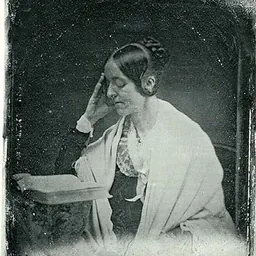
Among the admirers of Festus was Tennyson. Henry Wadsworth Longfellow imitated it in The Golden Legend (1851). Bailey himself described his approach with the neologism "omnist". Margaret Fuller was an enthusiast for the work, if with critical reservations.
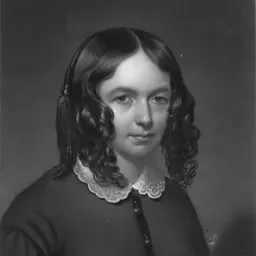
The subsequent poems of Bailey, The Angel World (1850), The Mystic (1855), The Age (1858), and The Universal Hymn (1867), were failures. The author then incorporated large extracts of these into the later editions of Festus, which ultimately extended to over 40,000 lines when the final edition was published in 1889. At one time his work was immensely popular, admired for its 'fire of imagination' (Elizabeth Barrett Browning), but, like the other works of the Spasmodic school of which Bailey was considered the father, it is now little read.
In 2021, Edinburgh University Press published a critical edition of Festus, edited by Mischa Willett.
Don’t just read it —
keep it.
Full-length biographies made to live with: read them, listen on the way to work, watch them tonight.
- E-book
- Audio
- Video
Instant download · yours to keep · every purchase keeps this site free
Important facts
People in Philip James Bailey's life
Named in this biography and alive at the same time




Related people
Same field, nearest in time

Contemporaries
People whose lives overlapped Philip James Bailey's



Frequently asked questions
Who was Philip James Bailey?
British writer and poet (1816–1902)
When was Philip James Bailey born?
Philip James Bailey was born on 22 April 1816 in Nottingham.
When did Philip James Bailey die?
Philip James Bailey died on 6 September 1902 in Nottingham.
What was Philip James Bailey's occupation?
Philip James Bailey was a poet, writer and barrister.
What nationality was Philip James Bailey?
Philip James Bailey was British.
Sources & further reading
· Wikipedia: Philip James Bailey
· DBpedia: Philip James Bailey
Cite this page
APA: Biography.guide. (2026). Philip James Bailey. https://biography.guide/philip-james-bailey/
MLA: "Philip James Bailey." Biography.guide, https://biography.guide/philip-james-bailey/.
Chicago: "Philip James Bailey." Biography.guide. https://biography.guide/philip-james-bailey/.
Data last updated: 2026-09-22 · Spot an error? Report a correction.
Page generated 2026-09-27 05:09 UTC