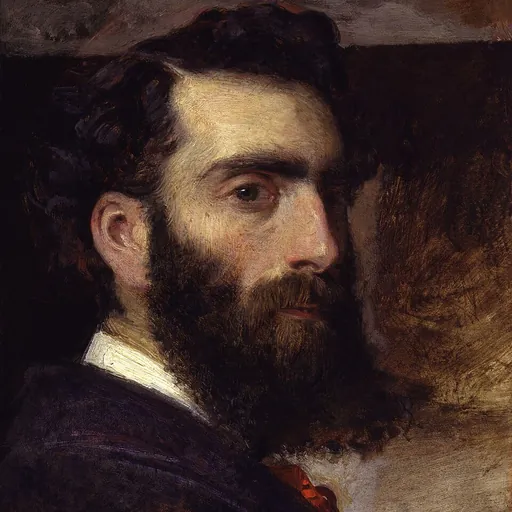
About Philip Hermogenes Calderon
Lived 1833 – 1898 (aged 64). Philip Hermogenes Calderon was a British painter.
Philip Hermogenes Calderon (3 May 1833 – 30 April 1898) was a British painter of Spanish-French ancestry, who initially worked in the Pre-Raphaelite style before moving towards historical genre painting. He was Keeper of the Royal Academy in London.
Life
Calderon by J. P. Mayall from Artists at Home, published 1884, Department of Image Collections, National Gallery of Art Library, Washington, DC
Calderon was born in Poitiers, France. His father, the Reverend Juan Calderón ( in Villafranca de los Caballeros – in London) was a professor of Spanish literature and a former Roman Catholic priest who had converted to Anglicanism. Calderon planned to study engineering, but he became so interested in drawing technical figures and diagrams that he changed his mind and devoted his time to art. In 1850, he trained at Leigh's art school, London, then went to Paris to study under François-Édouard Picot in 1851. His first successful painting was called By the waters of Babylon (1852), which was followed by a much more popular one called Broken Vows (1856). From the beginning he was inspired by the Pre-Raphaelites, and some of his work showed the detail, deep colors, and realistic forms that characterize the style. The artist Henry Stacy Marks was his friend and brother-in-law, and Calderon exhibited his portrait at the Royal Academy in 1872.
Calderon became a leading member of the St John's Wood Clique, a group of artists interested in modern genre and historical subjects who were inspired, both artistically and socially by the Pre-Raphaelites. Historical, biblical, and literary themes were common in Calderon's later work. Many of his pieces show women wearing rich, silky clothing in gently colored landscapes. His Morning (1884) features a copper-haired maiden watching a sunrise.
His Juliet (1888) shows Shakespeare's Juliet seated on her balcony gazing at the stars. His later paintings adopt a more classical style, comparable to Edward Poynter, which resulted from his close relationship with Frederic Leighton, then-President of the Royal Academy. Calderon became Keeper of the Royal Academy in 1887, and from then on worked to support the teaching of anatomy based on nude models at the Royal Academy Schools. His 1891 painting Saint Elizabeth of Hungary's Great Act of Renunciation was secured by the Chantrey bequest for the national collection, and is now located in Tate Britain, but caused considerable controversy because of its perceived anti-Catholic message. It depicted the saint bending nude over an altar watched by monks.
Works By the waters of Babylon (1852; Tate, London) 'Lord, Thy Will Be Done' (1855; Yale Center for British Art, New Haven) Broken vows ('More hearts are breaking in this world of ours, than one would say — Longfellow) (1856; Tate, London) French peasants finding their stolen child (1859; Private collection) The massacre of St. Bartholomew (1863; Private collection) Margaret (1876; Manchester Art Gallery) Morning (1884) Juliet (1888) St. Elizabeth of Hungary's great act of renunciation (1891; Tate, London)
Gallery
Don’t just read it —
keep it.
Full-length biographies made to live with: read them, listen on the way to work, watch them tonight.
- E-book
- Audio
- Video
Instant download · yours to keep · every purchase keeps this site free
Important facts
Family & relationships
People in Philip Hermogenes Calderon's life
Named in this biography and alive at the same time

Related people
Same field, nearest in time

Contemporaries
People whose lives overlapped Philip Hermogenes Calderon's




Frequently asked questions
Who was Philip Hermogenes Calderon?
British artist (1833-1898)
When was Philip Hermogenes Calderon born?
Philip Hermogenes Calderon was born on 3 May 1833 in Poitiers.
When did Philip Hermogenes Calderon die?
Philip Hermogenes Calderon died on 30 April 1898 in London.
What was Philip Hermogenes Calderon's occupation?
Philip Hermogenes Calderon was a painter.
What nationality was Philip Hermogenes Calderon?
Philip Hermogenes Calderon was British.
Sources & further reading
· Wikipedia: Philip Hermogenes Calderon
· DBpedia: Philip Hermogenes Calderon
Cite this page
APA: Biography.guide. (2026). Philip Hermogenes Calderon. https://biography.guide/philip-hermogenes-calderon/
MLA: "Philip Hermogenes Calderon." Biography.guide, https://biography.guide/philip-hermogenes-calderon/.
Chicago: "Philip Hermogenes Calderon." Biography.guide. https://biography.guide/philip-hermogenes-calderon/.
Data last updated: 2026-09-23 · Spot an error? Report a correction.
Portrait: Wikimedia Commons · author & licence
Page generated 2026-09-27 05:07 UTC