
About Philibert Commerson
Lived 1727 – 1773 (aged 45). Philibert Commerson was a French explorer, botanist, entomologist, physician, ichthyologist and botanical collector.
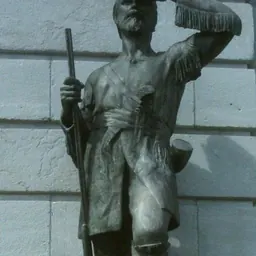
Philibert Commerson (; 18 November 1727 – 14 March 1773), sometimes spelled Commerçon by contemporaries, was a French naturalist, best known for accompanying Louis Antoine de Bougainville on his voyage of circumnavigation in 1766–1769.
Biography
Commerson was born at Châtillon-les-Dombes in France. He studied in Montpellier, and for a time was a practicing physician. He was in contact with Carl Linnaeus, who encouraged him to study fish of the Mediterranean.
Commerson also studied and collected plants wherever the expedition stopped; among others, he described the genus Bougainvillea. Pastel ringwrasse, Hologymnosus doliatus was originally formally described as Labrus doliatus in 1801 by Bernard Germain de Lacépède in Volume 5 of his Histoire naturelle des poissons based on a drawing by Commerson. In 1801 Lacépède created the genus Hologymnosus and designated a species, Hologymnosus fasciatus, he had just described as its type species, this was later shown to be a synonym of H. doliatus. Commerson provided the first description of the Ring-tailed cardinalfish (Ostorhinchus aureus) from Réunion in the western Indian Ocean, but it was not published in a format allowing full citation. Therefore, the species name and description by Bernard Germain de Lacépède (who acknowledged Commerson) takes precedence, albeit with a nod to Commerson. Gomphosus caeruleus was formally described in 1801 by Bernard Germain de Lacépède in the third volume of his Histoire naturelle des poissons from types collected by Commerson. No type locality was given, but now it is known to be Mauritius.
Rufous hornero drawn by François-Nicolas Martinet sometime before 1780 for the book Histoire Naturelle. The first notes taken on Rufous hornero Furnarius rufus were made by Commerson in 1767, from a specimen obtained at Barragán cove during Louis Antoine de Bougainville's expedition. Commerson named the bird as Turdus fulvus and his notes were later published by Georges Buffon in his Histoire Naturelle in 1779. However, the rufous hornero was first scientifically described, as Merops rufus, by the German naturalist Johann Friedrich Gmelin in the 13th edition of Systema Naturae published in 1788. Scatophagus tetracanthus was first formally described Chaetodon tetracanthus as in 1802 by the French naturalist Bernard Germain de Lacépède with no type locality given, Lacépède's description was based on a drawing and manuscript by Commerson. The specific name is a compound of tetra meaning "four" and acanthus which means "spines", a reference to the four anal fin spines. Hologymnosus annulatus was formally described in 1801 as Labrus annulatus by Bernard Germain de Lacépède in Volume 3 of his Histoire naturelle des poissons with the type locality given as Mauritius. Lacépède was following earlier work by Commerson. Trachinotus baillonii was formally described in 1801 by the French naturalist Bernard Germain de Lacépède (1726-1825) as Caesiomorus bailloni, the name having been written in a manuscript by Commerson, but was not formally published. The identity of the person nonoured in the specific name is not clear but is either the French naturalist Louis Antoine François Baillon (1778-1851), or his father Jean François Emmanuel Baillon (1742-1801), who was also a naturalist. Artocarpus heterophyllus was named by Jean-Baptiste Lamarck
Death Commerson died at Mauritius at the age of 45. His extensive collections from the voyage did not, unfortunately, receive their deserved recognition. Although his numerous manuscripts and herbaria were brought to Paris after his death they were never systematically organized and evaluated.
In 1801, Pomadasys commersonnii was first formally described as Labrus commersonnii by Lacépède with the type locality given as Grand golfe de l'Inde, interpreted as rivers of Madagascar. The specific name honors Commerçon, whose name is sometimes spelled Commerson, Lacepède used Commerçon's drawings and notes to base his description on. The specific name argenteus means "silver" and refers to the main colour of this species.
Also in 1801, Scomberoides commersonnianus was formally described by the French zoologist Bernard Germain de Lacépède with the type locality given as Fort Dauphin in the Toliara Province of Madagascar. The specific name uses the Latin suffix ianus meaning "belonging to" and adds this to the surname of Commerçon, this also being spelled as Commerson, whose notes and illustration were used by Lacépède as the base for his description of the species.
In 1803, Lacépède named a species of North American freshwater fish Catostomus commersonii in his honour.
Also in 1803, Lacépède named a species of anchovy Stolephorus commersonnii after Commerson.
In 1804, The dolphin Commerson's dolphin (Cephalorhynchus commersonii) is named by Lacépède after the French naturalist Commerson, who first described them in 1767 after sighting them in the Strait of Magellan. which is a species of bat endemic to Madagascar. It is named after French naturalist Philibert Commerson (1727-1773).
In 1836, Achille Valenciennes named Hypostomus commersoni which is a species of catfish in the family Loricariidae. It is native to South America, where it occurs in the Paraná River drainage, including the Iguazu River, the Paraguay River, the Río de la Plata, and the Dulce River. It is typically found in rivers with muddy substrates and moderate currents.
In 1838, Eduard Rüppell named the Bluespotted Cornetfish (Fistularia commersonii), also known as Smooth Cornetfish or Smooth Flutemouth, which is a marine fish which belongs to the family Fistulariidae after Commerson. This very long and slender reef-dweller belongs to the same order as the pipefishes and seahorses, called Syngnathiformes.
Synaptura commersonnii, Commerson's sole is named after him.
Cylindrocline commersonii is a species of flowering plant in the family Asteraceae, named after Commerson. It is found only in Mauritius. Its natural habitat is subtropical or tropical dry forests.
Other honors Commerson Crater which is a caldera in the mountains of Réunion is named after him.
Don’t just read it —
keep it.
Full-length biographies made to live with: read them, listen on the way to work, watch them tonight.
- E-book
- Audio
- Video
Instant download · yours to keep · every purchase keeps this site free
Important facts
People in Philibert Commerson's life
Named in this biography and alive at the same time



Related people
Same field, nearest in time


Contemporaries
People whose lives overlapped Philibert Commerson's






Frequently asked questions
Who was Philibert Commerson?
French scientist (1727-1773)
When was Philibert Commerson born?
Philibert Commerson was born on 18 November 1727 in Châtillon-sur-Chalaronne.
When did Philibert Commerson die?
Philibert Commerson died on 13 March 1773 in Mauritius Island.
What was Philibert Commerson's occupation?
Philibert Commerson was an explorer, botanist, entomologist, physician, ichthyologist and botanical collector.
What nationality was Philibert Commerson?
Philibert Commerson was French.
Sources & further reading
· Wikipedia: Philibert Commerson
· DBpedia: Philibert Commerson
Cite this page
APA: Biography.guide. (2026). Philibert Commerson. https://biography.guide/philibert-commerson/
MLA: "Philibert Commerson." Biography.guide, https://biography.guide/philibert-commerson/.
Chicago: "Philibert Commerson." Biography.guide. https://biography.guide/philibert-commerson/.
Data last updated: 2026-09-20 · Spot an error? Report a correction.
Page generated 2026-09-27 05:21 UTC