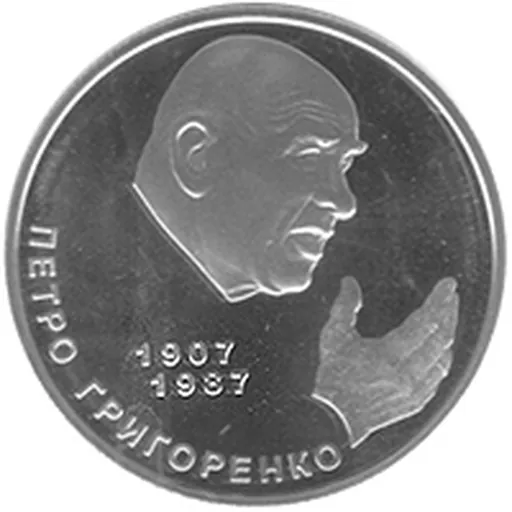
Petro Hryhorenko
Ukrainian soviet dissident, general
About Petro Hryhorenko
Lived 1907 – 1987 (aged 79). Petro Hryhorenko was a Russian, American and Ukrainian human rights defender, writer, dissident, military officer, military personnel and commanding officer, known for Moscow Helsinki Group, Struggle against political abuse of psychiatry in the Soviet Union and Ukrainian Helsinki Group.
Petro Grigorenko or Petro Hryhorovych Hryhorenko (, – 21 February 1987) was a high-ranking Soviet Army commander of Ukrainian descent, who in his fifties became a dissident and a writer, one of the founders of the human rights movement in the Soviet Union.
For 16 years, he was a professor of cybernetics at the Frunze Military Academy and chairman of its cybernetic section before joining the ranks of the early dissidents. In the mid-1970s Grigorenko helped to found the Moscow Helsinki Group and the Ukrainian Helsinki Group, before leaving the USSR for medical treatment in the United States. The Soviet government barred his return, and he never again returned to the Soviet Union. In the words of Joseph Alsop, Grigorenko publicly denounced the "totalitarianism that hides behind the mask of so-called Soviet democracy."
Early life Petro Grigorenko was born in Borysivka village in Taurida Governorate, Russian Empire (in present-day Zaporizhzhia Oblast, Ukraine).
In 1939, he graduated with honors from the Kuybyshev Military Engineering Academy and the Military Academy of the General Staff of the Armed Forces of Russia. He took part in the battles of Khalkhin Gol, against the Japanese on the Manchurian border in 1939, and in the Second World War. He commanded troops in initial battles following 22 June 1941. During the war, he also commanded an infantry division in the Baltic for three years.
He went on a military career and reached high ranks during World War II. After the war, being a decorated veteran, he left active career and taught at the Frunze Military Academy, reaching the rank of a Major General.
In 1949, Grigorenko defended his Ph.D. thesis on the theme "Features of the organization and conduct of combined offensive battle in the mountains."
In 1960, he completed work on his doctoral thesis. Over 70 of his scientific works on military science were published.
Dissident activities
In 1961, Petro Grigorenko started to openly criticize what he considered the excesses of the Khrushchev regime. He maintained that the special privileges of the political elite did not comply with the principles laid down by Lenin. When arrested, Grigorenko was sent to Moscow's Lubyanka prison, and from there for psychiatric examination to the Serbsky Institute During the closed political trials of 1965–1969, he was often present at the courthouses, demanding to open the doors of the courtrooms for everyone, explained to the people gathered around the goals of the defendants, expressed his dissatisfaction with the distortions in the internal political life of the country, and demanded a return to "true Leninism".
He became much more active in his dissidence, stirred other people to protest some of the State's actions and received several warnings from the KGB. until being freed on 26 June 1974 after 5 years of detention. As Grigorenko had followers in Moscow, he was lured to the far-away Tashkent.
In 1971, Dr. Semen Hluzman wrote an in-absentia psychiatric report on Grigorenko. Hluzman came to the conclusion that Grigorenko was mentally sane and had been taken to mental hospitals for political reasons. Amnesty International declared Grigorenko a prisoner of conscience.
Grigorenko became the key defender of Crimean Tatars deported to Soviet Central Asia. He advised the Tatar activists not to confine their protests to the USSR, but to appeal also to international organizations including the United Nations.
Grigorenko was one of the first who questioned the official Soviet version of World War II history. He pointed out that just prior to the German attack on June 22, 1941, vast Soviet troops were concentrated in the area west of Białystok, deep in occupied Poland, getting ready for a surprise offensive, which made them vulnerable to be encircled in case of surprise German attack. His ideas were later advanced by Viktor Suvorov.
After publishing Abdurakhman Avtorkhanov's book Stalin and the Soviet Communist Party: A Study in the Technology of Power, Grigorenko made and distributed its copies by photographing and typewriting. In 1976, Grigorenko helped found the Moscow Helsinki Group and the Ukrainian Helsinki Group. His health was ruined during forcible confinement in KGB-run mental hospitals. On 30 November 1977, Grigorenko arrived in the United States and was stripped of his Soviet citizenship. In Grigorenko's words, Leonid Brezhnev signed the decree of depriving Grigorenko of Soviet citizenship on the ground that he was undermining the prestige of the Soviet Union. The 1970s marked a peak in the use of external exile as a punitive measure by the Soviet Union (as opposed to the internal type, which was highest between the mid-1930s and early 1950s); often the pattern was that a trip abroad for work or medical treatment was transformed into permanent exile. In the same year, Grigorenko became a U.S. citizen.
Monument at Petro Grigorenko's grave. Cemetery of the Ukrainian Orthodox Church of St. Andrew in South Bound Brook, New Jersey Being in USA since 1977, Grigorenko took an active part in the activities of the Ukrainian Helsinki Group foreign affiliate. On 23 July 1978, Grigorenko made a statement condemning the trials of Soviet dissidents Anatoliy Shcharanskyi, Alexander Ginzburg and Viktoras Petkus.
In 1979 in New York, Grigorenko was examined by the team of psychologists and psychiatrists including Alan A. Stone, the then President of American Psychiatric Association. The team could find no evidence of mental disease in Grigorenko and his history consistent with mental disease in the past. Grigorenko's case confirmed accusations, Stone wrote, that psychiatry in the Soviet Union was at times a tool of political repression.
Petro Grigorenko described his life and views, and his assessment by Soviet psychiatrists and periods of incarceration in prison hospitals in his 1981 memoirs V Podpolye Mozhno Vstretit Tolko Krys… (In the Underground One Can Meet Only Rats…). and reviewed by Alexander J. Motyl, Raymond L. Garthoff, John C. Campbell, Adam Ulam, Raisa Orlova and Lev Kopelev.
In 1983, he said he considered the American political-economic system to be "the best that mankind has found to date." In 1983, a stroke he suffered left him partially paralyzed. Grigorenko died on 21 February 1987 in New York City. The 1992 psychiatric examination of Grigorenko was described by the Nezavisimiy Psikhiatricheskiy Zhurnal in its numbers 1–4 of 1992.
Family
Petro Grigorenko was married to Zinaida Mikhailovna Grigorenko and they had five sons: Anatoliy, Heorhiy, Oleh, Viktor and Andrew. was declared to have inherited his father's insanity. He was expelled from the USSR to the US, two years before Petro and Zinaida Hryhorenko themselves travelled to the United States. Andrew was repeatedly told that since his father was mentally ill, then he was also mad. If he did not stop speaking out in defense of human rights and his father, they told him, he would also be sent to the psikhushka.
Name spelling versions The different Latin spellings of Grigorenko's name exist due to the lack of uniform transliteration rules for the Ukrainian names in the middle of the 20th century, when he became internationally known. The correct modern transliteration would be Petro Hryhorenko. However, according to the American identification documents of the late general the official spelling of his name was established as Petro Grigorenko. The same spelling is engraved on his gravestone at the Ukrainian Orthodox Church of St. Andrew in South Bound Brook, New Jersey, USA. The same spelling is also retained by his surviving American descendants: son Andrew and granddaughters Tetiana and Olga.
Honours and awards
Soviet Union Medal "For the Victory over Germany in the Great Patriotic War 1941–1945" Jubilee Medal "Twenty Years of Victory in the Great Patriotic War 1941–1945" Jubilee Medal "Thirty Years of Victory in the Great Patriotic War 1941–1945" Ukraine
In Kharkiv the local Georgy Zhukov Avenue was renamed to Petro Hryhorenko Avenue to comply with decommunization laws (this was several times undone by the Kharkiv City Council).
Books, interviews, letters
(publicly available unabridged Russian text) (publicly available unabridged Russian text)
(publicly available unabridged Russian text)
(publicly available unabridged Russian text)
Don’t just read it —
keep it.
Full-length biographies made to live with: read them, listen on the way to work, watch them tonight.
- E-book
- Audio
- Video
Instant download · yours to keep · every purchase keeps this site free
Important facts
People in Petro Hryhorenko's life
Named in this biography and alive at the same time




Related people
Same field, nearest in time


Contemporaries
People whose lives overlapped Petro Hryhorenko's



Frequently asked questions
Who was Petro Hryhorenko?
Ukrainian soviet dissident, general (1907–1987)
When was Petro Hryhorenko born?
Petro Hryhorenko was born on 16 October 1907 in Borysivka.
When did Petro Hryhorenko die?
Petro Hryhorenko died on 21 February 1987 in New York City.
What was Petro Hryhorenko's occupation?
Petro Hryhorenko was a human rights defender, writer, dissident, military officer, military personnel and commanding officer.
What was Petro Hryhorenko known for?
Petro Hryhorenko was known for Moscow Helsinki Group, Struggle against political abuse of psychiatry in the Soviet Union, Ukrainian Helsinki Group and Working Commission to Investigate the Use of Psychiatry for Political Purposes.
What nationality was Petro Hryhorenko?
Petro Hryhorenko was Russian, American and Ukrainian.
Sources & further reading
Cite this page
APA: Biography.guide. (2026). Petro Hryhorenko. https://biography.guide/petro-hryhorenko/
MLA: "Petro Hryhorenko." Biography.guide, https://biography.guide/petro-hryhorenko/.
Chicago: "Petro Hryhorenko." Biography.guide. https://biography.guide/petro-hryhorenko/.
Data last updated: 2026-09-21 · Spot an error? Report a correction.
Portrait: Wikimedia Commons · author & licence
Page generated 2026-09-27 05:01 UTC