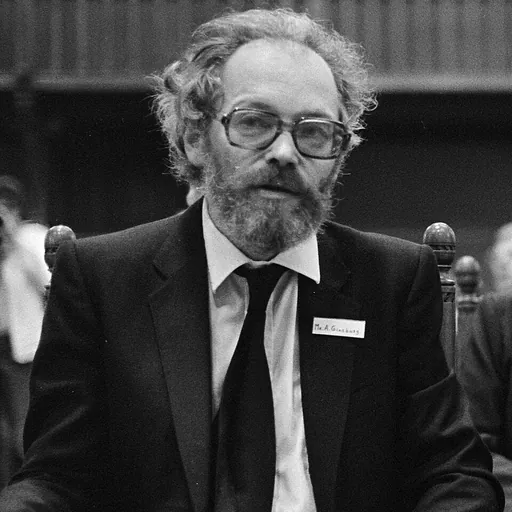
Alexander Ginzburg
Russian journalist, poet, human rights activist and dissident
About Alexander Ginzburg
Lived 1936 – 2002 (aged 65). Alexander Ginzburg was a French and Russian journalist, poet, human rights defender, writer, publisher and dissident, known for Moscow Helsinki Group, Phoenix (literary magazine) and Sintaksis (Moscow).
Alexander "Alik" Ilyich Ginzburg (; 21 November 1936 – 19 July 2002) was a Russian journalist, poet, human rights activist and dissident. Between 1961 and 1969 he was sentenced three times to labor camps. In 1979, Ginzburg was released and expelled to the United States, along with four other political prisoners (Eduard Kuznetsov, Mark Dymshits, Valentin Moroz, and Georgy Vins) and their families, as part of a prisoner exchange.
Biography Ginzburg was born in Moscow to a Russian-Jewish family. He was relative (nephew) of Yevgenia Ginzburg and semi-orphan, Alexander Ginzburg. Ginzburg was educated in Moscow, and worked as a lathe operator and part time journalist after leaving school, then as an actor, but had to give up acting in 1959, after falling from a third storey window.
Dissident work At the end of 1959, Ginzburg issued the USSR's first samizdat literary magazine Phoenix, with Yuri Galanskov. After three issues, he was expelled from Moscow University, arrested and sentenced to two years in a labour camp. Released in 1962, he was unable to find regular work, but continued to patronise underground art, by distributing literature and holding private film shows. He was returned to Lubyanka prison for a short time in 1964.
In December 1965, Alexander Ginzburg documented the trial of writers Yuli Daniel and Andrei Sinyavsky (Sinyavsky–Daniel trial). Having obtained a copy of closed-door court proceedings from the court stenographer, he compiled a White Book documenting the trial. He then sent copies of the book with his address to the KGB and the Chief Prosecutor's Office. He was a friend of Alexander Solzhenitsyn, with whom he initiated the Fund for the Aid of Political Prisoners. Based on the royalties derived from Solzhenitsyn's book The Gulag Archipelago, it distributed funds and material support to political and religious prisoners across the Soviet Union throughout the 1970s and 1980s. Ginzburg had power of attorney over the fund after Solzhenitsyn's expulsion from the USSR in February 1974, but in April, he was placed under police surveillance and forbidden to leave the district of Talusa where he lived, even to walk as far as the local cinema, and was forbidden to leave the house after 8.00pm.
In 1976, Ginzburg became a founding member of the Moscow Helsinki Group, which monitored breaches of the human rights guarantees the Soviet government signed up to in the 1975 Helsinki accords. Ginzburg was given the task of monitoring the State's persecution of the smaller Christian denominations, for which he was, again, arrested in 1978 and sentenced to an eight-year prison term. In April 1979, he was with four other dissidents deprived of his citizenship and exchanged for two Soviets who had been jailed for espionage.
Throughout his career, Ginzburg advocated nonviolent resistance. He believed in exposing human rights abuses by the Soviet Union and pressuring the government to follow its own laws. He made an effort to smuggle his writings abroad in order to increase external pressure on the Soviets.
Don’t just read it —
keep it.
Full-length biographies made to live with: read them, listen on the way to work, watch them tonight.
- E-book
- Audio
- Video
Instant download · yours to keep · every purchase keeps this site free
Important facts
People in Alexander Ginzburg's life
Named in this biography and alive at the same time



Related people
Same field, nearest in time

Contemporaries
People whose lives overlapped Alexander Ginzburg's




Frequently asked questions
Who was Alexander Ginzburg?
Russian journalist, poet, human rights activist and dissident (1936-2002)
When was Alexander Ginzburg born?
Alexander Ginzburg was born on 21 November 1936 in Moscow.
When did Alexander Ginzburg die?
Alexander Ginzburg died on 19 July 2002 in Paris.
What was Alexander Ginzburg's occupation?
Alexander Ginzburg was a journalist, poet, human rights defender, writer, publisher and dissident.
What was Alexander Ginzburg known for?
Alexander Ginzburg was known for Moscow Helsinki Group, Phoenix (literary magazine) and Sintaksis (Moscow).
What nationality was Alexander Ginzburg?
Alexander Ginzburg was French and Russian.
Sources & further reading
· Wikipedia: Alexander Ginzburg
Cite this page
APA: Biography.guide. (2026). Alexander Ginzburg. https://biography.guide/alexander-ginzburg/
MLA: "Alexander Ginzburg." Biography.guide, https://biography.guide/alexander-ginzburg/.
Chicago: "Alexander Ginzburg." Biography.guide. https://biography.guide/alexander-ginzburg/.
Data last updated: 2026-09-20 · Spot an error? Report a correction.
Portrait: Wikimedia Commons · author & licence
Page generated 2026-09-27 04:58 UTC