
About Petre Cișmigiu
Lived 1915 – 2006 (aged 90–91). Petre Cișmigiu was a Romanian sport shooter.
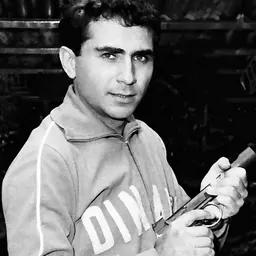
Petre or Petru Cișmigiu, also credited as Cișmigu (; 12 June 1915 – 2006), was a Romanian sports shooter, coach, sports expert, and civil engineer. A native of Bessarabia and graduate of the Bucharest Polytechnic, he worked for a while in designing telephone exchanges, and debuted as a shooter during World War II, with Telefon Club. After obtaining significant results in internal competitions, he qualified for the national shooting team during the first years of the Romanian communist regime. From early 1948, Cișmigiu was an official of the Romanian Shooting Sport Federation (FRT), emerging as a player-coach of the national squad in the early 1950s; his club affiliations were with the National Bank of Romania (BNR), CS Dinamo, and finally Metalul Energia. He competed in several international matches, appearing at the 50 m rifle, prone event of the 1952 Summer Olympics. Though he retired from playing shortly after, he was called up as a coach at subsequent Olympic events, with contributions that were initially criticized as unsatisfactory. He also began publishing guides to shooting and works of history on the sports, as well as inventing a scoring gauge.
In the 1960s, Cișmigiu became an expert and referee for the International Shooting Sport Federation, which awarded him honorary gold and silver medals. His involvement with the international body and its various affiliates also led him to become a technical adviser and designer of several shooting ranges, from Phoenix, Arizona, to Tokyo. Caught up in a simmering conflict with the FRT, he was coach of several other national federations and squads, and received special honors from the Mexican Federation of Shooting and Hunting. After the Romanian Revolution of 1989, Cișmigiu tried to revive sport shooting in Romania, but concluded that the regional authorities were ignoring him. As an octogenarian, he tried to obtain increased pension rights for himself and other non-Olympic champions. He died in 2006, some four years after publishing a final textbook on pistol-shooting.
Early life and playing career
In a 1999 article, sports journalist Andrei Dicu noted that Cișmigiu's native area was "somewhere in the present-day Republic of Moldova." According to standardized records, he was born on 12 June 1915 at Bolgrad, in the Russian Empire's Bessarabia Governorate (currently in Ukraine). He lived his youth in Greater Romania, graduating from the Bucharest Polytechnic's Civil Engineering Department. Cișmigiu was inducted into the company sports squad, the Telefon Club, during 1942, He took eleventh place at the national rifle, standing championship in December (a competition won by Sorin Cantili). He won his first national competition, the General Confederation of Labor Cup 1946, with Telefon Club—also setting a national record. In May, he was voted in as secretary of the FRT, and also designated to represent Romania in Budapest, at the centennial cup of the Hungarian Shooting Federation. In March 1949, he represented BNR at a club competition which doubled as training for the national squad, as well as a celebration of the Communist Youth; he took second place, after Penait Călcâi. By May 1950 he was Romania's player-coach, preparing the squad for an international face-off against the Hungarian team. Cișmigiu was sent to the 1952 ISSF World Shooting Championships in Oslo and that year's Summer Olympics in Helsinki That edition, which also had him as a coach,
Cișmigiu's affiliation was with CS Dinamo, where he personally founded a shooting department. In October of the same year, he appeared at international championships organized by the Romanian state. His performance was judged as underwhelming in the local sports press: while his colleague Henry Herscovici had taken 400 out of a possible 400 points in his trial, Cișmigiu had taken third place in his. He was however the republican champion in individual, supine and individual, combined competitions, both in June 1955. At the 1955 European Shooting Championships, held at Tunari near Bucharest, Cișmigiu placed seventh in the supine position, with 597 points.
Cișmigiu maintained the office of national coach after retiring from the playing squad; Cișmigiu had by then authored a specialty work, the 1954 Tirul cu arma sport ("Shooting Weapons for Sport"), which included detailed technical instructions. In 1962–1963, he publicized his invention of a "measuring rod"-type of gauge, which helped reduce fluctuations in score-keeping. He helped organize the 1965 European Shooting Championships, for which he supervised expansions to the Tunari range.
International expert
Upon retiring from competitions, Cișmigiu had become an expert of the International Shooting Sport Federation (ISSF). It awarded him honorary silver and gold medals, which he treasured alongside a diploma of merit from the International Olympic Committee. He worked on designing shooting ranges in Phoenix, Thun, Munich and Tokyo.
In 1966, Cișmigiu was credited by the journalists at Sportul Popular with instilling "seriousness" in the Olympic team, including in top-performing newcomers such as Virgil Atanasiu and Marcel Roșca. He appeared as a coach for Tokyo 1964, Mexico City 1968, Munich 1972, and finally Montreal 1976. At the end of his Olympic career, his players had won nine Olympic medals, including three gold ones. His performance in Mexico was recognized by the communist state, which awarded him the Meritul Sportiv medal, 3rd class, in November 1968. As an FRT trainer, in May 1972 he joined the official delegation at the continental skeet shooting championship, held in Francoist Spain (at Eurovillas). He also appeared at the 1975 European 10 m Events Championships, as both Romania's coach and an international referee.
Between 1969 and 1975, the Mexican Federation of Shooting and Hunting ran a "Romanian Tournament", which awarded the Petre Cișmigiu Challenger Cup. As Cișmigiu reported, this created tensions between him and the Romanian communist establishment, which insisted that the cup needed to be validated by the FRT. He continued to submit projects for the revival of sports shooting in Romania, but complained that the FRT was ignoring him.
Cișmigiu's wife, Lala Malvina, died as a result of "medical negligence" in July 2000. He was reportedly depressed, having seen her die "before my eyes" at Bucharest's Elias Hospital, and was living on his own in an apartment near Victory Square. His main focus was on writing his memoirs and a minute history of Romanian sports shooting. He is known to have died in 2006.
Don’t just read it —
keep it.
Full-length biographies made to live with: read them, listen on the way to work, watch them tonight.
- E-book
- Audio
- Video
Instant download · yours to keep · every purchase keeps this site free
Important facts
People in Petre Cișmigiu's life
Named in this biography and alive at the same time


Related people
Same field, nearest in time


Contemporaries
People whose lives overlapped Petre Cișmigiu's


Frequently asked questions
Who was Petre Cișmigiu?
sport shooter
When was Petre Cișmigiu born?
Petre Cișmigiu was born on 12 June 1915 in Bolhrad.
When did Petre Cișmigiu die?
Petre Cișmigiu died in 2006.
What was Petre Cișmigiu's occupation?
Petre Cișmigiu was a sport shooter.
What nationality was Petre Cișmigiu?
Petre Cișmigiu was Romanian.
Sources & further reading
Cite this page
APA: Biography.guide. (2026). Petre Cișmigiu. https://biography.guide/petre-cismigiu/
MLA: "Petre Cișmigiu." Biography.guide, https://biography.guide/petre-cismigiu/.
Chicago: "Petre Cișmigiu." Biography.guide. https://biography.guide/petre-cismigiu/.
Data last updated: 2026-09-20 · Spot an error? Report a correction.
Page generated 2026-09-27 05:21 UTC