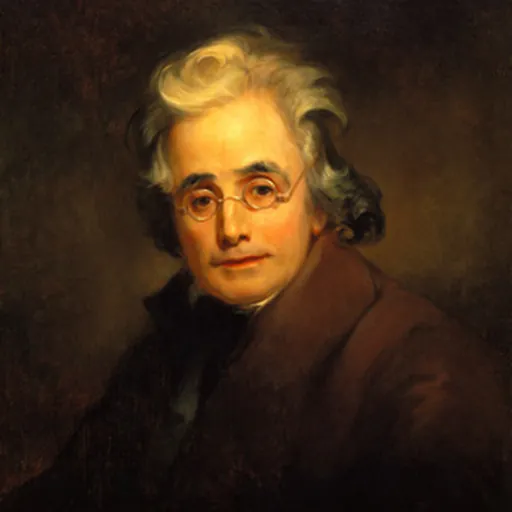
Peter Stephen Du Ponceau
French-born American linguist, philosopher and jurist
About Peter Stephen Du Ponceau
Lived 1760 – 1844 (aged 83). Peter Stephen Du Ponceau was a French philosopher, jurist-consultant, linguist, jurist, university teacher and linguistics.
Peter Stephen Du Ponceau (born Pierre-Étienne du Ponceau; 3 June 1760 – 1 April 1844) was a French-born American linguist, philosopher and jurist. After emigrating to the Thirteen Colonies in 1777, he served in the American Revolutionary War. Afterward, he settled in Philadelphia, where he lived the remainder of his years. He contributed significantly to work on the indigenous languages of the Americas, as well as advancing the understanding of written Chinese.
Family Du Ponceau was born in a French Catholic military family. As a child, he lived with his grandmother, aunt, mother, father, younger brother Jean-Michel Du Ponceau and older sister Louise-Geneviéve Du Ponceau. Both his parents died when he was relatively young: his father died in 1774, and his mother died in 1780. Du Ponceau wrote to his sister for 65 years after his departure to America, and his brother attempted to write to him later on, though it is unknown if he was able to reach him. Growing up, Du Ponceau was unloved by his mother, as was quite common in France at the time.
Early life Du Ponceau's fondness for languages began at a very young age. At the age of 5, Du Ponceau knew both French and Latin by heart. While learning to write, he held extreme fascination with the letters "K" and "W". When he was 17, he emigrated to America in 1777 with Baron von Steuben, who was 30 years older. It was speculated at the time that they had been lovers.
War service Du Ponceau served as a secretary, translator, and interpreter to the Baron von Steuben in the Continental Army during the American Revolution. In 1781, he was forced to return home due to health issues and sudden illness, at the time believed to be consumption. He became notable in linguistics for his analysis of the indigenous languages of the Americas. As a member of the society's Historical and Literary Committee, he helped build a collection of texts that described and recorded native languages. His book on their grammatical systems (Mémoire sur le système grammatical des langues de quelques nations indiennes de l'Amérique du Nord) won the Volney Prize of the Institute of France in 1835.
In 1816, he was elected a member of the American Antiquarian Society, and in 1820, he was elected a Fellow of the American Academy of Arts and Sciences.
Du Ponceau also worked on Asian languages and was one of the first Western linguists to reject the axiomatic classification of Chinese writing as ideographic. Du Ponceau stated: That the Chinese system of writing is not, as has been supposed, ideographic; that its characters do not represent ideas, but words, and therefore I have called it lexigraphic. Du Ponceau in a daguerreotype by Robert Cornelius, March 1840 (or earlier)That ideographic writing is a creature of the imagination, and cannot exist, but for very limited purposes, which do not entitle it to the name of writing. That among men endowed with the gift of speech, all writing must be a direct representation of the spoken language, and cannot present ideas to the mind abstracted from it. That all writing, as far as we know, represents language in some of its elements, which are words, syllables, and simple sounds. In the first case it is lexigraphic, in the second syllabic, and in the third alphabetical or elementary. He used the example of Vietnamese, then called "Cochinchinese," which used Chữ Nôm, a modified form of Chinese characters. He showed that Vietnamese used the Chinese characters to represent sound, not meaning. A hundred years later, his theory was still a source of controversy.
Death He died on 1 April 1844, in Philadelphia, Pennsylvania.
Don’t just read it —
keep it.
Full-length biographies made to live with: read them, listen on the way to work, watch them tonight.
- E-book
- Audio
- Video
Instant download · yours to keep · every purchase keeps this site free
Important facts
People in Peter Stephen Du Ponceau's life
Named in this biography and alive at the same time

Related people
Same field, nearest in time




Contemporaries
People whose lives overlapped Peter Stephen Du Ponceau's




Frequently asked questions
Who was Peter Stephen Du Ponceau?
French-born American linguist, philosopher and jurist (1760-1844)
When was Peter Stephen Du Ponceau born?
Peter Stephen Du Ponceau was born on 3 June 1760 in Saint-Martin-de-Ré.
When did Peter Stephen Du Ponceau die?
Peter Stephen Du Ponceau died on 1 April 1844 in Philadelphia.
What was Peter Stephen Du Ponceau's occupation?
Peter Stephen Du Ponceau was a philosopher, jurist-consultant, linguist, jurist, university teacher and linguistics.
What nationality was Peter Stephen Du Ponceau?
Peter Stephen Du Ponceau was French.
Sources & further reading
· Wikipedia: Peter Stephen Du Ponceau
· DBpedia: Peter Stephen Du Ponceau
Cite this page
APA: Biography.guide. (2026). Peter Stephen Du Ponceau. https://biography.guide/peter-stephen-du-ponceau/
MLA: "Peter Stephen Du Ponceau." Biography.guide, https://biography.guide/peter-stephen-du-ponceau/.
Chicago: "Peter Stephen Du Ponceau." Biography.guide. https://biography.guide/peter-stephen-du-ponceau/.
Data last updated: 2026-09-22 · Spot an error? Report a correction.
Portrait: Wikimedia Commons · author & licence
Page generated 2026-09-27 05:03 UTC