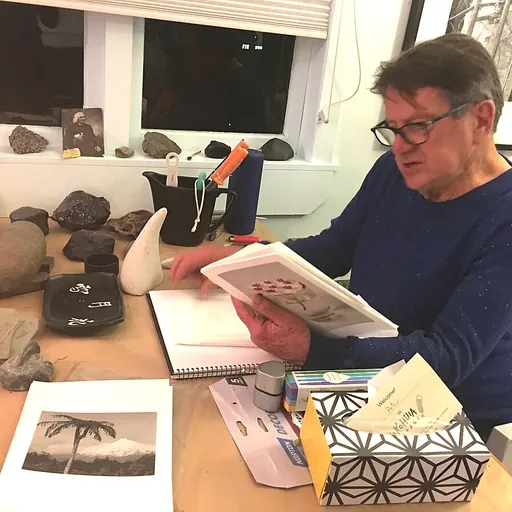
About Peter Peryer
Lived 1941 – 2018 (aged 76–77). Peter Peryer was a New Zealand photographer.
Peter Chanel Peryer (2 November 1941 – 18 November 2018) was a New Zealand photographer. In 2000, he was one of the five inaugural laureates of the Arts Foundation of New Zealand.
Career Born in Ōtāhuhu, Auckland, on 2 November 1941, Peryer completed a Master of Arts in education at the University of Auckland in 1972, and lectured in English at Auckland Teachers' College. He began photographing in 1973, and was largely self-taught. His work was included in The Active Eye, the first survey of contemporary New Zealand photography, mounted by the Manawatu Art Gallery in 1975. Peryer held his first solo exhibition at the Dowse Art Museum in 1977; this was the first solo exhibition of a contemporary photographer at a New Zealand public art gallery. His work has been extensively exhibited in public and private art galleries throughout New Zealand and internationally, in solo exhibition and group shows.
In 1995 an exhibition of Peryer's work titled Second Nature: Peter Peryer Photographs toured New Zealand and Germany. One of the works used to advertise the exhibition in Europe was Dead Steer (1987), which depicts the bloated carcass of a cow on a rural roadside. New Zealand's then Minister of Agriculture John Falloon protested the inclusion and use of the work, on the basis that it was bad publicity for the New Zealand meat industry. He attempted unsuccessfully to have the exhibition closed and ordered the New Zealand High Commissioner to withdraw from attending an opening of the exhibition.
In the 1997 Queen's Birthday Honours, Peryer was appointed an Officer of the New Zealand Order of Merit, for services to photography. In 2000, he was among the five artists recognised by the Arts Foundation of New Zealand as their inaugural Laureates.
Peryer died in New Plymouth on 18 November 2018 at the age of 77.
Work Peyer began taking photographs with a cheap Diana camera. Early series and portfolios included Mars Hotel (1975), Gone Home (1975) and Souvenir (1976.) In a review of Peryer's early activity in late 1977 critic Neil Rowe wrote "Although he has been taking photographs seriously for only two years he has achieved a highly distinctive style and an intensely personal repertoire of imagery". Peryer showed 11 works, including a number of photographs of various zoo animals, including pelican, ibis, peacock, alligator, monitor lizard, kingfisher. Each animal was captured in such a way that its surrounding enclosure was not removed but suggested in the image, an ongoing theme of Peryer's work.
Peryer's best-known early works are a series of photographs taken of his then-wife, Erika Parkinson. The portraits were gathered into a 2000–01 touring exhibition Erika: A Portrait by Peter Peryer. The exhibition curator Justin Paton wrote at the time:
Nothing in New Zealand photography of the seventies has the same psychological charge or stark glamour. Two decades later they still feel urgent, as if the need to look ignited the need to be looked at, and the photos just flared into being.
Writing in the mid-1990s, curator Robert Leonard observed "Peter Peryer made his name as an expressive photographer producing angst-ridden portraits. A change of heart in the early 1980s saw him adopt a more formalist approach, treating miscellaneous subjects in a more documentary but still quirky way." In a 1985 exhibition catalogue Peryer said:
I work in an additive way. I tend to start with a blank picture and add the elements one by one. That's one of the reasons why so few of my pictures have horizons because it is quite hard to control the background … a painter can subtract or alter – I just build up.
Photography critic Peter Ireland traced the "growing formalism" of Peryer's works to the Grid Series of 1981. He noted that "While Peryer draws on movements and artists as distinct as Constructivism, German avant-garde photography, and Moholy-Nagy, his intellect saves this from being merely an art-historical tour to mould it into a highly-personal visual ideology".
Solo exhibitions 2014 Peter Peryer: A Careful Eye, The Dowse Art Museum and Sarjeant Art Gallery 2012 Other: photographic portraits 1975–2011, Gus Fisher Gallery, Auckland 1997 At home and away: recent photographs, Sarjeant Art Gallery 1995–1996 Second Nature, touring New Zealand and Germany
Director Shirley Horrocks documentary Peter Peryer: the Art of Seeing was produced in 2019.
Collections Peryer's work is held in public collections throughout New Zealand and Australia. Art Gallery of New South Wales Auckland Art Gallery Christchurch Art Gallery Museum of New Zealand Te Papa Tongarewa National Gallery of Victoria Sarjeant Gallery
Don’t just read it —
keep it.
Full-length biographies made to live with: read them, listen on the way to work, watch them tonight.
- E-book
- Audio
- Video
Instant download · yours to keep · every purchase keeps this site free
Important facts
People in Peter Peryer's life
Named in this biography and alive at the same time


Related people
Same field, nearest in time


Contemporaries
People whose lives overlapped Peter Peryer's

Frequently asked questions
Who was Peter Peryer?
New Zealand photographer (1941–2018)
When was Peter Peryer born?
Peter Peryer was born in 1941 in Auckland.
When did Peter Peryer die?
Peter Peryer died on 18 November 2018 in New Plymouth.
What was Peter Peryer's occupation?
Peter Peryer was a photographer.
What nationality was Peter Peryer?
Peter Peryer was New Zealand.
Sources & further reading
Cite this page
APA: Biography.guide. (2026). Peter Peryer. https://biography.guide/peter-peryer/
MLA: "Peter Peryer." Biography.guide, https://biography.guide/peter-peryer/.
Chicago: "Peter Peryer." Biography.guide. https://biography.guide/peter-peryer/.
Data last updated: 2026-09-22 · Spot an error? Report a correction.
Portrait: Wikimedia Commons · author & licence
Page generated 2026-09-27 05:03 UTC