
Peter Nicholson
Scottish architect, mathematician and engineer
About Peter Nicholson
Lived 1765 – 1844 (aged 78). Peter Nicholson was a Scottish engineer, mathematician and architect.
Peter Nicholson (20 July 1765 – 18 June 1844) was a Scottish architect, mathematician and engineer. Largely self-taught, he was apprenticed to a cabinet-maker but soon abandoned his trade in favour of teaching and writing. He practised as an architect but is best remembered for his theoretical work on the skew arch (he never actually constructed one himself), his invention of draughtsman's instruments, including a centrolinead and a cyclograph, and his prolific writing on numerous practical subjects.
Biography
Early life Born in 1765 in the parish of Prestonkirk, East Lothian, Peter Nicholson was the son of a stonemason. Largely self-taught and excelling in the field of mathematics, he received only a rudimentary formal education, studying under a Mr Richardson, brother of architect George Richardson, at the local parish school from the age of nine until he left, aged 12, to assist his father in the family business.
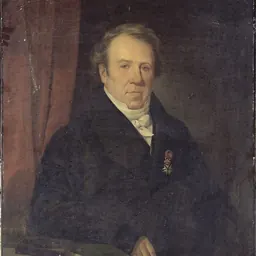
Portrait of Nicholson by James Green, c. 1816, donated to the National Portrait Gallery in 1961
Living in London, Nicholson continued trading as a cabinet-maker but also began teaching practical geometry at an evening school for mechanical engineers in Berwick Street, Soho, at which he became so successful that he soon abandoned his trade and took up authorship. was declared bankrupt and only five volumes were ever produced, this being the only project he left unfinished. During the nine years he lived in Newcastle, Nicholson published three more books, his Treatise on Projection (1837) containing his portrait, drawn from life by Edward Train, originally in pen and ink. A monument to his memory, designed by Robert William Billings in the form of a pair of interpenetrating obelisks, was erected in Carlisle cemetery in 1865. As a mathematician, he was largely self-taught, later turning to architecture as a means of finding a practical application for the theoretical knowledge he had amassed during his solitary studies.
For his work on involution and evolution, Nicholson received the following commendation from the French Académie des Sciences.
French Institute, Royal Academy of Sciences, Paris, 10 July 1820.
Sir,—The Academy has received with a lively degree of interest, the Essay that you obligingly addressed to it on Involution and Evolution, or a Method of determining the Numerical Value of any Function of an unknown Quantity. I am desired, in its name, to thank you for sending this interesting work, which has been honourably placed in the Library of the Academy; and to express the sense of obligation which the Institution entertains for your attention.
Receive, Sir, I beg, the assurance of the most distinguished respect with which I am,
Your's etc.
B.G. Cuvier 4 = Letter from the Perpetual Secretary to Mr Peter Nicholson. carries an information plaque commemorating Nicholson's pioneering work in this field.
Following his 1836 publication On the Construction of Skew Arches, Charles Fox openly acknowledged Nicholson's contribution while claiming his own to be the superior method.
In his 1837 publication A Practical and Theoretical Essay on Oblique Bridges, George W. Buck also acknowledged Nicholson's contribution but, finding it lacking in detail, applied his own original trigonometrical approach and considerable practical experience to the problem.
The unfavourable comments from Fox and Buck were comparatively mild and tempered in part by their acknowledgement of Nicholson's pioneering work. Nevertheless, Nicholson, by this time in his mid-70s and his health failing, felt the need to exercise his right of reply. A number of people expressed their public support for him, including his friend Henry Welch, the County Bridge Surveyor for Northumberland and an anonymous supporter known only by the initials M.Q. Unfortunately this exchange escalated into a paper war that became increasingly acrimonious, culminating in 1840 in a very personal attack by Buck's assistant, the 28-year-old William Henry Barlow, and causing Nicholson considerable distress.
By his fellow citizens A measure of the high esteem in which Nicholson was held by the residents of Newcastle and their sense of injustice at his financial plight can be gauged from the petition sent to the king in an unsuccessful attempt to obtain a pension on his behalf.
The works of Peter Nicholson, while they have contributed to the advancement of knowledge, have tended to raise the English mechanic to that pre-eminence he has attained over the other artificers of Europe; and while they have been honoured with the proudest marks of distinction by the various learned societies of this kingdom, have yet failed to produce to their author those benefits which are necessary for his existence; and it must ever be a source of regret that an individual who, having devoted his best energies to the advancement of science, should be left at the close of a long and laborious life, and in his seventy-third year, to struggle in penury and want. 4 = Petition from the people of Newcastle to H. M. King William IV on behalf of Peter Nicholson Principles of Architecture (in three volumes between 1794 and 1798). The Student's Instructor in Drawing and Working the Five Orders of Architecture (1795). The Carpenter and Joiner's Assistant (1797). Mechanical Exercises (1812). This book was re-published in 1831 as The Mechanic's Companion. The Architectural Dictionary (in two volumes between 1812 and 1819). This book was re-published in an expanded form in 1852 as the Encyclopædia of Architecture. A Treatise on Practical Perspective (1815). An Introduction to the Method of Increments (1817). Essays on the Combinatorial Analysis (1818). The Rudiments of Algebra (1819). Essay on Involution and Evolution (1820, for which he received the commendation of the Académie des Sciences in Paris). A Treatise on the Construction of Staircases and Handrails (1820). Analytical and Arithmetical Essays (1821). The Builder and Workman's New Director (1822). A Popular Course of Pure and Mixed Mathematics (1823, price 21s). The New Practical Builder, and Workman's Companion (1823). The Practical Builder's Perpetual Price-book (1823). A Practical System of Algebra (1824, with John Rowbotham). The Practical Cabinet-maker, Upholsterer, and Complete Decorator (1826, with Michael Angelo Nicholson, his elder son). The Carpenter and Builder's Complete Measurer (1826, intended as a sequel to the Carpenter's Guide). Practical Carpentry, Joinery and Cabinet-making (1826). In 1827 he commenced the publication of a work entitled The School of Architecture and Engineering, which he intended to complete in twelve volumes, at 1s 6d each; but, following the bankruptcy of the publisher, only five volumes appeared, causing Nicholson a considerable personal financial loss. A Popular and Practical Treatise on Masonry and Stone-cutting (1828). A Treatise on Dialing (1833). A Treatise on Projection (1837). Practical Masonry, Bricklaying, and Plastering (1838). The Guide to Railway Masonry, containing a Complete Treatise on the Oblique Arch (1839).
Nicholson also edited and revised later editions of the following publications by other authors. An Essay on the Teeth of Wheels by Robertson Buchanan (1808).
He also contributed several articles to Rees's Cyclopædia. Architecture (vol. 2, 1802–1803) Carpentry (vol. 6, 1806) Joinery (vol. 19, 1811) Panorama (vol. 26, 1813–1814) Perspective (vol. 26, 1813–1814) Projection (vol. 28, 1814) Proportional Compasses (vol. 28, 1814) Shadows (vol. 32, 1815–1816) Stereography (vol. 34, 1816) Stereometry (vol. 34, 1816)
Don’t just read it —
keep it.
Full-length biographies made to live with: read them, listen on the way to work, watch them tonight.
- E-book
- Audio
- Video
Instant download · yours to keep · every purchase keeps this site free
Important facts
People in Peter Nicholson's life
Named in this biography and alive at the same time
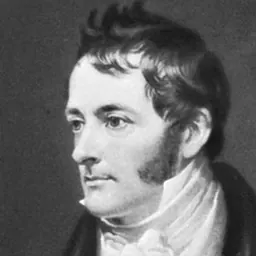
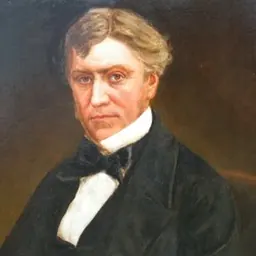
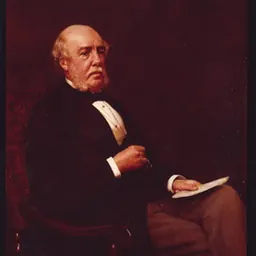
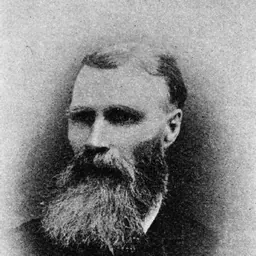


Related people
Same field, nearest in time

Contemporaries
People whose lives overlapped Peter Nicholson's





Frequently asked questions
Who was Peter Nicholson?
Scottish architect, mathematician and engineer
When was Peter Nicholson born?
Peter Nicholson was born on 20 July 1765 in East Lothian.
When did Peter Nicholson die?
Peter Nicholson died on 18 June 1844 in Carlisle.
What was Peter Nicholson's occupation?
Peter Nicholson was an engineer, mathematician and architect.
What nationality was Peter Nicholson?
Peter Nicholson was Scottish.
Sources & further reading
· DBpedia: Peter Nicholson (architect)
Cite this page
APA: Biography.guide. (2026). Peter Nicholson. https://biography.guide/peter-nicholson/
MLA: "Peter Nicholson." Biography.guide, https://biography.guide/peter-nicholson/.
Chicago: "Peter Nicholson." Biography.guide. https://biography.guide/peter-nicholson/.
Data last updated: 2026-09-20 · Spot an error? Report a correction.
Page generated 2026-09-27 05:22 UTC