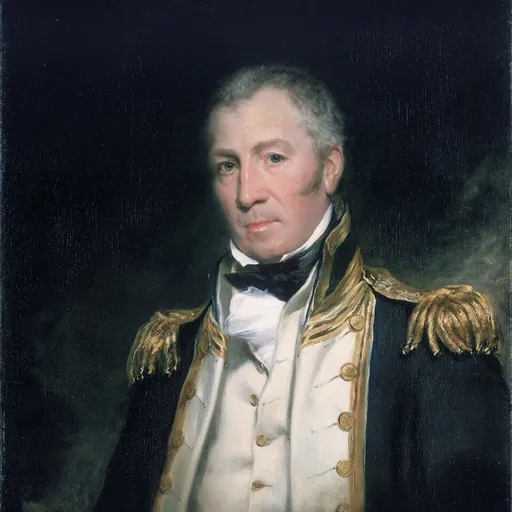
About Peter Heywood
Lived 1772 – 1831 (aged 58). Peter Heywood was a British sailor, hydrographer and historian.
On HMS Bounty
Outward journey alt=Map shows Australaian and New Zealand landmasses and a section of the southern Pacific Ocean. Bounty's travels are depicted by directional arrows coloured to distinguish movements before and after the mutiny. Bounty's mission was to collect breadfruit plants from Tahiti for transportation to the West Indies as a new source of food for the slave plantations. Bligh, a skilled navigator, had travelled to Tahiti in 1776, as Captain James Cook's sailing master during the explorer's final voyage. with a complement of 46 men crammed into limited accommodation. Heywood was one of several "young gentlemen" aboard ship who were mustered as able seamen but ate and slept with their social equals in the cockpit. His distant kinsman, Fletcher Christian, served as master's mate on the voyage. Bligh's orders were to enter the Pacific by rounding Cape Horn. After collecting sufficient breadfruit plants from the Tahitian islands he was to sail westward, through the Endeavour Strait and across the Indian Ocean. Entering the Atlantic he would continue on to the West Indies, incidentally completing a circumnavigation.
Bounty left London on 15 October 1787, and after being held at Spithead awaiting final sailing orders was further delayed by bad weather; it was 23 December before the ship was finally away. This long hiatus caused Bounty to arrive at Cape Horn much later in the season than planned and to encounter very severe weather. Unable to make progress against westerly gales and enormous seas, Bligh finally turned the ship and headed east. He would now have to take the alternative, much longer route to the Pacific, sailing first to Cape Town and then south of Australia and New Zealand, before working northwards to Tahiti.
Following its new route, Bounty reached Cape Town on 24 May 1788. Here, Heywood wrote a long letter to his family describing the voyage to date, with vivid descriptions of life at sea. Initially, Heywood relates, sailing had been "in the most pleasurable weather imaginable". In describing the attempts to round Cape Horn he writes: "I suppose there never were seas, in any part of the known world, to compare with those we met ... for height, and length of swell; the oldest seamen on board never saw anything to equal that ..." Bligh's decision to turn east was, Heywood records, "to the great joy of everyone on board". Historian Greg Dening records a story, unmentioned in Heywood's letter, that at the height of the Cape Horn storms Bligh had punished Heywood for some minor wrongdoing by ordering him to climb the mast and to "stay there beyond the point of all endurance"; this, Dening concedes, was possibly a later fabrication to discredit Bligh.
In Tahiti Sections of the breadfruit plant, from Bligh's voyage account, drawn by an artist only identified as "Mackenzie". Bounty sailed from Cape Town on 1 July 1788, reached Tasmania on 19 August, and arrived at Matavai Bay, Tahiti, on 26 October. The latter stages of this voyage, however, saw signs of trouble between Bligh and his officers and crew; rows and disagreements grew steadily more frequent. On arrival, Heywood and Christian were assigned to a shore camp which would act as a nursery for the breadfruit plants. They would live here throughout the Tahiti sojourn, a "situation of comfort and privilege" which, according to historian Richard Hough, was much envied by those required to spend their nights on the ship. Whether crew were ashore or on board, however, duties during Bounty's five months' stay in Tahiti were relatively light. Some men took regular partners from the native women, while others led promiscuous lives; both Christian and Heywood are listed among the officers and men treated for venereal infections.
Despite the relaxed atmosphere, relations between Bligh and his men, and particularly between Bligh and Christian, continued to deteriorate. Christian was routinely humiliated by the captain—often in front of the crew and the native Tahitians—for real or imagined slackness, Floggings, rarely administered during the outward voyage, now became a common occurrence; as a consequence, three men deserted the ship. They were quickly recaptured, and a search of their belongings revealed a list of names which included those of Christian and Heywood. Bligh confronted the pair and accused them of complicity in the desertion plot, which they strenuously denied; without further corroboration, Bligh could not act against them. One witness reported that "Whatever fault was found, Mr Christian was sure to bear the brunt." Tensions rose among the men, who faced the prospect of a long and dangerous voyage that would take them through the uncharted Endeavour Strait, followed by many months of hard sailing. Bligh was impatient to be away, but in Hough's words he "failed to anticipate how his company would react to the severity and austerity of life at sea ... after five dissolute, hedonistic months at Tahiti". On 5 April 1789, Bounty finally weighed anchor and made for the open sea. There followed hours of confusion as the majority of the crew sought to grasp the situation and decide how they should react. Finally, at about 10 am, Bligh and 18 loyalists were placed in the ship's launch, a open boat, with minimal supplies and navigation instruments, and cast adrift. Heywood was among those who remained on board.
Not all the 25 men who remained on Bounty were mutineers; Bligh's launch was overloaded, and some who stayed with the ship did so under duress. "Never fear, lads, I'll do you justice if ever I reach England", Bligh is reported as saying. With regard to Heywood, however, Bligh was convinced that the young man was as guilty as Christian. Bligh's first detailed comments on the mutiny are in a letter to his wife Betsy, in which he names Heywood (a mere boy not yet 17) as "one of the ringleaders", adding: "I have now reason to curse the day I ever knew a Christian or a Heywood or indeed a Manks man. Bligh's later official account to the Admiralty lists Heywood with Christian, Edward Young and George Stewart as the mutiny's leaders, describing Heywood as a young man of abilities for whom he had felt a particular regard. To the Heywood family Bligh wrote: "His baseness is beyond all description." Stewart was never able to refute Bligh charge of mutiny as he drowned when the Pandora sank in 1791; Edward Young actually slept through the mutiny although ironically enough he chose to be with the mutineers ex post facto.
alt=A small open boat, crowded with men, lies astern of a larger vessel. In the small boat a white-clad figure is standing, remonstrating with the figures on the larger boat, some of whom are throwing objects to the open boat. The mutineers turning Bligh and loyal officers and crew adrift, 29 April 1789. Members of the crew would later provide conflicting accounts of Heywood's actions during the mutiny. Boatswain William Cole testified that Heywood had been detained on the ship against his will. Ship's carpenter William Purcell thought that Heywood's ambiguous behaviour during the critical hours—he had been seen unwittingly resting his hand on top of a cutlass—was due to his youth and the excitement of the moment, and that he had no hand in the uprising itself. On the other hand, Midshipman John Hallett claimed that Bligh, with a bayonet at his breast and his hands tied, had addressed a remark to Heywood who had "laughed, turned round and walked away".
After the departure of Bligh's launch, Christian turned Bounty eastward in search of a remote haven on which he and the mutineers could settle. He had in mind the island of Tubuai, south of Tahiti, partly mapped by Cook. Christian intended to pick up women, male servants and livestock from Tahiti, to help establish the settlement. As Bounty sailed slowly towards Tubuai, Bligh's launch, overcoming many dangers and hardships, made its way steadily towards civilisation and reached Coupang (now Kupang), on Timor, on 14 June 1789. Here Bligh gave his first report of the mutiny, while awaiting a ship to take him back to England.
Fugitive alt=Dark-haired female figure facing half left, breasts exposed, wearing a white garment on her lower body. A month's sailing brought Bounty to Tubuai on 28 May 1789. Despite a hostile reception from the island's natives Christian spent several days surveying the land and selecting a site for a fort before taking Bounty on to Tahiti. When they reached Matavai Bay Christian concocted a story that he, Bligh and Captain Cook were founding a new settlement at Aitutaki. Cook's name ensured generous gifts of livestock and other goods, and on 16 June the well-provisioned Bounty sailed back to Tubuai with nearly 30 Tahitians, some of whom had been taken aboard by deception. The attempt to establish a colony on Tubuai was unsuccessful; the repeated raids by the mutineers for "wives" and the near-mutinous dissatisfaction of the duped Tahitians wrecked Christian's plans.
On 18 September 1789, Bounty sailed back to Matavai Bay for the final time. Heywood and 15 others now decided that they would remain in Tahiti and risk the consequences of discovery, while Christian, with eight mutineers and many Tahitian men and women, took off in Bounty for an unrevealed destination. Before departing, Christian left messages for his family with Heywood, recounting the story of the mutiny and emphasising that he alone was responsible.
On Tahiti, Heywood and his companions set about organising their lives. The largest group, led by James Morrison, began building a schooner, to be named Resolution after Cook's ship. Matthew Thompson and former master-at-arms Charles Churchill chose to lead drunken and generally dissolute lives which ended in the violent deaths of both. Heywood preferred quiet domesticity in a small house with a Tahitian wife, studying the Tahitian language and fathering a daughter. Over a period of 18 months (from September 1789 through 1790 to March 1791), he gradually adopted native manners of dress, and was heavily tattooed around the body. Heywood later explained: "I was tattooed not to gratify my own desires, but theirs", adding that in Tahiti a man without tattoos was an outcast. "I always made it a maxim when I was in Rome to act as Rome did."
What Dening describes as an "arcadian existence" ended on 23 March 1791, with the arrival of the search ship . Heywood's first reaction to the ship's appearance was, he later wrote, "the utmost joy".
Prisoner
Pandora voyage Within a few days, all of the 14 surviving fugitives in Tahiti had surrendered or been captured. Among Pandora's officers was former Bounty midshipman Thomas Hayward. Heywood's hopes that his former shipmate would verify his innocence were quickly dashed. Hayward, "... like all worldlings raised a little in life, received us very coolly, and pretended ignorance of our affairs." Pandora remained at Tahiti for five weeks while Captain Edwards tried without success to obtain information on Bounty's whereabouts. A cell was built on Pandora's quarterdeck, a structure known as "Pandora's Box" where the prisoners, legs in irons and wrists in handcuffs, were to be confined for almost five months. Heywood wrote: "The heat ... was so intense that the sweat frequently ran in streams to the scuppers, and produced maggots in a short time ... and the two necessary tubs which were constantly kept in place helped to render our situation truly disagreeable."
alt=Drawing of a three-masted ship sinking at the bow, its hull almost completely submerged. In the foreground are the jagged outlines of a coral reef. , wrecked on the Great Barrier Reef; an etching based on a sketch by Peter Heywood. Pandora left Tahiti on 8 May 1791 to search for Christian and the Bounty among the thousands of southern Pacific islands. Apart from a few spars—which had probably floated from Tubuai—discovered at Palmerston Island (Avarau), no traces of the ship could be found. Physical attacks from natives were frequent; early in August Edwards abandoned the search and headed for the Dutch East Indies via the Torres Strait. Knowledge of these waters and the surrounding reefs was minimal; on 29 August 1791, the ship ran aground on the outer Great Barrier Reef and began to fill with water. Three of the prisoners in "Pandora's Box" were let out and ordered to assist the crew at the pumps. In the subsequent struggle to save the ship, the rest of the men in "Pandora's Box" were ignored as the regular crew went about their efforts to prevent the ship from foundering. At dawn it was clear that their efforts were in vain; the officers agreed that the vessel could not be saved and orders were then given to abandon ship. The armourer was ordered into the "box" to knock off the remaining prisoners' leg irons and shackles; however, the ship sank before he had finished. Heywood, stripped naked, was one of the last to get out of the cell; four prisoners, including Heywood's best friend George Stewart, were drowned, as were 31 of the regular crew. The 99 survivors, including ten prisoners, recovered on a nearby island where they stayed for two nights before embarking on an open-boat journey which largely followed Bligh's course of two years earlier. The prisoners were mostly kept bound hand and foot on the slow passage to Coupang, which they reached on 17 September 1791.
Throughout this long ordeal Heywood somehow managed to hang on to his prayer book, and used it to jot down details of dates, places and events during his captivity. He recorded that at Coupang he and his fellow-prisoners were placed in the stocks and confined in the fortress before being sent to Batavia (now Jakarta) on the first leg of the voyage back to England. During a seven-week stay in Batavia confined aboard a Dutch East India Company ship, most of the prisoners, including Heywood, were allowed on deck only twice. On 25 December 1791 they were taken aboard a Dutch ship, Vreedenberg, for passage to Europe via Cape Town. Still in the charge of Captain Edwards, the prisoners were kept in irons for most of the way. At the Cape they were eventually transferred to a British warship, , which set sail for England on 5 April 1792. On 19 June the ship arrived in Portsmouth where the prisoners were moved to the guardship .
Following Heywood's arrival in Portsmouth his family sought help from their wide circle of influential friends, and set out to secure the best available legal counsel. Most active on Heywood's behalf was his older sister Hester ("Nessy"), who gave her brother unqualified support, writing to him on 3 June: "If the transactions of that day were as Mr. Bligh represented them, such is my conviction of your worth and honor that I will without hesitation stake my life on your innocence. If on the contrary you were concerned in such a conspiracy against your commander, I shall be firmly convinced that his conduct was the occasion of it." Heywood sent his personal narrative of the mutiny to the Earl of Chatham, who was First Lord of the Admiralty and brother to the prime minister, William Pitt. This was a step Heywood subsequently regretted; he had not consulted his lawyers, and his narrative contained statements that Heywood later rescinded on the grounds that they were "the errors of an imperfect recollection". On 8 June Nessy was advised by her and Heywood's uncle, Captain Thomas Pasley, that on the basis of information from the returned Pandora crew "...your brother appears by all account to be the greatest culprit of all, Christian alone excepted ... I have no hope of his not being condemned." Later, however, Pasley was able to offer some comfort; Captain George Montagu of Hector, where Heywood was held, was Pasley's "particular friend". By chance another Heywood naval relative by marriage, Captain Albemarle Bertie, was in Portsmouth Harbour with his ship , moored alongside Hector. Mrs Bertie and Edgar's officers were frequent visitors to Heywood, bringing gifts of food, clothing and other comforts.
Pasley secured the services of Aaron Graham, an experienced and clever advocate, to direct Heywood's legal strategy. Between June and September Heywood and his sister exchanged a stream of letters and ardent poems; Nessy's final letter, just before the court martial, exhorted: "May the Almighty Providence, whose tender care has hitherto preserved you, be still your bountiful Protector! May he instil into the hearts of your judges every sentiment of justice, generosity and compassion ... and may you at length be restored to us."
Court martial alt=Painting of an elderly man in a wig, wearing a naval uniform.
The court martial opened on 12 September 1792 aboard in Portsmouth Harbour. Accused with Heywood were Joseph Coleman, Thomas McIntosh and Charles Norman, all of whom had been exonerated in Bligh's account and could confidently expect acquittal, as could Michael Byrne, the nearly blind ship's fiddler. The other accused were James Morrison, Thomas Burkitt, Thomas Ellison, John Millward and William Muspratt. The court martial board was presided over by Lord Hood, naval commander-in-chief at Portsmouth, and included Pasley's friend George Montagu and Heywood's relative by marriage, Albemarle Bertie.
The testimonies of the boatswain Cole, the carpenter Purcell, and the sailing master John Fryer were not unfavourable towards Heywood. However, Thomas Hayward's declared belief that Heywood was with the mutineers was damaging, as was the evidence of John Hallett concerning Heywood's alleged insolence in laughing and turning away from the captive Bligh—though Hallett had previously written to Nessy Heywood professing total ignorance of the part Heywood had played in the mutiny.
Heywood opened his defence on 17 September 1792 with a long prepared statement read by one of his lawyers. It began with a frank acknowledgement of his predicament: to be even accused of mutiny was to "appear at once the object of unpardonable guilt and exemplary vengeance". His case rested on a series of arguments which, as historian Caroline Alexander points out, are not wholly consistent. First, Heywood pleaded his "extreme youth and inexperience" as the cause of his failure to join Bligh and the loyalists in the open boat, insisting that "...I was influenced in my Conduct by the Example of my Messmates, Mr. Hallet and Mr. Hayward ... the latter, tho' he had been many years at Sea, yet, when Christian ordered him into the Boat he was ... so much overcome by the harsh Command, that he actually shed tears."
Verdict and sentences On 18 September 1792, Lord Hood announced the court's verdicts. As expected, Coleman, McIntosh, Norman, and Byrne were acquitted. Heywood and the other five were found guilty of the charge of mutiny, and were ordered to suffer death by hanging. Lord Hood added: "In consideration of various circumstances, the court did humbly and most earnestly recommend the said Peter Heywood and James Morrison to His Majesty's Royal Mercy." Heywood's family were quickly reassured by the lawyer Aaron Graham that the young man's life was safe and that he would soon be free.
As the weeks passed, Heywood calmly occupied himself by resuming his studies of the Tahitian language. Shortly afterwards came the first indication that a royal pardon was in the offing, and on 26 October 1792, on Hector's quarterdeck, this was formally read to Heywood and Morrison by Captain Montagu. Heywood responded with a short statement that ended: "I receive with gratitude my Sovereign's mercy, for which my future life will be faithfully devoted to his service." According to a Dutch newspaper which reported the case, his contrition was accompanied by a "flood of tears". William Muspratt, the only other of the accused to employ legal counsel, was reprieved on a legal technicality and pardoned in February 1793. There was some unease expressed in the press, a suspicion that "money had bought the lives of some, and others fell sacrifice to their poverty." A report that Heywood was heir to a large fortune was unfounded; nevertheless, Dening asserts that "in the end it was class or relations or patronage that made the difference." while others speak of their "manly firmness that ... was the admiration of all".
Aftermath On the specific recommendation of Lord Hood, who had offered the young man his personal patronage, Heywood resumed his naval career as a midshipman aboard his uncle Thomas Pasley's ship . In September 1793, he was summoned by Lord Howe, commander of the Channel Fleet, to serve on , the fleet's flagship. Hough observes that a pardon, followed by promotion, for one of Bligh's chief targets was "a public rebuke to the absent captain, and everyone recognised it as such". Although Bligh had departed on his second breadfruit expedition in August 1791 as a national hero, the court martial had revealed damaging evidence of his erratic and overbearing behaviour. The families of Heywood and Christian, noting the leniency that had acquitted four and pardoned three of the ten accused, began their own campaigns for vindication, and for revenge on Bligh. When Bligh returned in August 1793 he found that opinion had turned sharply against him. Lord Chatham, at the Admiralty, refused to receive his report or even see him—although Nathaniel Portlock, Bligh's lieutenant, was given a meeting. Bligh was then left unemployed, on half-pay, for 19 months before his next assignment.
Shortly after his release, Heywood had written to Edward Christian, Fletcher's older brother, that he would "endeavour to prove that your brother was not that vile wretch, void of all gratitude ... but, on the contrary, a most worthy character ... beloved by all (except one, whose ill report is his greatest praise)". This statement, published immediately after Heywood's pardon in a local Whitehaven newspaper as an open letter to Edward Christian, contradicted the respect Heywood had accorded Bligh in the courtroom, and, in turn, it led to the publication in late 1794 of Edward Christian's Appendix to the court martial proceedings. Presented as an account of the "real causes and circumstances of that Unhappy Transaction", the Appendix was said by the press to "palliate the behaviour of Christian and the Mutineers, and to criminate Captain Bligh". In the controversy that followed, Bligh's rebuttals could not silence doubts as to his own conduct, and his position was further undermined when William Peckover, a Bligh loyalist, confirmed that the allegations in the Appendix were substantially accurate.
Subsequent career
Early stages alt=Depiction of a naval battle. A ship in full sail, flying the Union flag from its top mast, engages with enemy ships which are largely obscured by gunsmoke, although some have clearly suffered damage. engaging the French fleet off Ushant, 1 June 1794 – the "Glorious First of June". Heywood served on Queen Charlotte until March 1795, and was aboard her when the French fleet was defeated at Ushant on 1 June 1794, the occasion known as the "Glorious First of June". In August 1794 he was promoted acting lieutenant. In March 1795, doubts about his eligibility as a convicted mutineer for further promotion were set aside and his advancement to full lieutenant's rank was approved, despite his lacking the stated minimum of six years' service at sea. Among those who supported the promotion was Captain Hugh Cloberry Christian, a relative of Fletcher Christian.
In January 1796, Heywood was appointed third lieutenant to and sailed with her to the East Indies. He was to remain in this station for nine years. By the end of 1796 he was Fox's first lieutenant, and remained so until mid-1798 when he transferred to . On 17 May 1799, Heywood was given his first command, , a brig-of-war. In August 1800, Heywood was appointed commander of a bomb ship, the Vulcan, in which he visited Coupang where he had been held prisoner eight years earlier.
Hydrographer In 1803, after a succession of commands, Heywood was promoted to post-captain. Command of a ship did not automatically bring the rank of post-captain, although ship's commanders were generally referred to as "captain" as a matter of courtesy. |group=n In command of , Heywood conducted a series of surveys of the eastern coasts of Ceylon and India, areas that had not been studied previously, and produced what Caroline Alexander describes as "beautifully drafted charts". In later years he was to produce similar charts for the north coast of Morocco, the River Plate area of South America, parts of the coasts of Sumatra and north-west Australia, and other channels and coastlines. His skill in this area may well have developed from Bligh's tutelage in the earlier stages of the Bounty voyage. Bligh, an accomplished draughtsman, had written of Christian and Heywood: "These two had been objects of my particular regard and attention, and I had taken great pains to instruct them." James Horsburgh, who was hydrographer to the East India Company, wrote that Heywood's work had "essentially contributed to making my Sailing Directory for the Indian navigation much more perfect than it would otherwise have been." The extent of Heywood's professional reputation was demonstrated when the position of Admiralty Hydrographer was offered to him in 1818, after he had retired from the sea. He declined, and the appointment went to Francis Beaufort on Heywood's recommendation.
Captain Heywood took command of HMS Dedaigneuse in April 1803 in the East Indies. On 14 December she captured the two (or four-gun) French privateer Espiegle. Because of his poor health and the death of his elder brother, Captain Heywood resigned his command on 24 January 1805. He then returned to the United Kingdom as a passenger on the East Indiaman .
Later service After a brief period ashore in 1805–06 Heywood was appointed flag captain to Rear-Admiral Sir George Murray, aboard . In March 1802 Murray's squadron was employed in the transportation of troops from the Cape of Good Hope to South America, in support of a failed British attempt to capture Buenos Aires from the Spanish, who were allied to the French during the Napoleonic Wars. Polyphemus remained in the River Plate area, carrying out surveying and merchant vessel protection duties. Heywood was back in England in 1808, in command of , which in the following year was part of a squadron that attacked and destroyed three French frigates in the Bay of Biscay, an action for which he received the Admiralty's thanks. knowing that he had "perjured himself" in saying that he was kept below and therefore prevented from joining Bligh. |group=n She believes that Pasley and Graham may have bribed William Cole to testify that Heywood had been held against his will, echoing Thomas Bond, Bligh's nephew, who had asserted in 1792 that "Heywood's friends have bribed through thick and thin to save him". John Adams, the last survivor of Christian's Bounty party that sailed to Pitcairn Island, was discovered in 1808. In 1825, interviewed by Captain Edward Belcher, Adams maintained that Heywood was on the gangway, not below, and "might have gone [in the open boat] if he pleased." Two weeks later he married Frances Joliffe, a widow whom he had met ten years earlier, and settled with her at Highgate, near London. The couple had no children but, apart from his daughter in Tahiti, there is a suggestion in a will which he signed in 1810 that Heywood had also fathered a British child—the will makes provision for one Mary Gray, "an infant under my care and protection".
In May 1818, Heywood declined command of the Canadian Lakes with the rank of commodore. As he had become content with shore life, he said he would only accept another appointment in the event of war. In retirement Heywood published his dictionary of the Tahitian language, wrote papers relating to his profession, and corresponded widely. He enjoyed a circle of acquaintances which included the writer Charles Lamb, and was a particular friend of the hydrographer Francis Beaufort. He destroyed much of his writing shortly before his death, but a document from 1829 survives, in which he expresses his views on the unfitness for self-government of Greeks, Turks, Spaniards and Portuguese, the iniquities of the Greek Orthodox and Roman Catholic churches, and the doubtful benefits of Catholic emancipation in Ireland. Of strong religious convictions, Heywood was increasingly interested in spiritual matters during the last years of his life. His health began to fail in 1828, and he died after suffering a stroke, aged 58, in February 1831. He was interred in the vault of Highgate School chapel, where a memorial plaque was dedicated on 8 December 2008, and is also memorialised on the grave of his widow Frances on the west side of Highgate Cemetery.
Nessy Heywood had died on 25 August 1793, less than a year after Heywood's pardon.
Don’t just read it —
keep it.
Full-length biographies made to live with: read them, listen on the way to work, watch them tonight.
- E-book
- Audio
- Video
Instant download · yours to keep · every purchase keeps this site free
Important facts
People in Peter Heywood's life
Named in this biography and alive at the same time





Related people
Same field, nearest in time

Contemporaries
People whose lives overlapped Peter Heywood's




Frequently asked questions
Who was Peter Heywood?
British naval officer (1772–1831)
When was Peter Heywood born?
Peter Heywood was born on 6 June 1772 in Douglas.
When did Peter Heywood die?
Peter Heywood died on 10 February 1831 in London.
What was Peter Heywood's occupation?
Peter Heywood was a sailor, hydrographer and historian.
What nationality was Peter Heywood?
Peter Heywood was British.
Sources & further reading
Cite this page
APA: Biography.guide. (2026). Peter Heywood. https://biography.guide/peter-heywood/
MLA: "Peter Heywood." Biography.guide, https://biography.guide/peter-heywood/.
Chicago: "Peter Heywood." Biography.guide. https://biography.guide/peter-heywood/.
Data last updated: 2026-09-22 · Spot an error? Report a correction.
Portrait: Wikimedia Commons · author & licence
Page generated 2026-09-27 05:02 UTC