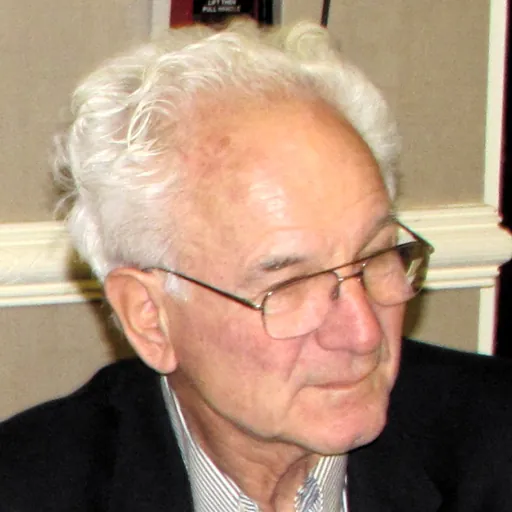
Peter Duesberg
German-American molecular biologist (born 1936)
About Peter Duesberg
Lived 1936 – 2026 (aged 89). Peter Duesberg was an American and German virologist, chemist, university teacher and biologist, known for AIDS denialism and Oncogene.
Peter Heinz Hermann Duesberg (2 December 1936 – 13 January 2026) was a German-American molecular biologist and a professor of molecular and cell biology at the University of California, Berkeley. He is known for his early research into the genetic aspects of cancer. He was a proponent of AIDS denialism, the claim that HIV does not cause AIDS.
Duesberg received acclaim early in his career for research on oncogenes and cancer. With Peter K. Vogt, he reported in 1970 that a cancer-causing virus of birds had extra genetic material compared with non-cancer-causing viruses, hypothesizing that this material contributed to cancer.
Biography
Early life and education Duesberg grew up during World War II, raised as a Catholic in Germany. He moved to the US in 1964 to work at the University of California, Berkeley, following completion of a Ph.D. in chemistry at the University of Frankfurt. and from 1986 to 1987 was a Fogarty scholar-in-residence at the NIH laboratories in Bethesda, Maryland.
Long considered a contrarian by his scientific colleagues, Duesberg began to gain public notoriety with a March 1987 article in Cancer Research entitled "Retroviruses as Carcinogens and Pathogens: Expectations and Reality". In this and subsequent writings, Duesberg proposed his hypothesis that AIDS is caused by long-term consumption of recreational drugs or antiretroviral drugs, and that the retrovirus known as 'HIV' is a harmless passenger virus. In contrast, the scientific consensus is that HIV infection causes AIDS; Duesberg's HIV/AIDS claims have been addressed and rejected as erroneous by the scientific community. Reviews of his opinions in Nature Duesberg disputed these findings in an article in the journal Medical Hypotheses, but the journal's publisher, Elsevier, later retracted Duesberg's article over accuracy and ethics concerns as well as its rejection during peer review. The incident prompted several complaints to Duesberg's institution, the University of California, Berkeley, which began a misconduct investigation of Duesberg in 2009. The investigation was dropped in 2010, with university officials finding "insufficient evidence ... to support a recommendation for disciplinary action."
In 2021, Duesberg had a stroke that left him with severe aphasia affecting speaking, reading, and writing, according to a woman who described him as her husband in an email to the host of a Radio‑Canada podcast.
His work with diseases Cancer In the 1970s, Duesberg won international acclaim for his groundbreaking work on cancer. Duesberg's early work on cancer included being the first to identify the oncogene v-src from the genome of Rous sarcoma virus, a chicken virus believed to trigger tumor growth.
Despite having discovered an oncogene, Duesberg rejects the importance of mutations, oncogenes, and anti-oncogenes entirely. In 1998, Duesberg co-authored a paper reporting a correlation between chromosome number and the genetic instability of cancer cells, which they dubbed "the ploidy factor," confirming earlier research by other groups that demonstrated an association between degree of aneuploidy and metastasis.
Although unwilling to concur with Duesberg in throwing out a role for cancer genes, many researchers support exploration of alternative hypotheses. In 2007, Scientific American published an article by Duesberg on his aneuploidy cancer theory. In an editorial explaining their decision to publish this article, the editors of Scientific American wrote: "Thus, as wrong as Duesberg surely is about HIV, there is at least a chance that he is significantly right about cancer."
A consequence of Duesberg's aneuploidy theory of cancer is his opposition to the HPV vaccine (against the virus that causes genital warts), as the idea that a virus could cause most cases of cervical cancer is inconsistent with his claims about what causes cancer. Although Duesberg generally favors vaccination, he vehemently opposed the rollout of the HPV vaccine, saying the vaccine was "all risk and no benefit".
AIDS
In his 1996 book, Inventing the AIDS Virus, published by Regnery Publishing, a politically conservative book publisher based in Washington, D.C., and in numerous journal articles and letters to the editor, Duesberg asserts that HIV is harmless and that recreational and pharmaceutical drug use, especially of zidovudine (AZT, a drug used in the treatment of AIDS) are the causes of AIDS outside Africa (the so-called Duesberg hypothesis). He considers AIDS diseases as markers for drug use, e.g., use of poppers (alkyl nitrites) among some homosexuals, asserting a correlation between AIDS and recreational drug use. This correlation hypothesis has been disproven by evidence showing that only HIV infection, not homosexuality or recreational/pharmaceutical drug use, predicts who will develop AIDS.
Duesberg asserts that AIDS in Africa is misdiagnosed and the epidemic a "myth", claiming incorrectly that the diagnostic criteria for AIDS are different in Africa than elsewhere, and that the breakdown of the immune system in African AIDS patients can be explained exclusively by factors such as malnutrition, tainted drinking water, and various infections that he presumes are common to AIDS patients in Africa.
A number of scientific criticisms of Duesberg's hypothesis were summarized in a review article in the journal Science in 1994, which presented the results of a three-month scientific investigation into some of Duesberg's claims. In the Science article, science writer Jon Cohen interviewed both HIV researchers and AIDS denialists (including Duesberg himself) and examined the AIDS literature in addition to review articles written by Duesberg. The article said:
The article also said that Duesberg and the AIDS denialist movement have garnered support from some prominent scientists, including Nobel Prize winner Kary Mullis, while others are cited as "equally, if not more, concerned about the treatment Duesberg has received at the hands of the establishment", rather than support of his specific claim that HIV does not cause AIDS.
In a 2010 article on conspiracy theories in science, Ted Goertzel highlights Duesberg's opposition to the HIV/AIDS connection as an example in which scientific findings are disputed on irrational grounds, relying on rhetoric, appeal to fairness and the right to a dissenting opinion rather than on evidence. Goertzel said that Duesberg, along with many other denialists frequently invoke the meme of a "courageous independent scientist resisting orthodoxy", invoking the name of persecuted physicist and astronomer Galileo Galilei. Regarding this comparison, Goertzel wrote: ...being a dissenter from orthodoxy is not difficult; the hard part is actually having a better theory. Publishing dissenting theories is important when they are backed by plausible evidence, but this does not mean giving critics 'equal time' to dissent from every finding by a mainstream scientist.| Goertzel, 2010 The panel was scheduled to meet concurrently with the 2000 International AIDS Conference in Durban and to convey the impression that Mbeki's doubts about HIV/AIDS science were valid and actively discussed in the scientific community. Mbeki later suffered substantial political fallout for his support for AIDS denialism and for opposing the treatment of pregnant HIV-positive South African women with antiretroviral medication. Mbeki partly attenuated his ties with denialists in 2002, asking them to stop associating their names with his.
In response to the inclusion of AIDS denialists on Mbeki's panel, the Durban Declaration was drafted and signed by over 5,000 scientists and physicians, describing the evidence that HIV causes AIDS as "clear-cut, exhaustive and unambiguous".
Two independent studies have concluded that the public health policies of Thabo Mbeki's government, shaped in part by Duesberg's writings and advice, were responsible for over 330,000 excess AIDS deaths and many preventable infections, including those of infants. had been rejected previously by the journal JAIDS, and a peer reviewer had warned that the authors could face scientific misconduct charges if the paper were published.
The reviewers claimed that Duesberg and his co-authors cherry-picked data, cited favorable results while ignoring unfavorable results, and quoted statements out of context. The article was not revised in response to these criticisms. Moreover, the reviewers claim that Duesberg, though he included in the article that neither he nor his co-authors had financial conflicts of interest, "[committed] a serious breach of professional ethics" by failing to state a possible conflict of interest: That co-author Rasnick previously worked for Matthias Rath, a vitamin entrepreneur who sold vitamin pills as AIDS remedies.
Letters of complaint to the University of California, Berkeley, including one from Nathan Geffen of the South African Treatment Action Campaign (TAC), prompted university officials to open an inquiry into possible academic misconduct related to false statements and failure to disclose potential conflicts of interest. He also had stroke-induced aphasia for the last five years of his life.
Don’t just read it —
keep it.
Full-length biographies made to live with: read them, listen on the way to work, watch them tonight.
- E-book
- Audio
- Video
Instant download · yours to keep · every purchase keeps this site free
Important facts
People in Peter Duesberg's life
Named in this biography and alive at the same time







Related people
Same field, nearest in time




Contemporaries
People whose lives overlapped Peter Duesberg's




Frequently asked questions
Who was Peter Duesberg?
German-American molecular biologist (born 1936)
When was Peter Duesberg born?
Peter Duesberg was born on 2 December 1936 in Münster.
When did Peter Duesberg die?
Peter Duesberg died on 13 January 2026 in Lafayette.
What was Peter Duesberg's occupation?
Peter Duesberg was a virologist, chemist, university teacher and biologist.
What was Peter Duesberg known for?
Peter Duesberg was known for AIDS denialism and Oncogene.
What nationality was Peter Duesberg?
Peter Duesberg was American and German.
Sources & further reading
Cite this page
APA: Biography.guide. (2026). Peter Duesberg. https://biography.guide/peter-duesberg/
MLA: "Peter Duesberg." Biography.guide, https://biography.guide/peter-duesberg/.
Chicago: "Peter Duesberg." Biography.guide. https://biography.guide/peter-duesberg/.
Data last updated: 2026-09-23 · Spot an error? Report a correction.
Portrait: Wikimedia Commons · author & licence
Page generated 2026-09-27 05:06 UTC