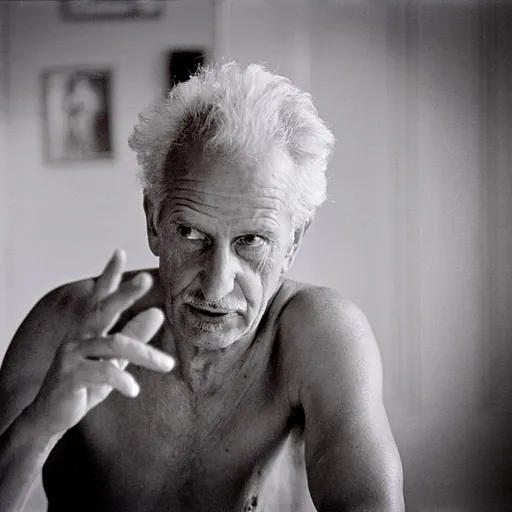
About Percy Cerutty
Lived 1895 – 1975 (aged 80). Percy Cerutty was an Australian coach.
Percy Wells Cerutty (10 January 189514 August 1975) was an Australian athletics coach in the 1950s and 1960s.
The eccentric Australian pioneered a home-spun system of "Stotan" training, embracing a holistic regime of natural diets, hard training in natural surroundings, and mental stimulation.
Cerutty coached Herb Elliott to a series of world record performances, culminating in an Olympic gold medal in the 1960 Rome Games.
Early life
Percy Cerutty was born in Prahran, a suburb of Melbourne, in 1895, the seventh child of Harry Richard Cerutty, accountant, and his wife Emily, née Nielsen, both Victorians. He was four years old when his mother left her alcoholic husband to raise her six surviving children alone.
In 1907, aged 12, he left school to help support the family but was considered unfit to serve in World War I. He competed in athletics without distinction, suffering from illness after racing. Despite this fact, Cerutty was still determined to reach his highest potential.
In 1939, at the age of 43 Cerutty was faced with a formative challenge in his life; a nervous breakdown that necessitated taking leave from work at the Postmaster-General's Department and which prompted a reassessment of his life. After this, he began educating himself in healthy living. He focused on running and weight lifting.
Athlete During World War II, Cerutty began competing in distance running events. having begun the coaching for which he is renowned.
Stotan philosophy
Cerutty's unique "Stotan" philosophies were a blend of Stoic and Spartan principles, a combination that provided Cerutty a base for training his athletes.
In 1946, Cerutty acquired 3/4 acres of land in Portsea with Dorothy Clara Barwell whom he had married in 1921, so that they could start a training camp there. In order to bring this new camp some attention, he ran 80 miles from Portsea to Melbourne. This act is reflective of his overall approach to the sport of distance running.
He introduced this approach to the athletes he trained at his Portsea headquarters. Training would involve running amongst idyllic environments, along beaches and over dunes, and it mixed poetry and philosophy with athletics training. His athletes would undertake a routine of challenging runs up sand dunes, on bark or wood chip paths, barefoot running and lifting weights frequently.
Athletes training under Cerutty said "You came here with the object of running more quickly, and achievement in running, but really it was an education in life" and "You got a whole philosophy of life and attitudes"
The new philosophy of life included the following tenets: and inevitably led to rivalries between Cerutty and other coaches who used different approaches to training.
Cerutty maintained a rivalry with fellow-coach Franz Stampfl whose Interval Training techniques were disliked by Cerutty.
Cerutty's training techniques will always remain controversial among those who study the sport of running. however, Cerutty was not a vegetarian in his personal life and in 1959 commented that "a proportion of meat and fish and poultry is included in the diet, liver being a must". Cerutty also preferred bananas and dairy products.
Herb Elliott
Cerutty's greatest successes came through Herb Elliott. Elliott won two gold medals at the 1958 Empire Games, and set world records at Mile (3:54.5) and 1500 metres (3:36.0) during the year.
Cerutty began coaching Elliott when the runner was eighteen. Elliott was a 4:20 miler when he came to run for Cerutty, and within a few months, he had run 4:06 (a world record at the junior level).
Soon enough, Elliott topped Merv Lincoln to be the top miler in Australia. Lincoln was coached by Cerutty's rival Franz Stampfl. Lincoln and Elliott raced many times, but as Cerutty says of Lincoln "Never did he once beat my Herb Elliott."
Elliott broke the 4 minute barrier on 17 separate occasions; an extraordinary feat for athletes during his time period. Elliott was never bettered at the distance of a mile or the 1500.
At one point during his career, Elliott and Cerutty got in an argument. To solve the argument, Cerutty challenged Elliott to a mile race. Whoever won this race would also win the argument. Sure enough they raced and Cerutty was clearly beaten on time; he was racing the top miler in the world who didn't even have to try to win the race between the two of them. However, when Cerutty crossed the line, he told Elliott that he had won because he had put in more effort than Elliott. His point being that regardless of the circumstances, 100% effort should always be put forth. This story reflects accurately upon his "Stotan" training philosophy.
Other athletes
Further athletes trained or assisted by Cerutty included:
John Landy - 1956 Olympic Bronze Medal 1500 metres - World Mile Record David (Dave) William Power - marathon runner - Olympic bronze medallist; dual Commonwealth Games gold medallist.
Cerutty also helped cyclist Russell Mockridge and boxer Jimmy Carruthers during their sporting careers. His strict training philosophy was not exclusive to distance running and could be transferred effectively to other sports because it taught competitors how to be tough; Cerutty saw his approach as a way of life and a way to train.
Retirement
Cerutty gave up coaching athletes in 1969 and continued to live at his beloved Portsea home - CERES.
Cerutty was appointed a Member of the Order of the British Empire (MBE) in the 1972 Birthday Honours for services to sport and physical fitness, and described as "Australia's most enigmatic, pioneering and controversial athletics coach".
Posthumously Cerutty was inducted into the Sport Australia Hall of Fame for his athletics coaching on 5 December 1989.
Personal life Cerutty and Dorothy Clara Barwell married at the East Malvern Baptist Church on 7 November 1921. They divorced in 1955, then on 3 March 1958 he married divorcee Ellen Ann ('Nancy'), née Keene, late Armstrong, at the Unitarian manse, East Melbourne. He died of motor neurone disease on 14 August 1975 at his home in Portsea and is buried at Sorrento cemetery.
Don’t just read it —
keep it.
Full-length biographies made to live with: read them, listen on the way to work, watch them tonight.
- E-book
- Audio
- Video
Instant download · yours to keep · every purchase keeps this site free
Important facts
People in Percy Cerutty's life
Named in this biography and alive at the same time






Related people
Same field, nearest in time


Contemporaries
People whose lives overlapped Percy Cerutty's
Frequently asked questions
Who was Percy Cerutty?
Australian athletics coach (1895–1975)
When was Percy Cerutty born?
Percy Cerutty was born on 10 January 1895 in Melbourne.
When did Percy Cerutty die?
Percy Cerutty died on 14 August 1975 in Portsea.
What was Percy Cerutty's occupation?
Percy Cerutty was a coach.
What nationality was Percy Cerutty?
Percy Cerutty was Australian.
Sources & further reading
Cite this page
APA: Biography.guide. (2026). Percy Cerutty. https://biography.guide/percy-cerutty/
MLA: "Percy Cerutty." Biography.guide, https://biography.guide/percy-cerutty/.
Chicago: "Percy Cerutty." Biography.guide. https://biography.guide/percy-cerutty/.
Data last updated: 2026-09-22 · Spot an error? Report a correction.
Portrait: Wikimedia Commons · author & licence
Page generated 2026-09-27 04:57 UTC