
About Pepi Sánchez
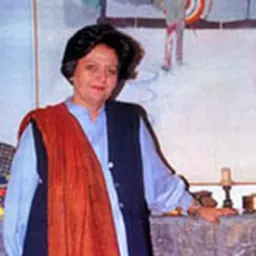
Lived 1929 – 2012 (aged 82–83). Pepi Sánchez was a Spanish painter and artist.
Pepi Sánchez was a Sevillian painter. Born in 1929, she moved to Madrid in 1958 and lived there until she died in 2012.
Her style featured oneiric elements and had a Baroque influence. Her work represents an addition to Spanish plastic arts. She was known for her use of unmodified rocks and stones as a support for her paintings. The characters that inhabit the structures in her paintings adapt themselves to the grooves in the stones, resulting in a combination of painting and sculpture.
Early life Josefa Sánchez Díaz started at the age of 12 when she joined the Santa Isabel de Hungria School of Fine Arts, in Seville. There her talent impressed teachers, as proven by her high grades and the awards she received. Later, however, these same teachers were to feel disappointed when, after finishing her training, she left the mainstream Realism, which she mastered, to start a new path, breaking away from the established styles.
Challenged by the dominant traditionalism, "She began working at what was starting to be called 'Modern Art', and refused to submit to the interfering past", declared José María Moreno Galván at the presentation of her first individual exhibition in Madrid (1954). After this first exhibition, there have been more than fifty opportunities to admire her work.
Recurring subjects in her work include angels, children, fantastical animals, princesses, and mythical creatures, often set in dreamlike, imaginary landscapes and structures. Alongside these, her paintings also depict figures such as feminists, disillusioned princes, weary caryatids, and dying stars; according to the museum, these figures convey messages that remain critical and forceful despite the gentleness of her style.
Biography
Josefa Sánchez Díaz, was born in Seville on 4 April 1929, second daughter of Ana María Díaz and José Sánchez. She had an elder sister, Lola.
Her father died from peritonitis when Pepi was only two years old. As a result, the young widow moved with her daughters to the house of her sister Concha, who was twenty years her elder and married to an Italian, Ernesto de Micheli Rivaro, employed at the Italian Consulate.
This childless couple "adopted" these two girls, involving themselves completely in their education. Uncle Micheli took the role of the father figure, while the two sisters, the cheerful Ana Maria and the more serious and formal Concha, shared the role of mother.
With a strict old fashioned view on education, this Italian from the outskirts of Milan was contrary to the idea of the girls going to school, preferring to provide them with private education. Consequently, he hired a teacher to come home every day. This childhood with little contact with other children led Pepi not to savour her infancy and left her wishing to prolong it.
Uncle Micheli was a strong influence in the artistic development of the two sisters. He was an expert and a great admirer of Italian art, and he helped them appreciate and love it from an early age. As a result, both sisters decided they wanted to become painters. At the young age of 9 and 12, Pepi and Loli entered Jose Maria Labrador's studio, a Cordovan painter settled in Seville, A few years later the two sisters joined the Santa Isabel de Hungria School of Fine Arts in Seville. Pepi was only 12, so she needed a special permit from the Ministry of Education to join the school. Soon she started standing out and earned State Awards in all her courses.
Her two trips to Italy in 1952 and 1955 were important in developing Pepi's style. Directly seeing Giotto, Mantegna, Paolo Ucello, Piero Della Francesca frescoes and all the Italian art that she had admired for years through books and photographs, left an indelible imprint.
Open to everything that meant renovation and modernity, after finishing her training, she broke with the official academic-ism and joined an avant-garde group called "Young Sevillian School of Painting and Sculpture".
As we can see from her Curriculum Vitae, Pepi's paintings, ceramics and mosaics were to be admired in many exhibitions.
In 1958 she married the Sevillian writer, Manuel Garcia Viño, and in a search for a more modern environment, they moved to Madrid. They stayed some time with Rafael Montesinos, a Sevillian poet, and his wife Marisa, until they received the keys to their new home.
The children followed soon: Monica (1959), Patricia (1960), Manolo (1962), Pablo (1964) and Chema (1966).
Being the mother of a large family with all the responsibilities and work entailed, did not stop her from devoting herself to her art with courageous perseverance.
There was a clear change in her iconography after she became a mother. As from 1959 her world became more personal That was the time when her world became the fantasy of princes, wizards and legendary characters, taking on those poetic and suggestive titles. It was also during those first years of motherhood that she started a busy career as an illustrator. She would become a frequent collaborator for "La Estafeta Literaria", among others, and in 1966 she illustrated "Historia y Antología de la Literatura Infantil Iberoamericana" by Carmen Bravo Villasante, Doncel publishing house.
In 1965, while playing with the children, she discovered stones as a support for her magical characters. At first, she used rounded stones from the river beds. Later, as her compositions became more baroque, she made use of lime stones with complex forms and grooves, found in the province of Guadalajara.
Her singular imaginative world has been a source of inspiration to her husband and many other poets and writers, who have written about her and her art: Manuel Alcántara, Montserrat del Amo, Marcelo Arroita-Jáuregui, Alfonso Canales, Antonio Enrique, Francisco Garfias, Antonio Hernández, Luis Jiménez Martos, Antonio Leyva, Manuel Mantero, Joaquín Márquez, Rafael Montesinos, Rafael Morales, Federico Muelas, Digna Palou, Fernando Quiñones, José María Requena, Mariano Roldán and Lázaro Santana are among them.
In 1984 she and the politician and art collector, Agustin Rodriguez Sahagun, signed an exclusivity contract, which his heirs took through to 2002.
An indefatigable worker, she continued painting until a few days before she died on 5 March 2012 in Madrid.
Museums and Public Collections
Museo Nacional Centro de Arte Reina Sofía. Museo de Arte Contemporáneo de Toledo. Museo de Arte Contemporáneo de Sevilla. Museo de Arte Contemporáneo de Vilafamés. Castellón. Museo Etnográfico de Povoa de Varzim, Oporto, Portugal. Museo Nacional de Artes Decorativas. Madrid. Museo Internacional de Arte Contemporáneo de Guinea Ecuatorial. Escuela de Estudios Hispanoamericanos de Sevilla. Instituto Nacional de Educación Física, Madrid. Ateneo de Madrid. Ministerio de Educación y Ciencia, Madrid. Caja de Ahorros de Córdoba. Escuela Superior de Santa Isabel de Hungría de Sevilla. Caja de Ahorros de San Fernando de Sevilla. Centro Cultural Español de El Cairo. Museo Provincial de Badajoz. Museo Municipal de Huete, Cuenca.
Don’t just read it —
keep it.
Full-length biographies made to live with: read them, listen on the way to work, watch them tonight.
- E-book
- Audio
- Video
Instant download · yours to keep · every purchase keeps this site free
Important facts
People in Pepi Sánchez's life
Named in this biography and alive at the same time





Related people
Same field, nearest in time


Contemporaries
People whose lives overlapped Pepi Sánchez's
Frequently asked questions
Who was Pepi Sánchez?
Spanish painter (1929-2012)
When was Pepi Sánchez born?
Pepi Sánchez was born in 1929 in Seville.
When did Pepi Sánchez die?
Pepi Sánchez died in 2012 in Madrid.
What was Pepi Sánchez's occupation?
Pepi Sánchez was a painter and artist.
What nationality was Pepi Sánchez?
Pepi Sánchez was Spanish.
Sources & further reading
Cite this page
APA: Biography.guide. (2026). Pepi Sánchez. https://biography.guide/pepi-sanchez/
MLA: "Pepi Sánchez." Biography.guide, https://biography.guide/pepi-sanchez/.
Chicago: "Pepi Sánchez." Biography.guide. https://biography.guide/pepi-sanchez/.
Data last updated: 2026-09-20 · Spot an error? Report a correction.
Page generated 2026-09-27 05:19 UTC