
About Pepe Marchena
Lived 1903 – 1976 (aged 73). Pepe Marchena was a Spanish cantaor, actor, singer and musician.
José Tejada Marín (November 7, 1903 – December 4, 1976), known as Pepe Marchena and also as Niño de Marchena in the first years of his career, was a Spanish flamenco singer who achieved great success in the ópera flamenca period (1922–1956). Influenced by singers like Antonio Chacón, he carried to the extreme the tendency to a more mellow and ornamented style of flamenco singing. Owing to his particular vocal conditions and singing style, he excelled mainly in palos (styles) like fandangos, cantes de ida y vuelta and cantes libres, contributing to making them the most popular flamenco styles in the era of the ópera flamenca, and created a new cante de ida y vuelta, the colombiana, later recorded by many other artists like El Lebrijano or Enrique Morente. He was also the first flamenco singer to use an orchestra to accompany flamenco singing, though later he returned to the guitar.
Marchena also revolutionized the public image of the flamenco singer: he was the first to sing standing on the stage (instead of sitting on a chair as had always been usual in flamenco), and often wore unusual outfits, such as riding clothes.
After the Spanish Civil War, he made two films: La Dolores and Martingala, and came back to the theatre in 1943 with La encontré en la serranía. In 1945 he visited Buenos Aires with the show Feria de Sevilla, together with Carmen Amaya, which stayed in the Teatro Avenida for three months, and finished his Latin American tour in Montevideo and Rio de Janeiro. In 1950 he accomplished a rare achievement for flamenco singers at the time: he started a tour in Morocco and Algeria, which was followed by concerts in Paris. During the 1950s he kept touring Spain with several concerts and theatre shows.
In 1961, he travelled to Karachi, Pakistan, to illustrate a lecture by Aziz Balouch, a Pakistani musicologist and Sufi philosophy student who had come to Spain to study flamenco and enjoyed temporary success as a flamenco singer. In 1965 and 1966 he toured with show Así Canta Andalucía, taking it again to Morocco and France. Towards the end of the decade of the sixties he reduced the number of his performances. In 1974, he received an homage in his hometown of Marchena, where singers like Juan Valderrama and Perlita de Huelva took part. In 1976, already ill with cancer, he received the Gold Medal of Marchena and Juan Valderrama organized a festival in his benefit, with the participation of several artists. He died in December of that same year. In 1986, a monument in his honour was erected in Marchena.
His work Pepe Marchena has probably been the most controversial flamenco singer in the 20th century. Although he has usually been considered as one of the prototypical non-Gypsy flamenco singers, Manuel de Falla, a lover of Gypsy singing, said of him: "In the Niño de Marchena, with the crystal clear pureness of a mountain spring, we find the inexhaustible charm of the authentic Andalusian singing, without the obstacles that diminish it when it is locked up in futile songs." And Leopold Stokowsky affirmed: "Niño de Marchena has the emotion of the plain chant expressed by a genius interpreter. If his prodigious fioritura could be taken to the score, he would astonish the world."
During the 1990s, together with a certain revival of the cantes de ida y vuelta and a reappreciation of the ópera flamenca period, his figure came back into favour for a significant part of the critics, artists and flamenco public. His influence was claimed by several outstanding singers, including Enrique Morente, Mayte Martín or Arcángel. A clear example is Álvarez Caballero himself who, only two years after writing the words quoted above, directed a partial compilation of his recordings (Un monumento al cante, Quejío collection, EMI, 1997), with an introductory leaflet in which he stated:
A singer of delicate ornaments, in the styles from Málaga and Eastern Andalusia he excelled especially with a convincing expressive quality. He was also an extraordinary interpreter of fandangos.[...] Pepe Marchena cannot be ranked together with his imitators. Marchena had a great personality, an extraordinary musical talent.[...] After his death, Marchena's popularity suffered diverse changes. His unconditional admirers kept affirming their adoration for him but, in general, the critical tendency gathered momentum. Later, however, marchenismo gradually gained prestige, and nowadays we have the impression that flamencologist and serious flamenco lovers increasingly value his work.
Partial discography As usual with flamenco works recorded before the decade of the sixties, Marchena's original recordings are regularly republished in different compilations. No reordered and complete republishing of his records has been made of his work. The list below is not complete and contains compilations published in the decades of the nineties and after the year 2000.
Pepe Marchena. Arte flamenco vol. 15. Las flores de la decadencia, Mandala, 1990
Pepe Marchena. Cantaores de época. Vol. 1, Fods, 1995 Comments and audio samples in Flamenco-world.com
El Niño de Marchena: primeras grabaciones. 1924–1934, Nuevos Medios, 1996. Early recordings.
Un monumento al cante, Quejío collection, EMI, 1997. Compilation of songs.
Grandes Figuras del Flamenco (Vol. 10). Pepe Marchena. Comments and audio samples in Flamenco-world.com.
Pepe Marchena. Flamenco viejo. El flamenco como suena. Recordings since 1950.
Niño de Marchena acompañado por Ramón Montoya y Orquesta. Flamenco Histórico. Vol. 10, dial, 1998
Pepe Marchena. Éxitos, Fonotrón, 1999
Niño de Marchena. Antología – La Epoca Dorada del Flamenco, Vol. 1, Tecnodisco, 2001
Pepe Marchena. Grabaciones discos pizarra. Año 1930, 2002 Comments and audio samples in Flamenco-world.com
Así era Pepe Marchena, 2003. Includes audio CD and a 72-page booklet. More information in Elflamencovive.es
Niño de Marchena. Antología – La Epoca Dorada del Flamenco, Vol. 22, Tecnodisco, 2003
Pepe Marchena. La voz de los pueblos, 2003. Special Edition for the 100th anniversary of Marchena's birth (1903–2003).
Pepe Marchena. 50 años de Flamenco. 1940–1990 (1ª época), Divucsa, 2003
Cantaores de época. Pepe Marchena. Vol 6, 2004. Audio samples in Esflamenco.com
Niño de Marchena. Antología – La Epoca Dorada del Flamenco, Vol. 36, Dienc, 2005
Flamenco y Universidad. Vol 1, 2006. Contains lecture offered on February 28, 1972 by Pepe Marchena at the University of Seville', together with songs in diverse flamenco styles.
Don’t just read it —
keep it.
Full-length biographies made to live with: read them, listen on the way to work, watch them tonight.
- E-book
- Audio
- Video
Instant download · yours to keep · every purchase keeps this site free
Important facts
People in Pepe Marchena's life
Named in this biography and alive at the same time




Related people
Same field, nearest in time

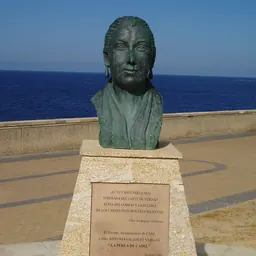


Contemporaries
People whose lives overlapped Pepe Marchena's
Frequently asked questions
Who was Pepe Marchena?
Spanish singer (1903–1976)
When was Pepe Marchena born?
Pepe Marchena was born on 7 November 1903 in Marchena.
When did Pepe Marchena die?
Pepe Marchena died on 4 December 1976 in Seville.
What was Pepe Marchena's occupation?
Pepe Marchena was a cantaor, actor, singer and musician.
What nationality was Pepe Marchena?
Pepe Marchena was Spanish.
Sources & further reading
Cite this page
APA: Biography.guide. (2026). Pepe Marchena. https://biography.guide/pepe-marchena/
MLA: "Pepe Marchena." Biography.guide, https://biography.guide/pepe-marchena/.
Chicago: "Pepe Marchena." Biography.guide. https://biography.guide/pepe-marchena/.
Data last updated: 2026-09-20 · Spot an error? Report a correction.
Page generated 2026-09-27 05:34 UTC