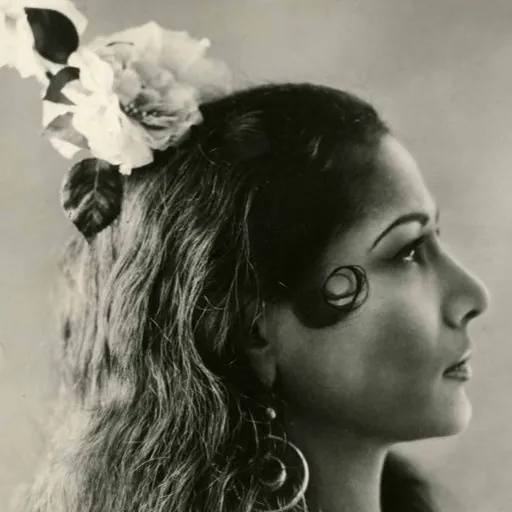
About Carmen Amaya
Lived 1918 – 1963 (aged 45). Carmen Amaya was a Spanish singer, bailadora flamenca, actor and dancer.
Carmen Amaya Amaya (2 November 1918 – 19 November 1963), nicknamed La Capitana (English: The Captain) was a Spanish Romani flamenco dancer and singer, born in the Somorrostro district of Barcelona, Catalonia, Spain.
She is often hailed as "the greatest Flamenco dancer ever" and "the most extraordinary personality of all time in flamenco dance." She was the first female flamenco dancer to master footwork previously reserved for the best male dancers, due to its speed and intensity. She sometimes danced in high-waisted trousers as a symbol of her strong character.
Biography Carmen Amaya Amaya was born in Somorrostro, Spain, to a Romani family, her father José Amaya Amaya (alias "El Chino", "The Chinaman"), a guitar player, and Micaela Amaya Moreno, her mother. Carmen was the second of eleven children, although only six (three sisters and two brothers) survived to adulthood. She was also the cousin of famed flamenco dancers Chato Amaya, Remedios Amaya, La Chunga, and La Chunguita.
Her date of birth is disputed. Montse Madridejos and David Pérez Merinero name 1918 as her year of birth. They cite Barcelona's inhabitants list of 1930, in which a family Amalla with a 12-year-old daughter Carmen is mentioned. They claim that no birth document is available and the document of baptism was lost due to a church fire. Furthermore, a 1920 oil painting by Julio Moisés named Maternidad shows a mother with a 2-3 year old girl, supposed to be Carmen with her mother Micaela. According to them, photographs showing Carmen Amaya as a teenager also support 1918 as the year of birth. According to Montse Madridejos, professor of Music History at the University of Barcelona and a flamenco history researcher, who specializes in Carmen Amaya, her ethnicity could have also been a factor in the birth date ambiguity: "At that time, a gypsy was neither baptized, nor registered".
In 2023, the researcher Montse Madridejos published an academic article in the journal Sinfonía Virtual in which she underscores and gives more weight to 1918 as the possible year of birth of Carmen Amaya.
Amaya entered the flamenco world accompanied by her father, an impoverished Calé Romani guitarist who made a living by playing in pubs day and night. When Carmen was a child, she started going out with her father at night. He accompanied her on the guitar while she performed. Afterwards, they begged and picked the small change that the public threw on the floor. Soon earned her first nickname, "La Capitana".
At the same time, she started to appear in some lesser known theaters. It was only after Josep Santpere, a bright variety show businessman, showed for the first time his interest in Carmen and introduced her to more prestigious venues, that she made her debut at the Spanish Theatre
The first time she appeared in print was in 1931 thanks to Sebastià Gasch, an art critic who saw her and wrote an article in the weekly newspaper .
At this point Vicente Escudero, a respected businessman, saw her dancing and concluded that Carmen would bring about a flamenco revolution thanks to her perfect synthesis of two important styles: that of the traditional dancers, and the emerging style of dancers in the variety shows. a member of her troupe, coming from a distinguished family from Santander, who was not Romani. They lived an authentic love story and celebrated an intimate wedding. In 1959, Carmen experienced one of the most exciting moments of her life, when the inauguration ceremony of a fountain bearing her name was held. The fountain was placed on the Paseo Marítimo de Barcelona, which crosses the neighbourhood of Somorrostro, the same places where she had walked by many years before as a child, barefoot and dragging her misery.
In subsequent years she continued her work in northern Europe, France, Spain, the United States, Mexico and South America. She triumphed at the Westminster Theatre in London and at La Zarzuela theatre in Madrid in 1959. At that time, Barcelona paid tribute to Carmen Amaya by building the Carmen Fountain in the artist's old home district, Somorrostro, to popular acclaim.
She recorded her last film, Los Tarantos, by Rovira-Beleta in 1963, and afterwards continued working. At the end her illness, a kind of renal impairment that impeded her properly eliminating the toxins that her body accumulated, prevented her from continuing in Gandía.
Her illness was exacerbated by the filming of her latest film, Los Tarantos, directed by Rovira-Beleta (1963). Carmen overcame her health issues and at the end of filming started a summer tour. The last time she performed in Madrid, she was already terminally ill. Finally, her illness stopped her from performing. The doctors could not find a suitable treatment. She danced for the last time in Malaga. On 8 August 1963, whilst she was working in Gandía, Carmen interrupted her performance. She was dancing when suddenly she said to Batista: "Andrés, we finished."
Death Carmen Amaya died of kidney disease in Begur, Girona, Catalonia, northeast Spain, in 1963 and is buried at the Cemetery of Ciriego in Santander. Posthumous monument erected in honor of Carmen Amaya. Located in Begur, Spain. She was awarded the Medal of Merit of Tourism in Barcelona, the Lasso of the Lady of the Order of Isabel la Católica award, and given the title of Adoptive Daughter of Begur.
Three years after her death (1966) she was honored by a monument placed in the Amusement Park of Montjuic. Buenos Aires has a street named after her. In Madrid in the "Tablao" Los Califas, she was honored by a tribute performance in which many artists participated, including Lucero Tena, Mariquilla, and Felix de Utrera.
In 1988, as an homage to Carmen Amaya, the Tablao de Carmen was founded in the Poble Espanyol, the very place where she danced for the King of Spain Alfonso XIII during the inauguration of the 1929 Barcelona International Exposition. Tablao de Carmen displays some of the photographic legacy of Carmen Amaya. The guitar of her husband Juan Antonio Agüero (by Santos Hernández 1930) is a part of the patrimony of the founder family of Tablao de Carmen and it is played in the Tablao on special occasions.
Medals and recognition awards Her death was a great loss for the entire Flamenco world. She was awarded with the Medalla del Mérito Turístico de Barcelona, Lazo de Isabel la Católica and the title of Hija Adoptiva de Bagur. Her funeral summoned a large number of Roma People from different parts of Spain and even France.
Amaya died in Bagur, where she spent her last days, her remains rest in the crypt of her husband's family, in Santander. Three years after her death in 1966, the statues of her were erected in the Parque de Montjuic in Barcelona, and in Buenos Aires, while in Madrid, in Tablao Los Califas, a tribute, led by Lucero Tena, among other artists, took place. She was also honored in Llafranch (Girona) in 1970.
The personality of Carmen Amaya has been celebrated by critics, flamencologists and writers, as well as by poets, including Fernando Quiñones, author of the poem Soneto y letras en vivo para Car men Amaya. A selected transcription of these comments by Vicente Marrero, reads: Carmen Amaya can see the amazing conviction that sometimes tends to dance. "Gitanilla" ungainly, skinny, petite, almost disembodied. Brunette, with a tragic and remote idol face, Asian cheekbones, with long eyes full of omens, twisted arms. With her "repajolera" gypsy [Romani] grace, she is not just another millionaire in North America, but one of our great dancers, who has succeeded, with the secret of dance and her dance she was born to dance, and she danced phenomenally. Carmen Amaya, is her name, is not a different woman in each of her dances, as so often happens with other great dance figures.
The performance technique of Amaya was often described by contemporaries in reviews, emphasizing her strong stage presence and distinctive physical technique. Her expressive body movements and Romani background were often mentioned in reviews as the main features of her art. During her years of activity in North America, Amaya gained a considerable financial success and became a well-known personality of the flamenco dance.
Carmen's flamenco legacy is still valid to this day as an example of dancing with force, meter, intensity and power and a way of expression which brought an end to the sweetness of flamenco which had endured until that point. The famous producer Sol Hurok described Carmen as "The Human Vesuvius." Carmen Amaya has been the incarnation of the flamenco dance par excellence. She has danced in numerous films.
On 2 November 2023, Google celebrated her 110th birthday with a Google Doodle.
Selected filmography 1929 - La bodega (Wine Cellars) 1934 - 2 mujeres y 1 Don Juan 1935 - La hija de Juan Simón 1935 - Don Viudo de Rodríguez 1936 - María de la O 1939 - Embrujo del Fandango (Cuba) 1941 - Original Gypsy dances 1942 - Aires de Andalucía 1942 - Panama Hattie 1944 - Knickerbocker Holiday (Pierna de Plata) 1944 - Follow the Boys (Sueños de Gloria) 1945 - Los amores de un torero (México) 1945 - See My Lawyer (Entiéndase con mi abogado) 1953 - When Do You Commit Suicide? (1953 film) 1954 - Dringue, Castrito y la lámpara de Aladino 1955 - Música en la Noche 1963 - Los Tarantos
Don’t just read it —
keep it.
Full-length biographies made to live with: read them, listen on the way to work, watch them tonight.
- E-book
- Audio
- Video
Instant download · yours to keep · every purchase keeps this site free
Important facts
People in Carmen Amaya's life
Named in this biography and alive at the same time


Related people
Same field, nearest in time




Contemporaries
People whose lives overlapped Carmen Amaya's





Frequently asked questions
Who was Carmen Amaya?
Spanish flamenco dancer and singer
When was Carmen Amaya born?
Carmen Amaya was born on 2 November 1918.
When did Carmen Amaya die?
Carmen Amaya died on 19 November 1963 in Begur.
What was Carmen Amaya's occupation?
Carmen Amaya was a singer, bailadora flamenca, actor and dancer.
What nationality was Carmen Amaya?
Carmen Amaya was Spanish.
Sources & further reading
Cite this page
APA: Biography.guide. (2026). Carmen Amaya. https://biography.guide/carmen-amaya/
MLA: "Carmen Amaya." Biography.guide, https://biography.guide/carmen-amaya/.
Chicago: "Carmen Amaya." Biography.guide. https://biography.guide/carmen-amaya/.
Data last updated: 2026-09-21 · Spot an error? Report a correction.
Portrait: Wikimedia Commons · author & licence
Page generated 2026-09-27 05:01 UTC