
Josefa Díaz Fernández
Spanish cantaora (flamenco singer)
About Josefa Díaz Fernández
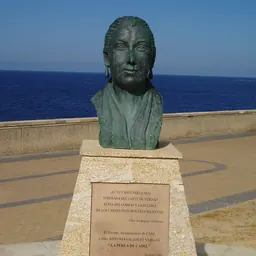
Lived 1871 – 1918 (aged 47). Josefa Díaz Fernández was a Spanish cantaor and bailadora flamenca.
Josefa Díaz Fernández, popularly known as Pepa de Oro, (Cádiz, 29 January 1871 – Cádiz, 18 May 1918), was a Spanish flamenco dancer and singer.
She shot to fame when she introduced Spain to the first milongas aflamencadas of Argentine folklore in 1904.
Biography Josefa Díaz Fernández, Pepa de Oro, was born in Cádiz on 29 January 1871. She was the daughter of the bullfighter Francisco Díaz García, Paco de Oro, and the flamenco singer Agustina Fernández Fernández. Pepa de Oro, was better known for her role in the world of dance than in that of folk singing. As young girl she accompanied her father in the bullfighting seasons of Latin America. There she encountered and absorbed milonga folk singing and gave it its unique style, mastering the rhythm of the tango; and she is credited for the creation of the flamenco milonga.
Her mother's brothers were the great singers María Fernández, La Borrico, and Pedro Fernández, known as El Viejo de la Isla.
After her mother's death in 1873, when she was 21, her father married Juana Vargas Ceda. At that point, her father and Juana did not reside in the same house, so they had to start poverty file proceedings. María Ceda, Juana's mother, was responsible for raising her, along with her stepsister, Antonia Díaz Vargas, born in 1884.
Pepa de Oro was a very popular figure in the “cafés cantante” in Jerez de la Frontera, Cádiz, Málaga, Sevilla, Madrid... In 1885 she was already In full artistic swing in the Café de Caviedes, receiving great applause from the fans who filled the cafés night after night.
Juan Junquera, from Jerez de la Frontera, became Pepa de Oro’s manager and organised her a tour around Argentina. Upon her return to Spain, Pepa de Oro had adapted the Argentinian milonga to her most peculiar musical style, Flamenco, and she offered shows with the milonga as the main act everywhere she performed. In those days, Pepa got to perform in the Salón Filarmónico in Seville, where she shared the stage with artists such as Enriqueta la Macaca, Carmen la Pichira, Carlota Ortega or Antonia Gallardo la Coquinera, among others.
In her youth, Pepa de Oro married a banderillero. After her first husband died, she married Esteban de Jerez¸ whom she later divorced. Finally, she lived with a flamenco singer from Seville known as El Macareno. Both set up a hostel in Madrid. This business did not go as expected, so Pepa decided to go back to her hometown, Cádiz. She left the music world, despite struggling financially.
From a musical perspective, it is more interesting the flamenco touch of a foreign music, though it keeps the original rhythm and accent.
The milonga followed an evolutive process that probably had its origins in the yaravi and other styles such as triste and cifra. In 1860, triste became milonga¸ and it was between 1880 and 1910 that the milonga reached the top.
Since the 13th Edition coincided with the celebration of the 5th Centenary of America, it was decided that a new group in the section of “folk singing” be added: cante de ida y vuelta.
Finding a name for this new category sparked a great debate. On the one hand, the “cantes de ida y vuelta” was the last artistic creation that the genre had had. Its most powerful defenders had been some flamenco divos, those who gave it harmonious and theatrical worth. Zarzuela and Género Chico were two of the many inspirations.
Don’t just read it —
keep it.
Full-length biographies made to live with: read them, listen on the way to work, watch them tonight.
- E-book
- Audio
- Video
Instant download · yours to keep · every purchase keeps this site free
Important facts
Related people
Same field, nearest in time




Contemporaries
People whose lives overlapped Josefa Díaz Fernández's


Frequently asked questions
Who was Josefa Díaz Fernández?
Spanish cantaora (flamenco singer)
When was Josefa Díaz Fernández born?
Josefa Díaz Fernández was born on 29 January 1871 in Cádiz.
When did Josefa Díaz Fernández die?
Josefa Díaz Fernández died on 18 May 1918 in Cádiz.
What was Josefa Díaz Fernández's occupation?
Josefa Díaz Fernández was a cantaor and bailadora flamenca.
What nationality was Josefa Díaz Fernández?
Josefa Díaz Fernández was Spanish.
Sources & further reading
· Wikipedia: Josefa Díaz Fernández
· DBpedia: Josefa Díaz Fernández
Cite this page
APA: Biography.guide. (2026). Josefa Díaz Fernández. https://biography.guide/josefa-diaz-fernandez/
MLA: "Josefa Díaz Fernández." Biography.guide, https://biography.guide/josefa-diaz-fernandez/.
Chicago: "Josefa Díaz Fernández." Biography.guide. https://biography.guide/josefa-diaz-fernandez/.
Data last updated: 2026-09-22 · Spot an error? Report a correction.
Page generated 2026-09-27 05:19 UTC