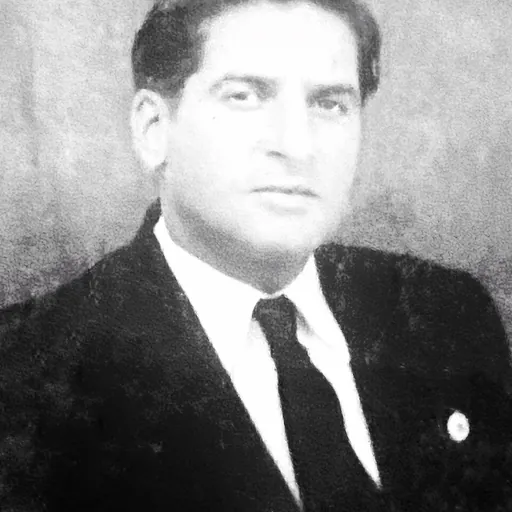
About Pedro Pablo Cazañas
Lived 1902 – 1978 (aged 75). Pedro Pablo Cazañas was a politician.
Pedro Pablo Cazañas y García (December 5, 1902 – June 28, 1978) was a Cuban judge and politician.
Early life
Pedro Pablo Cazañas y García was born December 5, 1902, in Matanzas, Cuba to Francisco E. Cazañas and Enriqueta García Martín. His family was of considerable wealth and he was raised on their Buena Vista estate near Varadero. Cazañas would remain in Cuba for much of his life before emigrating to the United States in the late 1960s as a result of the Cuban Revolution.
Career
Cazañas attended the University of Havana, earning a doctorate in law, after which Cazañas was often referred to as "Doctor Pedro (Pablo) Cazañas" in official documents, journals, and media. Cazañas served as a traveling judge, holding court in various locations across Cuba that required a judge on a case-by-case basis before becoming an increasingly prominent politician in the Cuban judiciary as a municipal and then regional judge.
In the 1930s Cazañas married Raquel María Díaz Teresa, thereafter Raquel Díaz Cazañas. The marriage was significant due to the Díaz family's importance in the San José de los Ramos area of Matanzas. Her father, José Lorenzo Díaz, was an administrator in the Cuban judicial system, working in the Juzgado de Primera Instancia (Court of First Instance) of the broader Colón area until his death in 1954. The Díaz family was also regarded for replacing the small chapel in the town center with a grand church.
After the coup d'état of 1952, Cazañas' stature in Cuba's judiciary rose further through the rest of the 1950s during the regime of Fulgencio Batista, with whom Cazañas had ties. However Batista was unable to attend due to his required presence in state visit abroad, therefore a top representative was sent to the ceremony in his place. Cazañas’ support of Batista would be a recurring source of generational tension with his children, each of whom were opposed to Batista.
Later life
The Cazañas family opposed Fidel Castro and, following the Cuban Revolution, some were able to leave the island to take refuge in the United States and seek life in democracy there. The first of his children to leave Cuba was Eduardo, in 1959, who would later join the United States Armed Forces. Cazañas' younger daughter, Marta, was deeply involved in the counter-revolution against Castro and left to the United States with her future husband Jesús Permuy, a leader of the counter-revolution, via Venezuela following the failure of the 1961 Bay of Pigs Invasion. The couple relocated permanently to Miami by 1968 and their eldest daughter's family joined them the following year.
Family Immediate ancestry
Both Pedro Pablo Cazañas’ ancestry and descendants have been a prominent force in Europe (especially Spain), the Caribbean, and the United States. In his immediate family, Cazañas’ grandfather, Francisco José Cazañas y Peraza (born 1840) was directly descendant of the Peraza and Bobadilla families that were influential in the Castilian royal court, ruled the Canary Islands, and participated in the conquest of the New World, including Cuba and Hispaniola. It was this Peraza lineage of the family that traveled from Spain to Cuba and the United States in the nineteenth century. Several generations of the Cazañas family would maintain regular business travel to the United States and be educated there before ultimately migrating back to the United States permanently following the Cuban Revolution. In Cuba the Cazañas family were significant landholders in Matanzas and owned several large estates, manor houses, and plantations, including the historic sugar plantation Dos Rosas, which was purchased in 1868 by Bartolomé Cazañas, great-grandfather of Pedro Pablo Cazañas. The country estate was originally named "San Francisco de Paula-Riverol" and Bartolomé Cazañas renamed it that year to "Dos Rosas" (Spanish for "Two Roses") in honor of his Italian wife and their daughter, both named Rosa. The publication was a literary collection dedicated to the debutantes of the Matanzas region's most prominent families in which a flower-themed poem was dedicated to each emerging ("blossoming") socialite. As an adult she owned the vast finca Buena Vista overlooking Varadero, its champion horses, and yacht while her husband Francisco would manage the estate's staff and grounds. The couple, which traveled frequently to the United States and would occasionally reside there, first filed their claims with the commission in 1902, the year Pedro Pablo was born. It took six years to settle their claims, in which Francisco's legal background and US ties proved useful. Their claims were finally settled in 1908 when the Secretary of the Treasury of the United States awarded the couple total compensation of $13,138 ($9,738 to Enriqueta and $3,400 to Francisco), equivalent to over $360,000 in 2020, adjusted for inflation. They received the second highest awards granted by the commission, and the highest among private citizens not representing a corporation. who became the second highest-ranking doctor in the Matanzas province and was later Chief Doctor of the Port of Matanzas and Head of Administration.
Extended ancestry
Pedro Pablo Cazañas’ ancestry is noted for several prominent lines. In addition to the Perazas, Bobadillas, García's and Martín's, he is directly descended from several other ancient Spanish and other European (French, English) noble and royal families, including the Guzmán, Haro, Lara, de Luna, Martel, and more distantly, the Plantagenets. and is descendant of the Plantagenets through Eleanor of England.
Progeny His son, Eduardo Enrique Cazañas y Díaz, emigrated to the United States in 1959 and quickly embraced his adopted homeland. He settled in Rhode Island, attending university to become an agricultural engineer and married his girlfriend in 1965. Eduardo is most known for his military service. With the escalation of the Vietnam War in the mid-1960s, he voluntarily enlisted in the United States Army to serve his adopted country and received the rank of SP-4 as an Armor Reconnaissance Specialist. He died in combat in 1967 at the age of 22, his death was covered in both Spanish and English media, including the Diario Las Américas, which described him as the son of "Doctor Pedro Cazañas."
Both his daughters, Raquel and Marta, would have high-profile marriages to Cuban leaders. Raquel married Rene de la Huerta, a noted psychiatrist, writer, and a leader of the Agrupación Católica Universitaria in Cuba, Spain, and the United States. She managed and co-founded the historic Permuy Gallery in Coral Gables, Florida, one of the first Cuban fine art galleries established in South Florida and credited with helping establish the early Miami Latin art market. Her children and grandchildren have in turn become prominent figures in art, architecture, politics, and finance. Marta's second son, Pedro Pablo Permuy, was named after Cazañas and served as Deputy Assistant Secretary of Defense (DASD) in the Clinton Administration and later as President of the US-Spain Council, where he would host and organize events with US Secretary of State Hillary Clinton and King Felipe VI of Spain.
Don’t just read it —
keep it.
Full-length biographies made to live with: read them, listen on the way to work, watch them tonight.
- E-book
- Audio
- Video
Instant download · yours to keep · every purchase keeps this site free
Important facts
People in Pedro Pablo Cazañas's life
Named in this biography and alive at the same time

Related people
Same field, nearest in time






Contemporaries
People whose lives overlapped Pedro Pablo Cazañas's


Frequently asked questions
Who was Pedro Pablo Cazañas?
Cuban judge
When was Pedro Pablo Cazañas born?
Pedro Pablo Cazañas was born on 5 December 1902 in Matanzas.
When did Pedro Pablo Cazañas die?
Pedro Pablo Cazañas died on 28 June 1978 in Miami, Florida.
What was Pedro Pablo Cazañas's occupation?
Pedro Pablo Cazañas was a politician.
What nationality was Pedro Pablo Cazañas?
Pedro Pablo Cazañas's recorded nationality: Cuban people, Cuban-American.
Sources & further reading
· Wikipedia: Pedro Pablo Cazañas
· DBpedia: Pedro Pablo Cazañas
Cite this page
APA: Biography.guide. (2026). Pedro Pablo Cazañas. https://biography.guide/pedro-pablo-cazanas/
MLA: "Pedro Pablo Cazañas." Biography.guide, https://biography.guide/pedro-pablo-cazanas/.
Chicago: "Pedro Pablo Cazañas." Biography.guide. https://biography.guide/pedro-pablo-cazanas/.
Data last updated: 2026-09-22 · Spot an error? Report a correction.
Portrait: Wikimedia Commons · author & licence
Page generated 2026-09-27 04:59 UTC