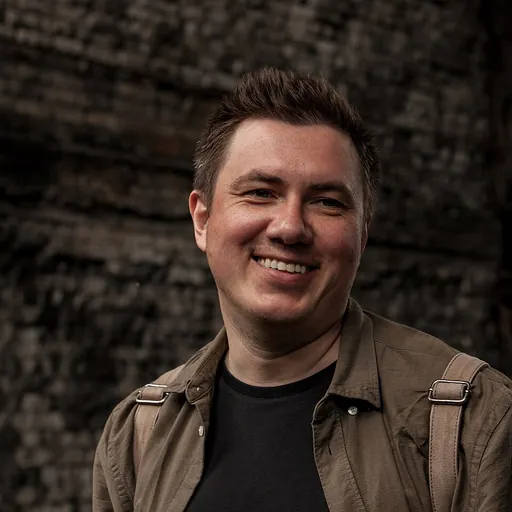
About Pavel Otdelnov
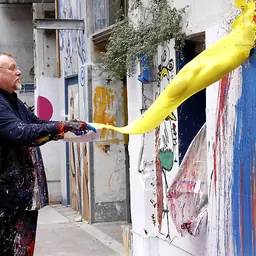
Born 1979. Pavel Otdelnov is a Russian painter.
Biography Pavel Otdelnov was born in Dzerzhinsk Nizhny Novgorod Region, a major cluster of the Soviet chemical industry. Since the 1930s, the artist's family was employed at local chemical enterprises. Given its industrial background, Dzerzhinsk faced an economic decline and neglect after the collapse of the Soviet Union, which has served as one of the sources of imagery and subject matter for Otdelnov. In 1999–2005, Otdelnov studied at Moscow Surikov State Academic Institute of Fine Arts in the Painting Department under the instruction of Pavel Nikonov and Yuri Shishkov. According to Otdelnov, studying in Pavel Nikonov's workshop emphasized artistic risk and independence. Nikonov encouraged students to move beyond repetition and not to fear losing achieved results. Treating them as colleagues, he promoted open discussion and critical thinking. Otdelnov later described the main lesson he learned from Nikonov as the value of inner freedom. In 2005, he presented the graduation project in the form of a Gospel-inspired series. From 2005 to 2007, he was a post-graduate student at Surikov Art Institute. From 2013 to 2015, he studied at the Joseph Backstein Institute of Contemporary Art. In 2022, he relocated to the United Kingdom and has since been living and working in London. Otdelnov has described painting as a medium intrinsically linked to time. He compares his mode of perception to time-lapse footage, which allows changes in familiar landscapes and everyday life to become visible:
From the mid-2010s onward, Otdelnov began incorporating painting into large-scale installation and research-based projects, including Promzona and Ringing Trace. Within these projects, painting functions alongside video, found objects, archival documents, and immersive environments. Critics have compared his work to that of Gerhard Richter and artists associated with the Düsseldorf School of Photography. Otdelnov has cited influences ranging from nineteenth-century Russian landscape painting to Mario Sironi and Giorgio Morandi. He has also referred to artists such as Semen Faĭbisovich, Mikhail Roginsky, Erik Bulatov, and Cyprien Gaillard. Early work Combine. Retrospective. 2007—2008
In 2007, Otdelnov and Egor Plotnikov went on a creative journey to Western Siberia where for two weeks they observed the operations of the Novokuznetsk Iron and Steel Plant and West-Siberian Metal Plant, two industrial behemoths built during the Soviet industrialization. The trip was initiated by Pavel Nikonov as a continuation of the Soviet practice of creative travel assignments. The idea behind this particular trip was to reconceptualize the experience of artists who participated in expeditions to major national construction projects in the 1920s–30s: Alexander Drevin, Aleksandr Labas, Alexander Tyshler, Nadezhda Udaltsova, Alexander Shevchenko, and others. The resulting series of paintings by Otdelnov and Plotnikov based on photos and sketches from the trip were exhibited at Heritage Gallery in May 2012. In Otdelnov's words, that visit to Novokuznetsk enabled a view of the Soviet industrial architecture as ancient ruins, akin to the Baths of Caracalla or a Roman Forum, that apparently achieved reconciliation with the surrounding landscape and became its part. Land. Sky. 2007—2008 In 2007–2008 Otdelnov painted a series of five abstract landscapes where he amalgamated the inflection of the Russian lyrical landscapes from the 19th century and the expressive language of abstract painting. In his LiveJournal, the artist refers to Alexei Savrasov and Mark Rothko as the two main sources for the series Land. Sky. Three of the five landscapes from it were exhibited at Art Sanatorium, an exhibition hosted by the Tretyakov Gallery in 2010. This was Otdelnov's first attempt to present painting as part of an installation. The canvases were hung in a specially constructed isolated room with black walls, an invitation for the viewer to come inside and be surrounded by the acutely familiar Central Russia landscapes.
In the 2010s the artist lived in Khimki near Moscow and travelled to his studio in the capital every day. During his commute, Otdelnov was able to take in the landscapes of the Moscow outskirts and spent his weekend wandering around residential areas or the big waste dump not far from his home. These observation practices resulted in the series titled Metro, 2009–2010; In Motion, 2010; and the painting Desert, 2010, where the artist addresses for the first time the motifs central to his subsequent art: the urban outskirts, landfills, and abandoned plots. Urban Outskirts and Non-places Inner Degunino. 2013—2014 In 2013, Otdelnov began the series Inner Degunino, where he depicts Moscow's residential areas and draws inspiration from the Zapadnoye Degunino District, situated near the Moscow Ring Road, comprising mostly industrial facilities and pre-fab mass housing of type P-44. According to the artist, his aim was to "construct an image of the modern Russian landscape, uncover the features of our time usually unseen through the habitual optics. This is primarily about the deserted post-Soviet landscapes, with their power transmission lines stretching into the void, with the ubiquitous pre-fab panel housing, and the gloomy sky." The author's take on the architecture of residential areas with spot inclusions of industrial plants across the endless snowy expanse drew the attention of David Elliott, a curator of the 4th Moscow International Biennale for Young Art, which then featured Otdelnov's paintings at the Biennale in the summer of 2014. The exposition garnered high praise from art critics and culture correspondents. In October 2014, Otdelnov exhibited the completed Inner Degunino series at a solo show at the Moscow Museum of Modern Art. Inner Degunino was featured in the top 50 most prominent art projects of 2014 according to the editorial board of AroundArt; was ranked 3rd in the readership survey for the best exhibition; and was nominated in 2015 for the Kandinsky Prize in the Project of the Year category. The image of the artist's painting Ark from the Inner Degunino project was used in 2014 on the album cover for a Nizhny Novgorod band, KernHerbst, where the artist's brother Leonid Otdelnov is a member
In 2013–2014, Pavel Otdelnov painted a series entitled "Inner Degunino," dedicated to the outskirts of Moscow: bastions of residential areas in the midst of wastelands that never became cities. The title refers to Inner Mongolia (an autonomous region in northern China) for a reason—the imagination fills in the endless steppes stretching around the high-rise fortresses. The landscapes of "Inner Degunino," which can hardly be called urban, look like a familiar picture of a "dark future" from the movies. But we are talking about a Utopian project that has degenerated into a dystopia.|author=Irina Kulik|source= Otdelnov proposed a large-scale object constructed with bright composite panels to be installed next to the Moscow Ring Road near the 81st kilometer. It employed the parallax effect to make the structure seem stably whole from one vantage point but, as the perspective shifts, to disintegrate into parts becoming fluid and unstable. This piece was meant to imitate abandoned or uncompleted mall projects that look like a disruption in the landscape and, at the same time, symbolize the volatility in the economy.
Russian Nowhere. 2020—2021
The next project by Otdelnov that addressed the subject of post-Soviet wastelands and non-places was the Russian Nowhere, exhibited at Triumph Gallery in 2021. The artist searched for imagery by travelling the country through Yandex and Google Street View. For the paintings, he chose the most banal and typical images that could be taken anywhere in Russia. Next to the landscapes, Otdelnov placed illuminated red-letter signs, fashioned after the ubiquitous shop signage. The sign texts were borrowed from online comments in such social media communities as The Beauty Of Blight, Birch Tree, Russian Death, etc. Philosopher Svetlana Polyakova noted the extreme degree of dehumanization in the landscapes of this series:
Pavel Otdelnov is aware that direct replication of reality is impossible, so he uses another optic – machine vision and collective human intelligence. This typifies his work as post-conceptualism. Turning to landscapes that are no longer used or populated, the artist reaffirms their existence and proposes to define them based on negation. Although these places actually exist, their description or identification, even supported by an accurate image, is not possible. This "nowhere" is in fact everywhere, emerging from the void, which is, in the end, the main character in Otdelnov's work. — Marina Bobyleva Environmental issues Sand and Landscapes of the Kazanka River Floodplain. 2016—2017 In 2016, as part of the Non-Places Program run by the Department of Research Art, an interdisciplinary project in Moscow, Otdelnov went to Kazan for a residency at the Smena Center of Contemporary Culture. He met local environmental experts and activists who were trying to counter planned construction projects in the Kazanka River floodplain. While in residency, he shot the film Sand and painted landscapes of the Kazanka River . Psychozoic Era. 2018—2019
In 2018, Otdelnov further explored the environmental issues in a new film and installation, titled collectively the Psychozoic Era. The project depicted Russian industrial waste storage facilities and their impacts on the environment and people.
Within the framework of the environmental agenda, Pavel Otdelnov's oeuvre is in line with the concept of ‘novel ecosystems’ – human-modified landscapes that crossed a threshold making it difficult to return to their original state. The Psychozoic Era project, shown at the exhibition, addresses human–environment interaction and changes in the landscape, which are usually invisible from the Earth's surface to the naked eye. The artist finds reservoirs for industrial waste disposal using satellite images and collects information on the impact of these facilities on the everyday life and recreational activities of the residents. — Yulia Aksenova
Research projects Promzona. 2015—2020
Promzona (Industrial Zone) is a project about the industrial landscape of Dzerzhinsk and the memory of the Soviet past. Through the history of his hometown and his own family, Pavel Otdelnov examines how the legacy of Soviet industry continues to shape the landscapes, memories, and identities of those who lived within it. The project brings together painting, photography, archival research, documentary materials, and found objects. It explores abandoned factories, restricted industrial zones, workers’ settlements, and family archives, examining how a former industrial world survives in the landscape and in personal memory. As part of the project, No Entry Without Gas Mask!, a book of memoirs written by the artist’s father Aleksandr Otdelnov, was published. Ringing Trace. 2021
In the fall of 2021, invited by the Ural Industrial Biennale of Contemporary Art, Otdelnov created a project about the history of the nuclear industry in the Southern Urals. The project was exhibited at the former dormitory of the secret Laboratory B in the village of Sokol, Chelyabinsk Region. During the Soviet time, the lab studied radiobiology, but over the recent few decades, the dorms have been vacant and in disrepair. The artist structured the exposition as a parallel alternative to that of a local history museum. Alongside the newly created paintings, the exhibits included found documents and records, which resonated deeply with Pavel. Each of the 21 rooms in the exhibition narrates the different aspects of the history of the nuclear industry: the invention of the atomic bomb, the 1957 explosion at the Mayak Facility and its liquidators, the Chelyabinsk radioactive trace and the villages that it killed, the secret lingo of nuclear scientists and the daily life in closed towns, the poisoned Techa River, which had been receiving dumps of heavy radioactive waste in 1949–1956 while the riverside population continued to use its water. The project was deemed a success by both the audience and critics and recognized as one of the best at the Biennale. Despite its remote location, the exposition was visited by many people from all across Russia, and upon completion of the Biennale program, it was decided to make the exhibit permanent. The exposition became officially permanent in 2022.
Hometown. 2024
Hometown is an exhibition project by Otdelnov, shown in June 2024 in the abandoned Old Waiting Room of Peckham Rye railway station in London. The project is dedicated to the artist's hometown of Dzerzhinsk, a former centre of the Soviet chemical industry that still has factories involved in munitions production. In a series of large-scale paintings, Otdelnov depicts industrial landscapes, the environmental impact of chemical production, local crime, family history, and ghost-like figures of the city's residents, combining personal and collective memory with visual images of decline and change. The architecture of the Old Waiting Room was integrated into the exhibition as part of the installation, creating the feeling of a "ghost place". The project reflects the historical and social development of Dzerzhinsk and continues his earlier project Promzona. The exhibition received press attention as an example of artistic reflection on post-Soviet industrial cities and their social and environmental problems.
The youthful Otdelnov in his school uniform, his grandmother—the factory worker and matriarch of a ‘labor dynasty’—and the collective portrait of archetypal provincial riffraff, all surface. The personal and the local converge in a lexicon of metaphors, the full grasp of which is veiled by a certain reticence and the artist's detachment from absolute theories and concepts. The experiment of reconstruction within The Hometown extends beyond the confines of a specific place and evolves into a more universal narrative, where an individual's stance in the modern world is marked by an all-encompassing sense of global uncertainty. — Il Gurn
The exhibition is structured around several thematic strands, including Primer and Television. In the Primer series, Otdelnov reinterprets the structure of the Soviet school alphabet book, replacing its didactic imagery with motifs associated with childhood anxiety and fear. The Television works draw on imagery from Soviet broadcasts, including the children's programme Good Night, Little Ones!, the news programme Vremya, and televised sessions of Anatoly Kashpirovsky. Through these references, the project examines the role of mass media and educational imagery in shaping collective consciousness and memory in late Soviet society. The project has been discussed in relation to contemporary concerns about censorship, surveillance and ideological control in the Russian art scene. Estates: Fragile Utopia. 2026
Estates: Fragile Utopia explores council estates as material remnants of post-war ideas about welfare, collective responsibility and social equality, situating them within a broader history of twentieth-century modernist urban planning. Drawing on research into the work of Patrick Abercrombie and Geoffrey Jellicoe, as well as housing developments including the Aylesbury Estate, Robin Hood Gardens and Thamesmead, Otdelnov considers architecture as a carrier of political and social ideals. The project relates British post-war housing to parallel histories of mass housing in the Soviet Union while emphasising the differences between the two contexts, using the artist's dual perspective to place British estates within a wider transnational history of modernist utopian thought. Through paintings based on contemporary observation and historical research, the series reflects on the legacy of post-war housing policy and its relationship to the present-day housing crisis. War, Trauma and Memory Unheimlich. 2015—2024 In 2015, for the exhibition War Museum at the Moscow Museum of Modern Art, Otdelnov created the installation Unheimlich. The work recreated a domestic interior into which subtle references to war were inserted, including a toy tank and armed figures hidden within the carpet pattern. The project referred to Freud’s concept of the "unheimlich" and to Martha Rosler's series Bring the War Home. In the same context, Otdelnov produced photographic collages juxtaposing private interiors with images of war-damaged cities in the Donetsk Region, as well as the painting No Flights Today (2015). In 2023, Otdelnov revisited Unheimlich and produced a new version of the installation, which was presented as part of the series of exhibitions Brainwashing Machine. This updated version continued to explore the intimate intersections of domestic spaces and the pervasive presence of war, reflecting his ongoing engagement with memory, trauma, and the absurdity of conflict. Acting Out. 2022
In autumn 2022, Otdelnov presented his first UK solo exhibition, Acting Out, at Pushkin House of London. Spread over three floors, the show unfolded as a visual narrative on the afterlife of the Soviet Union and its psychological echoes in contemporary Russia. Using recurring motifs such as the red carpet of Soviet bureaucracy and imagery of bunkers, missile silos, and discarded rouble notes, Otdelnov reflected on the transformation of collective trauma into new forms of aggression and nostalgia. Combining historical and psychological perspectives, Acting Out addressed how unresolved Soviet legacies continue to shape Russia's present identity and its war in Ukraine, turning symbols of power and progress into reminders of loss, denial, and cyclical violence.
Otdelnov views the historical trajectory of his country with an eye for paradoxical recurrences and for the self-serving revisionism of the current political elite. But the absurdism in his work is understated, as it has to be to avoid the shrillness of propaganda, old and new. This is a tightly organised show with a dark and complex narrative that is no less powerful for being expressed in muted terms. — Marcus Verhagen
In March–April 2022, he produced the watercolor series Field of Experiments, exhibited in summer 2022 at Kalmar Art Museum (Sweden). The works depict a deserted snowy field interrupted by isolated objects such as a checkpoint, a concrete fence, a red carpet, a burned house, and human figures. The title refers to the song Russian Field of Experiments by the band Grazhdanskaya Oborona. The series addresses themes of isolation, generational rupture, and geopolitical conflict. In 2025, Otdelnov unified these works under the new title Scenes from a Nightmare and exhibited them at Wolfson College, Oxford. Exhibitions and collections Selected personal exhibitions
2026 — Estates: Fragile Utopia. Lewisham Arthouse, London 2024 — Hometown. The Old Waiting Room, Peckham Rye railway station, London 2022 — Acting Out. Pushkin House, London 2022 — Promzona, Uppsala Art Museum, Uppsala 2021 — Russian Nowhere. The Art Gallery of Yeltsin Center, Yekaterinburg 2021 — Russian Nowhere, Triumph Gallery, Moscow 2016 — White Sea. Black Hole, Arsenal, National Centre for Contemporary Arts, Nizhny Novgorod 2016 — Deserts. 2002 – 2017, Belyaevo Gallery, Moscow 2015 — Mall, Triumph Gallery, Moscow
Biennials 2021 — Ringing Trace. Personal project within the Artist-in-Residence program of the 6th Ural Industrial Biennale of Contemporary Art, former dormitory of the Laboratory B, Sokol village, Chelyabinsk region 2014 — A Time for Dreams. The Main Project of the 4th Moscow International Biennale for Young Art, Museum of Moscow 2014 — No man's land. Parallel Programme of the 4th Moscow International Biennale for Young Art, Grinberg Gallery, Moscow 2007 — Personal Acquaintance. Parallel Programme of the 3rd Moscow Biennale for Contemporary Art, Kovcheg Gallery, Moscow Selected group exhibitions
2025 — The Last Train. The Old Waiting Room, Peckham Rye Station, London 2025 — NO. Kunstraum Kreuzberg, Berlin 2024 — Cellule. Storage room, Centre Pompidou, Paris 2024 — Breath 2024. CICA Museum, Czong Institute for Contemporary Art, Gimpo, South Korea 2024–2025 — Brainwashing Machine, The Crypt Gallery, London; Artten Gallery, Stockholm; La Zona Gallery, Madrid 2023 — 73—23, Pal Project Gallery, Paris 2020 — Generation XXI. Tretyakov Gallery, Moscow 2018 — Where will I be, Selected works from MMOMA Collection. Krasnoyarsk Museum Center, Krasnoyarsk 2018 — Metageography: Orientalism and Dreams of Robinsons. Zarya Center for Contemporary Art, Vladivostok 2018 — 10/7. Collection Highlights / Display History, Moscow Museum of Modern Art, Moscow 2017 — Come Back Home. Institute of Russian Realist Art, Moscow 2017 — Noise of Time. Russian Contemporary Art from Erarta Museum, Maritime Centre, Kotka, Finland 2015 — Fest, Krasnoyarsk Museum Center. Krasnoyarsk 2015 — Piece of Space Traversed by Mind. New Wing of Gogol Museum, Moscow 2014 — Fortune Museum. Moscow Museum of Modern Art, Moscow 2014 — Perception Transfers. From analog to digital. CCA Sokol, Moscow 2013 — Strabag Art Award, Vienna 2013 — Stanzas, Erarta Gallery, St. Petersburg 2013 — Horizons, CCI Fabrika, Moscow 2012 — Combine. Retrospective. Heritage Gallery, Moscow
Selected collections Tretyakov Gallery, Moscow, Russia State Russian Museum, St. Petersburg, Russia Uppsala Art Museum, Sweden Kalmar Art Museum, Sweden Moscow Museum of Modern Art, Russia Institute of Russian Realist Art, Moscow, Russia National Center for Contemporary Art, Russia Pushkin State Museum of Fine Arts, Moscow, Russia Sergey Kuryokhin Center for Contemporary Art, St. Petersburg, Russia Erarta Museum of Contemporary Art, St. Petersburg, Russia Bardin Scientific and Technical Museum, Novokuznetsk, Russia 2017 — Sergey Kuryokhin Contemporary Art Award: short list, Artist of the Year nomination for White Sea. Black Hole project 2017 — Sergey Kuryokhin Contemporary Art Award: "Special Award of the French Institute" nomination, for the White Sea. Black Hole project 2017 — Kandinsky Prize long list, "Project of the Year" nomination for White Sea. Black Hole project 2019 — Kandinsky Prize: long list, "Project of the Year" nomination for Psychozoic era project 2020 — Artist of the Year by Cosmoscow Foundation 2020 — Innovation Art Prize: the winner, "Artist of the Year" nomination for Promzona project 2021 — Kandinsky Prize: short list (Promzona project) A. Khitrov, I. Krasilschik, A. Stognei, G. Timchenko, I. Venyavkin, A. Zerkaleva (2025). NO. The Book. Berlin, Germany: Kunstraum Kreuzberg/Bethanien. pp. 260. I. Kulik (2024). Projected Passages. Contemporary Art in a Hauntological Perspective. PArt. Lectures (in Russian). AST. pp. 66–71/384. E. Sarkisian Åkerman (2021). Det kollektiva och det privata minnet: Sokol, Otdelnov och Muromtseva, Konst i ruinerna av en utopi: en analys av nominerade bidrag till Kandinsky- och Innovatsijapriserna 2019/2020 (in Swedish). [The Collective and the Private Memory: Sokol, Otdelnov and Muromtseva part of: Art in the Ruins of a Utopia: An Analysis of Nominated Entries for the Kandinsky and Innovation Prizes]. Uppsala University. pp. 29–35/54. L. A. Zaks (2021). Эстетическое наших дней: новая феноменология [The Aesthetic of Our Times: A New Phenomenology]. Koinon Vol. 2(3), pp. 44–66. S. V. Polyakova (2021). Русское Нигде как пространство семиозиса: к истории одной выставки [Russian Nowhere as a Space of Semiosis]. Human Being: Image and Essence. INION RAN. Faculty of Philosophy, Moscow State University, Vol. 1(49), pp. 146–164 P. Otdelnov (2023). Making of an Art Project: Ringing Trace. In N. Mörner (Ed.), Ecological Concerns in Transition. Södertörn University. pp. 59–64. R. Wigh Abrahamsson; A. Brutemark; Joosse, S. et al. (2023). IMAGINATIVE POWER: The role of art in environmental communication, Swedish University of Agricultural Sciences. 26 p. A. Arutyunyan; A. Egorov (2024). Personal Traces in the Soviet Industrial Aftermath. Pavel Otdelnov's Promzona and Haim Sokol's Paper Memory Exhibitions in Moscow. In F. Guerin & M. Szcześniak (Eds.), Visual culture of post-industrial Europe. Amsterdam University Press. pp. 243–266. Gallery
Don’t just read it —
keep it.
Full-length biographies made to live with: read them, listen on the way to work, watch them tonight.
- E-book
- Audio
- Video
Instant download · yours to keep · every purchase keeps this site free
Important facts
People in Pavel Otdelnov's life
Named in this biography and alive at the same time







Related people
Same field, nearest in time


Contemporaries
People whose lives overlapped Pavel Otdelnov's



Frequently asked questions
Who is Pavel Otdelnov?
Contemporary artist
When was Pavel Otdelnov born?
Pavel Otdelnov was born on 19 June 1979 in Dzerzhinsk.
What is Pavel Otdelnov's occupation?
Pavel Otdelnov is a painter.
What nationality is Pavel Otdelnov?
Pavel Otdelnov is Russian.
Sources & further reading
Cite this page
APA: Biography.guide. (2026). Pavel Otdelnov. https://biography.guide/pavel-otdelnov/
MLA: "Pavel Otdelnov." Biography.guide, https://biography.guide/pavel-otdelnov/.
Chicago: "Pavel Otdelnov." Biography.guide. https://biography.guide/pavel-otdelnov/.
Data last updated: 2026-09-20 · Spot an error? Report a correction.
Portrait: Wikimedia Commons · author & licence
Page generated 2026-09-27 04:58 UTC