
About Pauline de Rothschild
Lived 1908 – 1976 (aged 67). Pauline de Rothschild was an American designer, socialite, model, banker, translator and fashion designer.
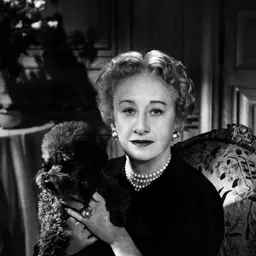
Pauline, Baroness de Rothschild (née Potter; December 31, 1908 – March 8, 1976) was an American fashion designer, writer and, with her second husband, a translator of both Elizabethan poetry and the plays of Christopher Fry. She was named, with Diana Vreeland, who was added to this list in 1964, to the International Best Dressed List Hall of Fame in 1969, alongside Douglas Fairbanks, Jr., Dean Acheson, Angier Biddle Duke, Cary Grant, and Prince Philip, Duke of Edinburgh.
Early life
She was born Pauline Potter at 10 rue Octave Feuillet in the Paris neighborhood of Passy, to wealthy expatriate American parents of Protestant background. Her mother was Gwendolen Cary, a great-grand-niece of Thomas Jefferson and a distant cousin of Britain's Lords Falkland and Cary. Her father was Francis Hunter Potter, a playboy who was a grandson of Alonzo Potter, an Episcopal Bishop of Pennsylvania, and a nephew and great-nephew of successive Episcopal bishops of New York, Horatio Potter and Henry Codman Potter. His wife Mary Tayloe Lloyd Key was both a Lloyd, daughter of Edward Lloyd IV of Wye House and a Tayloe of Mount Airy on her mother, Elizabeth's side, the daughter of John Tayloe II and sister to John Tayloe III of The Octagon House, arguably the wealthiest American, if not Southern planter. Her grand-aunts Jennie and Hetty Cary (wife of the Confederate general John Pegram) were well-known figures during the Civil War, known as the "Cary Invincibles" and considered heroines for sewing battle flags. It was Jennie Cary who put the words of James Ryder Randall's poem "Maryland, My Maryland" to the German folk song "Lauriger Horatius", thereby creating what would become the state song of Maryland. Her mother's cousin and sometime guardian Constance Cary Harrison was one of the United States' best-known women in the late 19th century, a prominent novelist and social reformer. Another cousin, Francis Burton Harrison, served as Governor General of the Philippines and was a Democratic candidate for the U.S. presidency.
Due to her parents' frequent separations and subsequent divorce and their later marital and romantic entanglements and custody disputes, she was brought up in varying degrees of poverty and luxury in New York City, Paris, Biarritz, and Baltimore.
First marriage In 1930, in Baltimore, Maryland, she married Charles Carroll Fulton Leser (1900–1949), a descendant of Charles Carroll of Carrollton, an art restorer, who was the younger son of a prominent judge and a grandson of Felix Agnus one of the city's leading newspaper publishers. He also was an alcoholic and a homosexual. After moving to Mallorca, Spain soon after their marriage, they separated in 1934, divorced in 1939, and had no children. For a period of years she also was the lover of Isabelle Kemp, an heiress to a New York drug-store and real-estate fortune.
Career In the early 1930s, she worked as a personal shopper in New York City, acting as a fashion advisor to wealthy socialites too busy to shop and too unsure of their personal style. Later, after moving to Europe with her first husband, she operated dress shops on Mallorca. Potter went on to design a collection for Marshall Field and later to direct the custom-fashion division of Hattie Carnegie, the New York fashion company, succeeding Jean Louis, who left in 1943 to become chief fashion designer for Columbia Pictures.
She remained at Hattie Carnegie for nearly a decade and was known professionally as Mrs. Fairfax Potter. a polymath and poet who was the owner of the fabled French winery Château Mouton Rothschild.
By this marriage, she had one stepchild, Philippine de Rothschild (1933–2014). In 1966, Harcourt Brace published her only book, The Irrational Journey, a brief, atmospheric memoir of a trip she and her husband took to the Soviet Union in the dead of winter. She previously had been diagnosed with breast cancer and had undergone open-heart surgery for a deteriorated valve in 1975. Rothschild's health problems were exacerbated by Marfan's syndrome, a genetic abnormality.
Burial She is buried on the grounds of Château Mouton Rothschild in Pauillac, Bordeaux, France, beneath a translucent tomb made of Lalique glass and marble. The monument also contains the remains of her second husband and his parents, Mathilde and Henri de Rothschild.
Ancestors
Don’t just read it —
keep it.
Full-length biographies made to live with: read them, listen on the way to work, watch them tonight.
- E-book
- Audio
- Video
Instant download · yours to keep · every purchase keeps this site free
Important facts
People in Pauline de Rothschild's life
Named in this biography and alive at the same time




Related people
Same field, nearest in time


Contemporaries
People whose lives overlapped Pauline de Rothschild's


Frequently asked questions
Who was Pauline de Rothschild?
French socialite (1908-1976)
When was Pauline de Rothschild born?
Pauline de Rothschild was born on 31 December 1908 in Passy.
When did Pauline de Rothschild die?
Pauline de Rothschild died on 8 March 1976 in Santa Barbara.
What was Pauline de Rothschild's occupation?
Pauline de Rothschild was a designer, socialite, model, banker, translator and fashion designer.
What nationality was Pauline de Rothschild?
Pauline de Rothschild was American.
Sources & further reading
· Wikipedia: Pauline de Rothschild
· DBpedia: Pauline de Rothschild
Cite this page
APA: Biography.guide. (2026). Pauline de Rothschild. https://biography.guide/pauline-de-rothschild/
MLA: "Pauline de Rothschild." Biography.guide, https://biography.guide/pauline-de-rothschild/.
Chicago: "Pauline de Rothschild." Biography.guide. https://biography.guide/pauline-de-rothschild/.
Data last updated: 2026-09-20 · Spot an error? Report a correction.
Page generated 2026-09-27 05:04 UTC