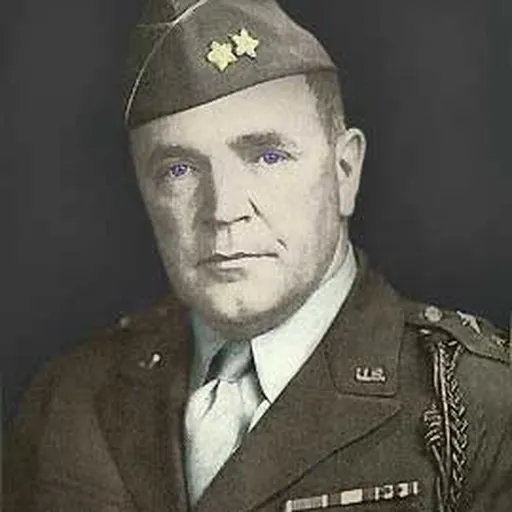
About Paul Wilkins Kendall
Lived 1898 – 1983 (aged 85). Paul Wilkins Kendall was an American military personnel.
Lieutenant General Paul Wilkins Kendall (July 17, 1898 – October 3, 1983) was a senior United States Army officer who served during World War I, World War II and Korean War.
Early life and military career
Kendall was born on July 17, 1898, in Baldwin City, Kansas, and raised in Sheridan, Wyoming. In 1916, during World War I (although the American entry into World War I did not occur until April 1917), he obtained an appointment to the United States Military Academy (USMA) at West Point, New York, from which he graduated in November 1918, receiving his commission as a second lieutenant into the Infantry Branch of the United States Army. By the time he graduated, the war had come to an end with the signing of the Armistice.
Siberian Campaign Kendall attended the Infantry School of Arms at Fort Benning, Georgia, from late 1918 to early 1919.
After completing his training, he was assigned to the 27th Infantry Regiment during the Siberian Campaign. Kendall participated in an action on January 10, 1920, for which he received the Distinguished Service Cross. The citation for the medal reads:
Post-Siberian Campaign Kendall carried out a variety of assignments in the 1920s and '30s, including a posting to Fort Logan, Colorado with the 38th Infantry Regiment in 1923 and served as an instructor in the Department of English and History at the United States Military Academy from 1925 to 1930 and later at Northwestern Military and Naval Academy. Kendall also performed duty in China, Hawaii and the Philippines.
In 1936, Kendall graduated from the Command & General Staff College. In the early 1940s, he served in a staff assignment at the Office of the Chief of Staff in Washington, D.C.
World War II At the start of World War II, Kendall was assigned as Chief of Staff of the 85th Infantry Division. He then served as Assistant Division Commander of the 84th Infantry Division, receiving a promotion to brigadier general.
From September 1944 to July 1945, Kendall was commander of the "Blue Devils" of the 88th Infantry Division and was promoted to major general. The division's second World War II commander, he led it during its assault through Italy, including the capture of Vicenza and Verona.
During the war, Kendall received the Silver Star for heroism on three occasions, two in 1944 and one in 1945.
Post-World War II From June 1946 to May 1948, Kendall was commander of the 2nd Infantry Division. In 1951, Kendall was assigned to occupation duty in Austria as commander of the American Zone. He was in that position until 1952, then he returned to the United States for a short assignment as commander of VI Corps at Camp Atterbury, Indiana.
Korean War Senior commanders meet on board Seventh Fleet flagship off Korean waters. (Left to right): Vice Admiral Joseph J. Clark, USN, Commander, Seventh Fleet; General James A. Van Fleet, Commanding General, Eighth Army; Lieutenant General Glenn O. Barcus, Commanding General, Fifth Air Force; Lieutenant General Paul W. Kendall, Commanding General, First Army Corps; and Lieutenant General Reuben E. Jenkins, Commanding General, Ninth Army Corps.
In June 1952, Kendall became commander of I Corps, receiving promotion to lieutenant general. He led the corps as it manned a defensive line until the end of 1952. In January 1953, the corps took part in an offensive with troops of the 1st Republic of Korea (ROK) Division, attacking the enemy at Big Nori. Beginning in March, the North Koreans and Chinese continually attacked I Corps positions, and I Corps began a phased withdrawal that resulted in numerous enemy casualties. Kendall turned command of I Corps over to Bruce C. Clarke in April 1953.
Post-Korean War After leaving I Corps, Kendall was assigned as Deputy Commanding General, US Army Forces Far East, in Manila, Philippines.
In 1954, Kendall was assigned as commander of Allied Land Forces Southeastern Europe in İzmir, Turkey, where he served until his 1955 retirement.
Personal life General Kendall was married to Ruth Child Pistole (November 10, 1900 – January 29, 1985). They had two daughters, Jean and Elizabeth. Jean was the wife of Navy officer Neal D. Baumgardner and Elizabeth was the wife of Army officer Raymond O. Miller.
Retirement and death Kendall retired to Palo Alto, California, where he died on October 3, 1983. He was buried at West Point Cemetery.
Ribbon bar Below is the ribbon bar of Lieutenant General Kendall:
Don’t just read it —
keep it.
Full-length biographies made to live with: read them, listen on the way to work, watch them tonight.
- E-book
- Audio
- Video
Instant download · yours to keep · every purchase keeps this site free
Important facts
People in Paul Wilkins Kendall's life
Named in this biography and alive at the same time


Related people
Same field, nearest in time





Contemporaries
People whose lives overlapped Paul Wilkins Kendall's


Frequently asked questions
Who was Paul Wilkins Kendall?
United States Army general (1898–1983)
When was Paul Wilkins Kendall born?
Paul Wilkins Kendall was born on 17 July 1898 in Baldwin City.
When did Paul Wilkins Kendall die?
Paul Wilkins Kendall died on 3 October 1983 in Palo Alto.
What was Paul Wilkins Kendall's occupation?
Paul Wilkins Kendall was a military personnel.
What nationality was Paul Wilkins Kendall?
Paul Wilkins Kendall was American.
Sources & further reading
· Wikipedia: Paul Wilkins Kendall
· DBpedia: Paul Wilkins Kendall
Cite this page
APA: Biography.guide. (2026). Paul Wilkins Kendall. https://biography.guide/paul-wilkins-kendall/
MLA: "Paul Wilkins Kendall." Biography.guide, https://biography.guide/paul-wilkins-kendall/.
Chicago: "Paul Wilkins Kendall." Biography.guide. https://biography.guide/paul-wilkins-kendall/.
Data last updated: 2026-09-20 · Spot an error? Report a correction.
Portrait: Wikimedia Commons · author & licence
Page generated 2026-09-27 04:58 UTC