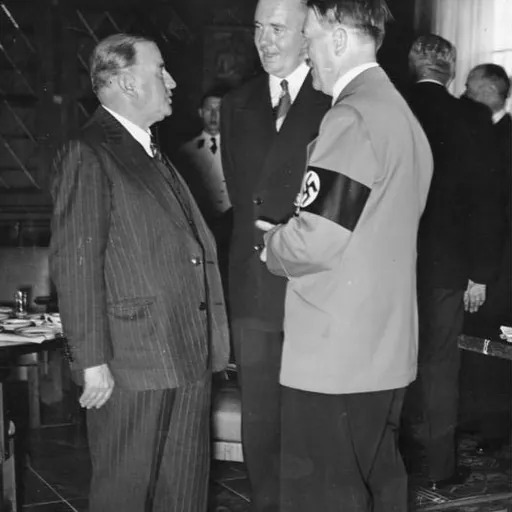
About Paul Schmidt
Lived 1899 – 1970 (aged 70). Paul Schmidt was a German linguist, politician, translator, diplomat, interpreter and official.
Paul Otto Gustav Schmidt (23 June 1899 – 21 April 1970) At the summit, Antonescu spoke in French and had his remarks translated into German by Schmidt, who also translated Hitler's remarks into French (Schmidt knew no Romanian).
During the meeting, Hitler, via Schmidt, informed Antonescu of the planned "war of extermination" that Operation Barbarossa was intended to be and asked that Antonescu set up a Romanian equivalent of the Einsatzgruppen, a request that Antonescu agreed to.
Postwar Arrested in May 1945, Schmidt was freed by the Americans in 1948.
After he was captured at Salzburg in May 1945, Schmidt asserted that there was little anti-Semitism in Germany until Hitler imported it from Austria. He said: "Hitler's biggest mistakes were his campaign against the Jews and his policy of imperialism."
In 1946, he testified at the Nuremberg trials, where psychiatrist Leon Goldensohn noted and later published conversations with him. In 1947, he testified for the prosecution against the directors of IG Farben. In 1952, he founded the Sprachen & Dolmetscher Institut in Munich, a college where students could learn languages and become translators and interpreters. He retired in 1967.
Memoirs Entitled An Extra on the Diplomatic Stage, Schmidt's memoirs cover his 21 years as an important eyewitness to European foreign policy. They begin with his frontline experiences during the First World War at the German spring offensive of 1918 and continue with his work for the German chancellors before 1933.
The English edition of the book, Hitler's Interpreter , skips that material and describes only the Hitler years (1933–1945). The memoirs present an atmospheric but detailed portrait of the highest level of the Third Reich. He has this advice for interpreters in training:
"Over the years I have arrived at the conviction that a good diplomatic interpreter must possess three characteristics: Most important, he must, paradoxically, be able to be silent; he must be expert in the subject he is translating; and only in third place is his mastery of the language he translates".
According to Christian Kammertöns, Schmidt presents himself (and Germany) in the memoirs more as a victim, and does not mention the Holocaust.
Don’t just read it —
keep it.
Full-length biographies made to live with: read them, listen on the way to work, watch them tonight.
- E-book
- Audio
- Video
Instant download · yours to keep · every purchase keeps this site free
Important facts
People in Paul Schmidt's life
Named in this biography and alive at the same time



Related people
Same field, nearest in time


Contemporaries
People whose lives overlapped Paul Schmidt's


Frequently asked questions
Who was Paul Schmidt?
German interpreter and translator (1899-1970)
When was Paul Schmidt born?
Paul Schmidt was born on 23 June 1899 in Charlottenburg.
When did Paul Schmidt die?
Paul Schmidt died on 21 April 1970 in Gmund am Tegernsee.
What was Paul Schmidt's occupation?
Paul Schmidt was a linguist, politician, translator, diplomat, interpreter and official.
What nationality was Paul Schmidt?
Paul Schmidt was German.
Sources & further reading
· DBpedia: Paul Schmidt (interpreter)
Cite this page
APA: Biography.guide. (2026). Paul Schmidt. https://biography.guide/paul-schmidt-linguist/
MLA: "Paul Schmidt." Biography.guide, https://biography.guide/paul-schmidt-linguist/.
Chicago: "Paul Schmidt." Biography.guide. https://biography.guide/paul-schmidt-linguist/.
Data last updated: 2026-09-20 · Spot an error? Report a correction.
Portrait: Wikimedia Commons · author & licence
Page generated 2026-09-27 04:57 UTC