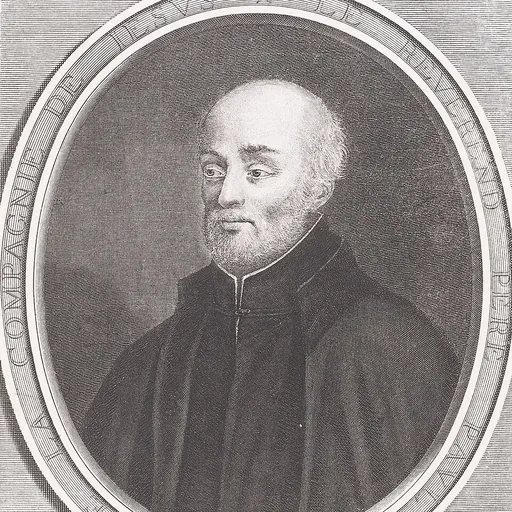
About Paul Le Jeune
Lived 1591 – 1664 (aged 73). Paul Le Jeune was a French missionary and jesuit.
Paul Le Jeune, SJ (; 1591–1664) was a French Jesuit missionary in New France. He served as the Superior of the Jesuits in the French colony of Canada from 1632 to 1639. During his tenure, he began a mission at Trois-Rivières, founded the community at Sillery, and saw the establishment of the Hôtel-Dieu de Québec.
Biography Le Jeune was born to a Huguenot family in Vitry-le-François in the region of Champagne, France in 1591, and converted to Roman Catholicism at the age of sixteen. Le Jeune received a thorough preparation for the Jesuit priesthood; he was a novice for two years between 1613 and 1615, and he was deeply influenced by his mentor Father Massé, whom he met at the collège Henri IV de La Flèche. During his studies, Le Jeune developed a keen interest in missions and became convinced that education was a key element in any successful attempt to spread Christianity. After finishing his philosophical studies Father Le Jeune was a teacher at the colleges in Rennes (1618–19) and Bourges (1619–22).
In 1624, Le Jeune was ordained, and in 1632 he was named superior of the Jesuit mission in Canada. Among his most well-documented experiences are his travels during the winter of 1633-1634 among the Montagnais.
Le Jeune decided that in order to effectively carry out his apostolate, he needed to establish mission settlements, on the model of Jesuit missionary work in San Ignacio Miní in Misiones Argentina and bordering region of Paraguay, a hospital to care for the aged and the ill, and schools for educating the young. Le Jeune encouraged his missionaries to learn the native languages.
In 1635 a Jesuit college to educate French and Amerindian boys was established in Quebec, with Antoine Daniel in charge, but closed after five years. That December Le Jeune preached the sermon at Samuel de Champlain's funeral.
In a 1637 letter he cautions all missionaries not to make the "savages" wait for them when embarking in the morning, to never show distaste for any of their customs, and to help out during portages, or over-land journeys, from one river to another. That same year he laid the foundation of a house for missionaries at Sillery, named after benefactor Noël Brûlart de Sillery, who provided the funds.
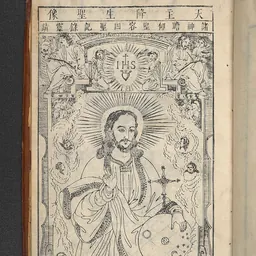
Le Jeune found that devotional images helped a good deal in conveying ideas he was trying to express. Religious processions had an important civic function. Le Jeune recorded a celebration held in Quebec in 1639 honoring the birth of Louis XIV. Along with fireworks and cannon salutes, a procession was held in conjunction with the Feast of the Assumption, in which the French and more than a hundred Indians, six of them dressed in sumptuous French royal garments, processed from the hospital, to the Ursuline convent, and finally to the Jesuit church. Prayers were said in both French and the local Indian language, and when the procession ended, the Governor provided a feast for all in attendance. The procession had become a centerpiece of the fragile multicultural community. By 1639 there were less than 100 converts among the Hurons, who numbered several thousands. Also on board were three Canonesses of St. Augustine of the Mercy of Jesus to establish a hospital underwritten by Marie Madeleine d'Aiguillon, niece of Cardinal Richelieu in response to a report from Le Jeune that had been published in the Relations in France.
Le Jeune remained the superior of the Jesuit mission until 1639 when he was replaced by Father Barthélemy Vimont, but he did not return to France until 1649. Upon his return, he served as the mission procurator of New France until 1662, only two years before his death.
Long-term implications The writings and experiences of Le Jeune and his fellow Jesuits are reflected in the Code Noir passed by France's King Louis XIV in 1685. This document outlined the rights of both slaves and their masters throughout the French colonies and notably advocated that slaves gain enough education that they would understand and embrace Catholicism. In fact, slave masters were required to offer access to baptism.
Le Jeune's influence was not limited to Canadian territories or seventeenth century Jesuits; when the French settled Louisiana, there was a clear sense that literacy and religion were interconnected. Even after Louisiana became part of the United States, Catholic priests and laypersons continued to advocate for slave literacy. Indeed, the lack of formal education for slaves became a key factor in the Catholic Church's later support of Abolitionism.
Toponyms Le Jeune In recognition of the work of the missionary life Paul Le Jeune, some geographic names have been assigned to this Jesuit who came from France, and founder of the hamlet of Trois-Rivières in 1634: "Canton Le Jeune" (Township Le Jeune), Sainte-Thècle, Quebec. Already baptized in 1873, this Township of forest is located between the village of Saint-Joseph-de-Mékinac, Quebec and Sainte-Thècle, Quebec. This township has several lakes whose names evoke the Jesuit Paul Le Jeune: Missionary lake and the Lake Jesuit. Chemin du Canton-Le Jeune (Le Jeune Township road), Sainte-Thècle, Quebec. Domaine du Canton-Le Jeune, Sainte-Thècle, Quebec. "Le Jeune" lake, Sainte-Thècle, Quebec. Lake Jesuit, Sainte-Thècle, Quebec. Missionary lake. École polyvalente Paul Le Jeune (High School), in Saint-Tite, Quebec. This school was opened in September 1969 for secondary students in the area known as Normandy (now Mékinac area). Historical research on the passage said Mékinac-Tawachiche were made in 1968-69 by Jean-Noël Carpentier, who was General Director of the "Commission scolaire de Normandie" (headquartered in Saint-Tite) from 1969 to 1972. His historical research was based in part on the "Jesuit Relations," written by missionaries at the beginning of the French colony.
Don’t just read it —
keep it.
Full-length biographies made to live with: read them, listen on the way to work, watch them tonight.
- E-book
- Audio
- Video
Instant download · yours to keep · every purchase keeps this site free
Important facts
People in Paul Le Jeune's life
Named in this biography and alive at the same time


Related people
Same field, nearest in time

Contemporaries
People whose lives overlapped Paul Le Jeune's




Frequently asked questions
Who was Paul Le Jeune?
French missionary
When was Paul Le Jeune born?
Paul Le Jeune was born on 15 June 1591 in Vitry-le-François.
When did Paul Le Jeune die?
Paul Le Jeune died on 7 August 1664 in Paris.
What was Paul Le Jeune's occupation?
Paul Le Jeune was a missionary and jesuit.
What nationality was Paul Le Jeune?
Paul Le Jeune was French.
Sources & further reading
Cite this page
APA: Biography.guide. (2026). Paul Le Jeune. https://biography.guide/paul-le-jeune/
MLA: "Paul Le Jeune." Biography.guide, https://biography.guide/paul-le-jeune/.
Chicago: "Paul Le Jeune." Biography.guide. https://biography.guide/paul-le-jeune/.
Data last updated: 2026-09-22 · Spot an error? Report a correction.
Portrait: Wikimedia Commons · author & licence
Page generated 2026-09-27 04:57 UTC