
About Peter Claver
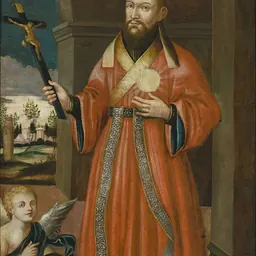
Lived 1580 – 1654 (aged 74). Peter Claver was a missionary.
Early life Claver was born in 1580 into a devoutly Catholic and prosperous farming family in the village of Verdú, Urgell, located in Spain about from Barcelona. He was born 70 years after King Ferdinand of Spain set the colonial slavery culture into motion by authorizing the purchase of 250 African slaves in Lisbon for his territories in New Spain.
Later, as a student at the University of Barcelona,
Formation and Work in the New World After he had completed his studies, Claver entered the Society of Jesus in Tarragona at the age of 20. When he had completed the novitiate, he was sent to study philosophy at Palma, Mallorca. While there, he came to know the porter of the college, St. Alphonsus Rodriguez, a laybrother known for his holiness and gift of prophecy. Rodriguez felt that he had been told by God that Claver was to spend his life in service in the colonies of New Spain, and he frequently urged the young student to accept that calling. Required to spend six years studying theology before being ordained a priest, he lived in Jesuit houses at Tunja and Bogotá. During those preparatory years, he was deeply disturbed by the harsh treatment and living conditions of the black slaves who were brought from Africa.
By this time, the slave trade had been established in the Americas for about a century. Local Native Americans were considered physically ill-suited to work in the gold and silver mines. Mine owners met their labor requirements by importing blacks from Angola and Congo, whom they purchased in West Africa for four crowns a head or bartered for goods and sold in America for an average two hundred crowns apiece. Others were captured at random, especially able-bodied males and females deemed suitable for labor.
Cartagena was a slave-trading hub and 10,000 slaves poured into the port yearly, crossing the Atlantic from West Africa under conditions so foul that an estimated one-third died in transit. Although the slave trade was condemned by Pope Paul III and Urban VIII had issued a papal decree prohibiting slavery,
Claver's predecessor in his eventual lifelong mission, Alonso de Sandoval, was his mentor and inspiration. Claver gained his reputation from charitable acts towards the enslaved Africans. He had been known to spend extensive amounts of time caring for injured and sickly slaves upon their arrival in Cartagena. On one occasion having been described as devoting hours to nursing a dying slave back to health in order to baptize him. Claver and his translators would convey the catechism concurrently in both Spanish and the respective language of the African slaves. He also learned a language himself, described as the "language of Angola," in order to communicate with the enslaved. In support for his beatification, Claver's peers recognized him for his dedication to Christian matrimony of enslaved Africans, many of whom he supported through the process of marriage. He preached in the city square, to sailors and traders and conducted country missions, returning every spring to visit those he had baptized, ensuring that they were treated humanely. During these missions, whenever possible he avoided the hospitality of planters and overseers; instead, he would lodge in the same quarters as the slaves. He died on 8 September 1654.
When the news of his death spread throughout Cartagena many came to his room to pay their last respects. Such was his reputation for holiness that the room was stripped bare of anything that might serve as a relic. Many organizations, missions, parishes, religious congregations, schools and hospitals bear the name of St. Peter Claver and also claim to continue the Mission of Claver as the following:
The Knights of Peter Claver, Inc., is the largest African-American Catholic fraternal organization in the United States. In 2006, a unit was established in San Andres, Colombia. The Order was founded in Mobile, Alabama, and is presently headquartered in New Orleans. and his inspiration remains among port chaplains and those who visit ships in the name of the church, through the AoS. The Missionary Sisters of St. Peter Claver are a religious congregation of women dedicated to serving the spiritual and social needs of the poor around the world, particularly in Africa. They were founded in Austria by the Blessed Mary Theresa Ledóchowska in 1894. Among the many parishes dedicated to St. Peter Claver are those in Lexington, Kentucky, West Hartford, Connecticut, Macon, Georgia, New Orleans, Louisiana, Simi Valley, California, Saint Paul, Minnesota, Sheboygan, Wisconsin, Montclair, New Jersey, Baltimore, Maryland, Huntington, West Virginia, Punta Gorda, Belize, and Nairobi, Kenya. Among the many schools dedicated to St. Peter Claver are those in Decatur, Georgia, and Pimville, South Africa. The oldest African American school in the Diocese of Saint Petersburg, and the oldest African American school still functioning in the State of Florida, is the St. Peter Claver Catholic School.
The Congress of the Republic of Colombia declared September 9 as the Human Rights national Day in his honor.
His canonization caused angst among some due to his own slaveholding and treatment of slaves (including corporal punishment), and it is alleged that these matters may have initially stalled his canonization. Katie Grimes takes the view that the way the church celebrates Peter Claver as “the saint of the slave trade” would uphold anti-blackness much more than it undermines. However, the sources cited by Grimes in her criticism stated that Claver allowed uncommon freedom for the slaves he purchased (using them in his ministry rather than for hard labor), and resorted to physical punishment solely to prevent what he saw as immoral behavior.
Don’t just read it —
keep it.
Full-length biographies made to live with: read them, listen on the way to work, watch them tonight.
- E-book
- Audio
- Video
Instant download · yours to keep · every purchase keeps this site free
Important facts
People in Peter Claver's life
Named in this biography and alive at the same time

Related people
Same field, nearest in time

Contemporaries
People whose lives overlapped Peter Claver's



Frequently asked questions
Who was Peter Claver?
Jesuit missionary
When was Peter Claver born?
Peter Claver was born on 24 June 1580 in Verdú.
When did Peter Claver die?
Peter Claver died on 8 September 1654 in Cartagena.
What was Peter Claver's occupation?
Peter Claver was a missionary.
What nationality was Peter Claver?
Peter Claver's recorded nationality: Spanish Empire.
Sources & further reading
Cite this page
APA: Biography.guide. (2026). Peter Claver. https://biography.guide/peter-claver/
MLA: "Peter Claver." Biography.guide, https://biography.guide/peter-claver/.
Chicago: "Peter Claver." Biography.guide. https://biography.guide/peter-claver/.
Data last updated: 2026-09-20 · Spot an error? Report a correction.
Page generated 2026-09-27 05:21 UTC