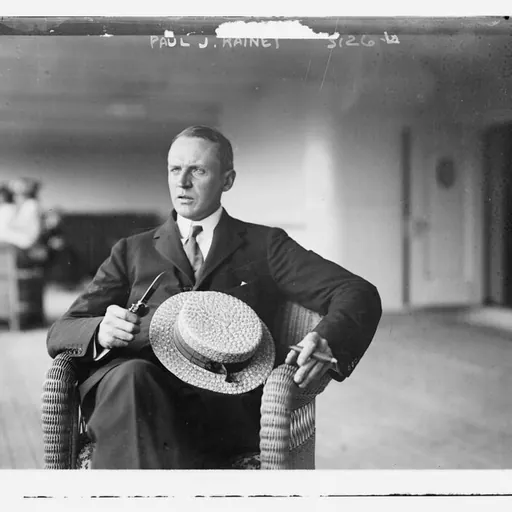
About Paul J. Rainey
Lived 1877 – 1923 (aged 46). Paul J. Rainey was an American photographer and businessperson.
Paul James Rainey (September 18, 1877 – September 18, 1923) was an American businessman, philanthropist, filmmaker, hunter, and photographer. He made films about his hunts in Africa. Gates at the Bronx Zoological park were commissioned in his memory and a preserve established in Louisiana.
Early life
Paul James Rainey was born September 18, 1877, in Cleveland, Ohio, the fifth of Eleanor Beatty (née Mitchell) and William Joab Rainey's five children. His sister was Grace Rainey Rogers.
Life Scion of a wealthy family whose fortune came from coal and coke production, Rainey earned a reputation as a playboy. He invested in numerous personal projects, including his Tippah Lodge in Mississippi, a hotel, prize horses, and private railroad cars.
Although he owned other residences, he favored Tippah Lodge, his sprawling estate in rural Mississippi.
Rainey was active with the American Geographical Society, American Museum of Natural History, the New York Zoological Society, and the Smithsonian Institution, among other organizations.
Rejected by the military for health reasons, Rainey purchased an ambulance and drove it on the Western Front during World War I.
African expedition films Paul J. Rainey's African Hunt
After the war, Rainey hunted big game in Africa. He and his team filmed some of the earliest film footage of African animals in the wild. In 1912, they released the six-reel documentary film Paul J. Rainey's African Hunt.
Rainey's silent film grossed over a half-million dollars , an extraordinary sum for an early motion picture. It was one of the most successful non-fiction films of the decade. The success of Rainey's films led to a boom in expedition and nature films. These were silent films, so many of these films were at first presented by a lecturer in a lyceum-like context.
Heart of the Jungle Rainey's five-reel African expedition film Heart of the Jungle was playing in US theaters during 1919. Edward Bernays's pioneering public relations firm publicized it.
Death and burial He died on his forty-sixth birthday in 1923 of a cerebral hemorrhage. The death occurred while Rainey was en route from England to South Africa, where he had planned to hunt. He was buried at sea.
Legacy After his death, Rainey's family set aside 26,000 acres (110 km2) of his marshland as a wildfowl refuge in coastal south Louisiana. The refuge, known as the Paul J. Rainey Wildlife Sanctuary, is owned by the National Audubon Society.
Don’t just read it —
keep it.
Full-length biographies made to live with: read them, listen on the way to work, watch them tonight.
- E-book
- Audio
- Video
Instant download · yours to keep · every purchase keeps this site free
Important facts
People in Paul J. Rainey's life
Named in this biography and alive at the same time


Related people
Same field, nearest in time




Contemporaries
People whose lives overlapped Paul J. Rainey's



Frequently asked questions
Who was Paul J. Rainey?
American businessman (1877–1923)
When was Paul J. Rainey born?
Paul J. Rainey was born on 18 September 1877.
When did Paul J. Rainey die?
Paul J. Rainey died on 18 September 1923.
What was Paul J. Rainey's occupation?
Paul J. Rainey was a photographer and businessperson.
What nationality was Paul J. Rainey?
Paul J. Rainey was American.
Sources & further reading
Cite this page
APA: Biography.guide. (2026). Paul J. Rainey. https://biography.guide/paul-j-rainey/
MLA: "Paul J. Rainey." Biography.guide, https://biography.guide/paul-j-rainey/.
Chicago: "Paul J. Rainey." Biography.guide. https://biography.guide/paul-j-rainey/.
Data last updated: 2026-09-22 · Spot an error? Report a correction.
Portrait: Wikimedia Commons · author & licence
Page generated 2026-09-27 05:01 UTC