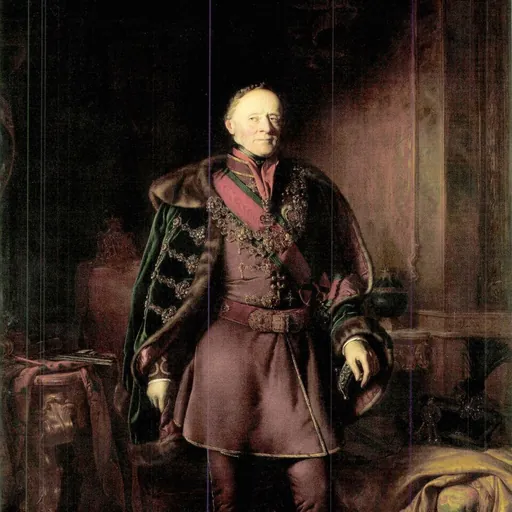
About Paul III Anton, Prince Esterházy
Lived 1786 – 1866 (aged 80). Paul III Anton, Prince Esterházy was a Hungarian diplomat, composer and politician.
Paul III Anton, Prince Esterházy (German: Paul Anton Esterházy von Galantha; 11 March 178621 May 1866) was a Hungarian prince, a member of the famous Esterházy family. He was the son of Prince Nikolaus II and succeeded his father on the latter's death in 1833.
The basis of his wealth
For several generations, the Esterházy family had been exceedingly wealthy. The wealth came from their extensive landholdings, mostly in Hungary. In 1848, the American author John Stevens Cabot Abbott wrote the following of him:
[In Hungary,] the feudal system still exists in all its ancient barbaric splendor. Prince Esterhazy, a Hungarian baron, is probably the richest man, who is not seated on a throne, in the world. He lives in the highest style of earthly grandeur. One of his four magnificent palaces contains three hundred and sixty rooms for guests, and a theater. His estates embrace one hundred and thirty villages, forty towns, and thirty-four castles. By the old feudal law, still undisturbed, he possesses unlimited power over his vassals, and can imprison, scourge, and slay at pleasure ... He has quite a little band of troops in his pay, and moves with military pomp and gorgeous retinue from palace to palace.
The Prince's wealth came partly from the great number of peasants who owed him a portion of the fruits of their labours. He also had his own enterprises, directed by his staff, notably sheep raising. Of his enormous flock, Abbott relates:
Not long ago he visited England, and was a guest of the Lord of Holkham, one of the most wealthy proprietors of that island. While looking upon a very beautiful flock of two thousand sheep, the Lord of Holkham inquired if Esterhazy could show as fine a flock upon his estates. The wealthy baron smilingly replied, "My shepherds are more numerous than your sheep." This was literally true, for Esterhazy has two thousand five hundred shepherds.
Despite his great wealth, Paul managed to spend beyond his means, getting into financial trouble just as his father had. According to the Encyclopædia Britannica Eleventh Edition, "the last years of his life were spent in comparative poverty and isolation, as even the Esterházy-Forchtenstein estates were unequal to the burden of supporting his fabulous extravagance and had to be placed in the hands of curators." His successor Nikolaus III got out of debt in part by selling the famous family art collection.
Career as diplomat and politician
While most of Paul's ancestors had served the Empire as military officers, Paul instead pursued a career in diplomacy, and later politics.
In 1806 he was secretary of the embassy in London, and in 1807 worked with Metternich in the same capacity in Paris. In 1810 he was accredited to the court of Dresden, where he tried in vain to detach Saxony from Napoleon, and in 1814 he accompanied his father on a secret mission to Rome. He took a leading part in all the diplomatic negotiations consequent upon the wars of 1813–1815, especially at the Congress of Châtillon. After the Congress of Vienna (1815) he was appointed as ambassador to the United Kingdom at the request of the Prince Regent. His wife Maria Theresia became extremely popular in London, and was a patroness of Almack's club, the centre of fashionable society. In 1824 he represented Austria as ambassador extraordinary at the coronation of Charles X of France, and was the premier Austrian commissioner at the London conferences of 1830–1836.
In 1842 Paul returned to Hungary and became a member of the Conservative Party, which supported the Habsburg supremacy and did not favour the reform experiments. On 7 April 1848 he was appointed as Minister beside the King in the first cabinet of Hungary which was controlled by Count Lajos Batthyány. His role was as the mediator between Vienna and the Hungarian government. Seeing that his pacifying intentions ended in failure, he resigned from his position in September. Later Esterházy took connections with the immigrated politicians.
He was Minister besides the King during the Hungarian Revolution of 1848. At the time of the Napoleonic Wars, he worked for the Austrian Empire as a diplomat. He tried to form diplomatic associations for Vienna, (for example with the Kingdom of Saxony), but he did not achieve any results. Despite this failure, Esterházy remained a famous and acknowledged politician.
Don’t just read it —
keep it.
Full-length biographies made to live with: read them, listen on the way to work, watch them tonight.
- E-book
- Audio
- Video
Instant download · yours to keep · every purchase keeps this site free
Important facts
Family & relationships
People in Paul III Anton, Prince Esterházy's life
Named in this biography and alive at the same time
Related people
Same field, nearest in time



Contemporaries
People whose lives overlapped Paul III Anton, Prince Esterházy's



Frequently asked questions
Who was Paul III Anton, Prince Esterházy?
Hungarian prince (1786-1866)
When was Paul III Anton, Prince Esterházy born?
Paul III Anton, Prince Esterházy was born on 11 March 1786 in Vienna.
When did Paul III Anton, Prince Esterházy die?
Paul III Anton, Prince Esterházy died on 21 May 1866 in Regensburg.
What was Paul III Anton, Prince Esterházy's occupation?
Paul III Anton, Prince Esterházy was a diplomat, composer and politician.
What nationality was Paul III Anton, Prince Esterházy?
Paul III Anton, Prince Esterházy was Hungarian.
Sources & further reading
· Wikipedia: Paul III Anton, Prince Esterházy
· DBpedia: Paul III Anton, Prince Esterházy
Cite this page
APA: Biography.guide. (2026). Paul III Anton, Prince Esterházy. https://biography.guide/paul-iii-anton-prince-esterhazy/
MLA: "Paul III Anton, Prince Esterházy." Biography.guide, https://biography.guide/paul-iii-anton-prince-esterhazy/.
Chicago: "Paul III Anton, Prince Esterházy." Biography.guide. https://biography.guide/paul-iii-anton-prince-esterhazy/.
Data last updated: 2026-09-23 · Spot an error? Report a correction.
Portrait: Wikimedia Commons · author & licence
Page generated 2026-09-27 05:06 UTC