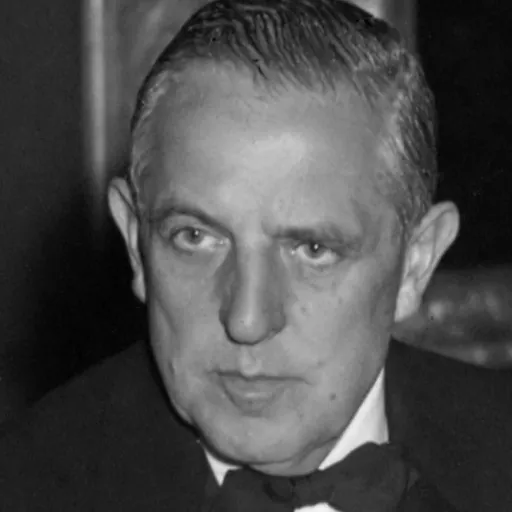
About Paul G. Hoffman
Lived 1891 – 1974 (aged 83). Paul G. Hoffman was an American economist and manager.
Paul Gray Hoffman (April 26, 1891 – October 8, 1974) was an American automobile company executive, statesman, and global development aid administrator. He was the first administrator of the Economic Cooperation Administration, where he led the implementation of the Marshall Plan from 1948 to 1950.
Life and work Hoffman was born in Western Springs, Illinois, a suburb of Chicago. He quit his studies at the University of Chicago at 18 to sell Studebaker cars in Los Angeles. He had made his first million dollars by the age of 34 and became president of Studebaker ten years later. Hoffman and Harold Sines Vance were the two executives most responsible for rescuing Studebaker from insolvency in the 1930s.
From 1935 to 1948, Hoffman served as president of Studebaker. From 1950 to 1953, he also served as the president of the Ford Foundation.
In May 1951 he was appointed to the executive committee of the California branch of the Committee on the Present Danger.
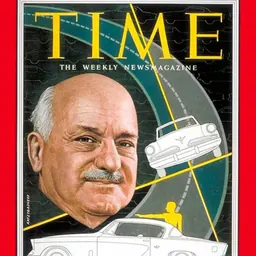
Returning to Studebaker in 1953, Hoffman was chairman of the corporation during the turbulent period leading up to and during the 1954 merger with the Packard Motor Car Company. When Studebaker-Packard found itself nearing insolvency in 1956, the company entered into an Eisenhower Administration-brokered management agreement with Curtiss-Wright. Hoffman, Vance (who had become chairman of the executive committee after the Packard merger) and S-P president James J. Nance all left the company.
From 1966 to 1972, he was the first administrator of the United Nations Development Programme when it was founded, with David Owen as his co-administrator.
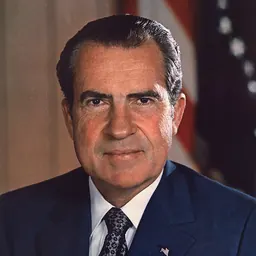
On June 21, 1974, he was awarded the Presidential Medal of Freedom by President Richard Nixon.
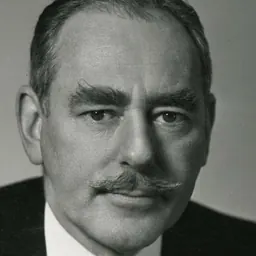
The Marshall Plan President Harry S. Truman nominated Hoffman to lead the Economic Cooperation Administration (ECA) in April 1948. Truman initially wanted to nominate Dean Acheson, but Hoffman was a more acceptable candidate to Congress, which preferred someone with more business acumen. In this role as administrator, he was responsible for managing the distribution of U.S. aid to post-WWII Europe. He primarily worked with the Organization of European Economic Cooperation (OEEC) and coordinated policy with the U.S. State Department.
He was a forceful advocate of European integration. In September 1949, Hoffman and his staff met in Washington to assess the progress of the Marshall Plan. They agreed that the "salvage function is substantially completed" and that the ECA should now focus on integrating the economies of Europe by supporting European-led initiatives to reduce trade barriers, coordinate fiscal policy, streamline regulation, and ensure currency convertibility and stability. This would, in their view, strengthen the European economies so that by they could be "free from dependence on sustained outside assistance."
His most famous speech as ECA administrator was his October 31, 1949, address to the OEEC in which he argued that Europe must integrate. Invoking a comparison to the United States, he argued:He concluded this speech with a veiled threat that the U.S. Congress may not continue to fund the Marshall Plan if the Europeans did not integrate. Congressional leadership was, indeed, sceptical of continuing to fund the Marshall Plan absent integration.
Hoffman's tenure as administrator of ECA was marked by dramatic improvements in the industrial and agricultural output of countries receiving Marshall Plan aid. Hoffman married businesswoman Anna M. Rosenberg on July 19, 1962.
Publications Film clips
Don’t just read it —
keep it.
Full-length biographies made to live with: read them, listen on the way to work, watch them tonight.
- E-book
- Audio
- Video
Instant download · yours to keep · every purchase keeps this site free
Important facts
Family & relationships
People in Paul G. Hoffman's life
Named in this biography and alive at the same time


Related people
Same field, nearest in time



Contemporaries
People whose lives overlapped Paul G. Hoffman's


Frequently asked questions
Who was Paul G. Hoffman?
American businessman (1891–1974)
When was Paul G. Hoffman born?
Paul G. Hoffman was born on 26 April 1891 in Western Springs.
When did Paul G. Hoffman die?
Paul G. Hoffman died on 8 October 1974 in New York City.
What was Paul G. Hoffman's occupation?
Paul G. Hoffman was an economist and manager.
What nationality was Paul G. Hoffman?
Paul G. Hoffman was American.
Sources & further reading
Cite this page
APA: Biography.guide. (2026). Paul G. Hoffman. https://biography.guide/paul-g-hoffman/
MLA: "Paul G. Hoffman." Biography.guide, https://biography.guide/paul-g-hoffman/.
Chicago: "Paul G. Hoffman." Biography.guide. https://biography.guide/paul-g-hoffman/.
Data last updated: 2026-09-21 · Spot an error? Report a correction.
Portrait: Wikimedia Commons · author & licence
Page generated 2026-09-27 05:01 UTC