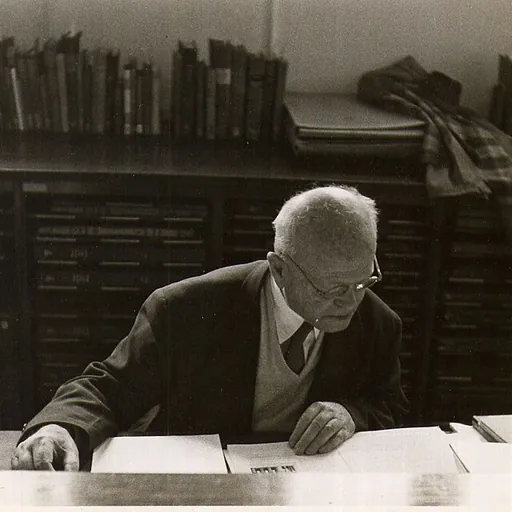
About Paul Frankl
Lived 1878 – 1962 (aged 83). Paul Frankl was a German art historian, university teacher, architect, teacher and art theorist.
Paul Frankl (22 April 1878 – 30 January 1962) was an art historian born in Austria-Hungary. Frankl is known for his writings on the history and principles of architecture, which he presented within a Gestalt-oriented framework.
Early education and career Paul Frankl was born in Prague into the rabbinic Spira-Frankl family. From 1888 to 1896, he attended a German Gymnasium, after which he enrolled in the German Staats-Obergymnasium of Prague, graduating in 1896. He served for one year as Lieutenant in the Austrian military. In order to pursue a degree in higher education, he converted to Catholicism, a move that was not uncommon among non-Catholics during this era. He matriculated to the Technische Hochschule München and, later, the Technische Hochschule Berlin. He graduated with a degree in architecture in 1904.
While in Berlin, Frankl fostered social relationships with philosophers and artists including fellow Pragueian Max Wertheimer and Käthe Kollwitz. These artists and philosophers not only introduced Frankl to new systems of thinking, such as Gestalt psychology, but also to his future wife, the artist and musician, Elsa Herzberg, who shared a studio with Käthe Kollwitz. Frankl and Herzberg eventually had five children.
In 1908, Frankl left his work as an architect to study philosophy, history, and art history at the Ludwig-Maximilians-Universität München under Heinrich Wölfflin and Berthold Riehl, the founder of the Zentralinstitut für Kunstgeschichte. Riehl supervised Frankl's doctoral dissertation on fifteenth-century glass painting in southern Germany. Frankl was heavily influenced by Wölfflin's understanding of architectural development, but did not adhere to Wölfflin's views on formalism. From 1914 to 1920, Frankl held a position as privatdozent, which enabled him to teach at the Ludwig-Maximilians-Universität München while contributing to the Handbuch der Kunstwissenschaft (ed. Albert Brinckmann and Fritz Burger). After six months, Frankl's visa expired and he became ill. In order to apply for US citizenship, he sailed to Cuba – to step on "foreign" soil – and reentered the United States as an immigrant. In 1939, with the assistance of Max Wertheimer, Paul Oskar Kristeller, and Erwin Panofsky, Frankl received a position as art historian at the Institute of Advanced Study at Princeton University. The Institute was under the direction of Frank Aydelotte at that time.
Four days after Kristallnacht, Frankl's wife, Elsa, and daughter, Susanne, fled to Denmark from Munich. Elsa's son, Wolfgang, was in England at the time. Six months after entering Denmark, Elsa was allowed to enter England as well. Upon coming to England, she was interned as an "enemy alien" on the Isle of Man.
Wolfgang had left Germany in 1933 to live in Rome, but the increased Fascist threat prompted him to seek safety in England. When Wolfgang first came to England, he was interned as an "enemy alien". However, since Wolfgang was an architect, he was allowed to live in an apartment with the caveat that if he wandered more than 5 miles from the apartment, he had to inform the authorities. He helped to design buildings during the rebuilding of London after the Blitz.
Susanne escaped to Sweden with the Danish boat-saving rescue venture – Rescue of the Danish Jews – after the Nazis started their attempt at rounding up the Jews.
Another daughter, Johanna, survived the war in Berlin with protected status with her non-Jewish husband.
Frankl's youngest daughter, Regula, followed soon after Frankl to the US. Since she was still a minor, she was allowed to stay in the US without renewing her visa. She went to Radcliffe under a special program for German refugees.
As a personal response to the plight of the Jewish people and his family, Frankl joined a committee at Princeton that sought to hypothesize a world government system that would ensure that racial genocide could never happen again. Among the committee's members numbered Albert Einstein. During this period, Frankl wrote a book called Welt Regierung (1948), his own thoughts on a system of world government.
Later life and career, 1947-1962 Frankl returned to Europe in 1947 with the support of a Guggenheim Grant. For two years, Frankl studied European cathedrals and taught at European universities. After returning to the United States, he wrote The Gothic: Literary Sources and Interpretations through Eight Centuries (1960) and Gothic Architecture (1962), which he completed the day of his death. These works revealed Wölfflin's continued influence on Frankl, who applied his former advisor's ideas of architectural style while supplementing his study with an analysis of social function and religious significance.
Legacy Frankl's work on spatial analysis influenced many German architectural historians such as Siegfried Giedion and Nikolaus Pevsner. Frankl's pupil, Richard Krautheimer, may have been influenced by Frankl's writings on architectural function and significance. Frankl is responsible for creating the term "akyrism," which connotes the changing contexts and meanings of art.
Materials relating to Frankl's life and work are currently held at the Leo Baeck Institute in New York City, US, and the Exilliteratur Archive in Frankfurt, Germany.
Writings Die Glasmalerei des fünfzehnten Jahrhunderts in Bayern und Schwaben (Strasbourg, 1912) Die Entwicklungsphasen der neueren Baukunst (Leipzig and Berlin, 1914) (See English translation, The Principles of Architectural History: The Four Phases of Architectural Style, 1420–1900 (Cambridge, MA, and London, 1968, 1973)). Die frühmittelalterliche und romanische Baukunst (Potsdam, 1926) Das System der Kunstwissenschaft (Brno, 1938) Weltregierung (1948) Kistenfiger (1956) Theobald von Lixheim (1957 Zeit Schrift) The Gothic: Literary Sources and Interpretations through Eight Centuries (Princeton, 1960) Kunst Chronik (1961 Hemmel) "Boucher's Girl on the Couch" (1961) Encyclopædia Britannica article on Gothic Architecture (1962) "Roundel in Boston" (1962) Gothic Architecture, Pelican Hist. A. (Harmondsworth, 1962) Zu Fragen des Stils (Leipzig 1988)
Don’t just read it —
keep it.
Full-length biographies made to live with: read them, listen on the way to work, watch them tonight.
- E-book
- Audio
- Video
Instant download · yours to keep · every purchase keeps this site free
Important facts
People in Paul Frankl's life
Named in this biography and alive at the same time




Related people
Same field, nearest in time

Contemporaries
People whose lives overlapped Paul Frankl's




Frequently asked questions
Who was Paul Frankl?
German art historian (1878–1962)
When was Paul Frankl born?
Paul Frankl was born on 22 April 1878 in Prague.
When did Paul Frankl die?
Paul Frankl died on 30 January 1962 in Princeton.
What was Paul Frankl's occupation?
Paul Frankl was an art historian, university teacher, architect, teacher and art theorist.
What nationality was Paul Frankl?
Paul Frankl was German.
Sources & further reading
Cite this page
APA: Biography.guide. (2026). Paul Frankl. https://biography.guide/paul-frankl/
MLA: "Paul Frankl." Biography.guide, https://biography.guide/paul-frankl/.
Chicago: "Paul Frankl." Biography.guide. https://biography.guide/paul-frankl/.
Data last updated: 2026-09-20 · Spot an error? Report a correction.
Page generated 2026-09-27 05:10 UTC