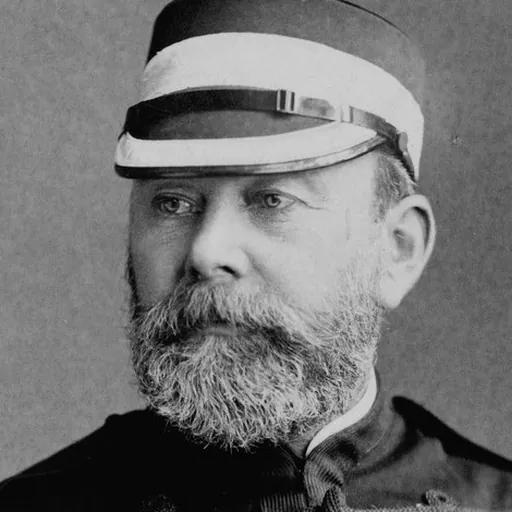
Paul Foelsche
Australian police officer, photographer and plant collector
About Paul Foelsche
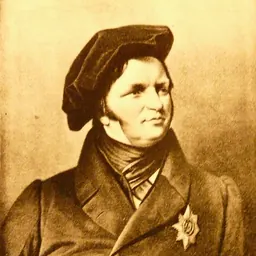
Lived 1831 – 1914 (aged 82). Paul Foelsche was an Australian photographer, inspector, botanical collector and scientific collector.
Paul Foelsche (30 March 1831 – 31 January 1914) was a South Australian police officer and photographer born in Germany, remembered for his work in the Northern Territory of Australia from 1870 to 1904.
Early life He was born Paul Heinrich Matthias Fölsche in Moorburg, Germany on the south bank of the river Elbe near Hamburg. His mother died when he was quite young; his father, a ropemaker, married again and had another six children. At seventeen he enlisted in the Prussian cavalry which was fighting Denmark over ownership of the Schleswig-Holstein region to the north, learning the use of weapons and becoming a proficient horseman and gunsmith.
Career in Australia South Australia On 22 June 1854 he left Hamburg for Australia on the Reiherstieg, landing at Port Adelaide on 26 October. He may have headed, like so many, for the Victorian goldfields His work entailed frequent contact with the local Aboriginal people, with whom he seemed to get on well. until December 1869, when as Sub-Inspector (on a salary of £230) in December 1869 he was transferred to Palmerston in the Northern Territory, at that time the responsibility of South Australia. He was naturalised as a British citizen on 6 December. It is not known whether this was a condition of his employment in the North. accompanied by J. Stokes Millner, then acting Government Resident (B. Douglas was appointed in April 1870). His Corporal, F. Drought and five troopers – W. Stretton, K. Kappler, H. J. Boord, H. Q. Smith, and J. Massey – were on the same boat (he had Smith and Boord recalled three months later for breaches of discipline).
Northern Territory On arrival in Palmerston he found there was no Police Station and no help on offer from the Government Resident, so Foelsche and his six troopers had to build one themselves.
Policing in the Northern Territory involved not only maintaining the law amongst the European settlers, but sorting out difficulties between them and Aboriginal people and to some extent among Aboriginal people themselves. He was promoted to Inspector around 1876.
With the discovery of gold around 1872 and the increased population that brought, mostly single men, then the arrival of Chinese miners, labourers and merchants who came to dominate the population, policing in the late 1870s became vastly more complex.
He was appointed J.P. and Special Magistrate in 1884.
He was appointed Inspector of Taxation in April 1902.
He took leave of absence from February 1903.
He retired in January 1904.
Apart from photography, which absorbed much of his income and spare time, he took a great interest in aboriginal culture, was a skilled armourer and a capable dentist. He may have been offered the position of Government Resident in 1891.
Involvement in violence against Indigenous populations Historians concur in showing that Foelsche played an important role, as the chief of police forces, in the violence inflicted upon Indigenous Australians in the Northern Territory.
Tony Roberts, known for his award-winning 2005 book Frontier Justice, depicts Foelsche as "merciless with Aboriginals":
In a personal letter, Foelsche openly spoke of what he called his "Nigger Hunt":
Foelsche's active role in the brutal colonisation of northern Australia is seldom acknowledged in textbooks and mainstream historical accounts, most of which were originally based on the perspective of European settlers at the end of the 19th century.
Photography
Foelsche learned much of the art and craft of photography during the years 1869–1871 from Samuel Sweet, captain of the schooner Gulnare, the Government supply vessel.
Paul Foelsche's photography first came to public notice in 1874, when he displayed photographs taken, with a Mr. Ludwig, of various Government buildings in Palmerston. Foelsche's camera made valuable historical records of early Territory life: Architectural photographs including the first police station (built by Foelsche and his men), Solomon's Emporium (now Brown's Mart) and the Commercial Bank building. Portraits of members of the Larrakia, Woolna (Djerimanga), Iwaidja and other aboriginal groups of the Top End. Aboriginal constructions, camps, ceremonies and activities Industry: scenes of mining, transportation and agriculture. Scenery, including views of the Katherine, Victoria, Elizabeth and Wickham rivers. Landmarks such as Charles Point lighthouse, A. C. Gregory's baobab tree, Adelaide River railway bridge. Historical reportage, including staged reconstructions such as the shooting of Ah Kim.
In 2005 the South Australian Museum mounted a travelling exhibition of Foelsche's work drawn from the South Australian Museum's Paul Foelsche Collection of 284 registered artefacts, interpreted with a great deal of historical information. The reproduces the structure and much detail of the display.
Anthropology Foelsche took hundreds of portraits of Larrakia, Woolna (Djerimanga) and Iwaidja people, usefully annotated with the subjects' names and some personal details.
In response to a general plea by anthropologist E. M. Curr, Foelsche collected many aboriginal words and their meanings.
For E. C. Stirling, Director of the South Australian Museum, Foelsche collected numerous articles of common use by aboriginal people, annotated with their vernacular terms and usage. Stirling visited Palmerston in 1891 with the Governor of South Australia, Lord Kintore.
Natural history Foelsche struck up a correspondence with Ferdinand von Mueller of Melbourne, perhaps through an introduction by Maurice William Holtze, who founded Port Darwin's Botanical Gardens in 1878. Foelsche had a keen eye for rare and unusual plants and sent Mueller (who visited the Top End with the A. C. Gregory expedition of 1891) some 200 plant specimens, in the Melbourne Herbarium. married businessman H. W. H. Stevens (1852–1942) on 28 April 1884. Mary Jane (1863 – 19 May 1932) married railway engineer William Wallace Andrews, AM (28 May 1859 – 22 February 1924) on 25 October 1892 and moved to Moseley Street, Glenelg.
He died in 1914 after a year of suffering from gangrene, arteriosclerosis, and senility. His gravestone may be viewed here. He was survived by his two daughters.
Criticism It has been suggested that Foelsche's appointment to Port Darwin had much to do with the friends and contacts he made through Freemasonry: his intelligence, aptitude and courage were undoubted but he was unproven as a leader. He was awarded the Imperial Service Order by the South Australian Governor, Sir George Le Hunte in 1903. Foelsche Street, Darwin, Foelsche Bank, Foelsche Headland, Foelsche Rock, Foelsche River (and hence the nearby Foelsche crater), all in the Northern Territory, were named for him. A large selection of his photographs is on permanent display at Police Headquarters, Darwin.
Don’t just read it —
keep it.
Full-length biographies made to live with: read them, listen on the way to work, watch them tonight.
- E-book
- Audio
- Video
Instant download · yours to keep · every purchase keeps this site free
Important facts
People in Paul Foelsche's life
Named in this biography and alive at the same time



Related people
Same field, nearest in time


Contemporaries
People whose lives overlapped Paul Foelsche's




Frequently asked questions
Who was Paul Foelsche?
Australian police officer, photographer and plant collector (1831–1914)
When was Paul Foelsche born?
Paul Foelsche was born on 30 March 1831 in Moorburg.
When did Paul Foelsche die?
Paul Foelsche died on 31 January 1914 in Darwin.
What was Paul Foelsche's occupation?
Paul Foelsche was a photographer, inspector, botanical collector and scientific collector.
What nationality was Paul Foelsche?
Paul Foelsche was Australian.
Sources & further reading
Cite this page
APA: Biography.guide. (2026). Paul Foelsche. https://biography.guide/paul-foelsche/
MLA: "Paul Foelsche." Biography.guide, https://biography.guide/paul-foelsche/.
Chicago: "Paul Foelsche." Biography.guide. https://biography.guide/paul-foelsche/.
Data last updated: 2026-09-21 · Spot an error? Report a correction.
Portrait: Wikimedia Commons · author & licence
Page generated 2026-09-27 05:00 UTC